





Last reviewed: September 2026. This guide is general information, not legal advice. For your own situation, talk to a licensed Texas attorney or a legal aid group.
Knowing how to break a lease in Texas can save you thousands of dollars and months of stress. At 1836 Property Management, founded in 2007, we manage more than 900 Austin-area rental homes with a strong focus on legal and compliance work. Our company-reported results include a 99.5% annual tenant success rate, which we attribute to our resident screening criteria, and an annual eviction rate under 0.5%. Over those years, we have handled early move-outs from both sides of the table: residents who needed a way out, and owners who needed the home re-rented fast. Below, we cover the legal grounds that let a tenant leave without penalty, notice rules, real costs, credit effects, and what landlords can and cannot do.
Key Takeaways
- Texas tenants can end a lease early without penalty for military orders, family violence, sexual offenses or stalking, or unrepaired health and safety problems, each with strict paperwork rules.
- Without a statutory ground, the lease controls: a buyout clause sets a fixed cost, and otherwise you owe vacancy rent until a replacement tenancy begins, plus any reletting charge.
- The landlord must take reasonable steps to mitigate, but a replacement tenant does not erase a provable rent shortfall or other lease damages.
- A buyout fee, a reletting charge, and rent until relet are three different things, and only a buyout ends your liability on a set date.
- Give written notice with proof of delivery, keep paying rent until the lease actually ends, and never skip the last month’s rent expecting the deposit to cover it.
- A voluntary sale generally does not cancel a fixed-term lease; the buyer usually must honor it, and foreclosure follows separate rules.
- A landlord keeps the right to collect delinquent rent from a protected tenant only if the lease contains the statutory termination-rights language.
Table of Contents
- The Short Answer: Yes, but the Lease Is a Contract
- Legal Grounds to Break a Lease in Texas Without Penalty
- How to Get Out of a Lease Without a Statutory Reason
- Notice Rules: How Much Notice Do You Have to Give?
- How Much Does It Cost to Break a Lease in Texas?
- How Much Does Breaking a Lease Affect Your Credit?
- Tenant Rights When Breaking a Lease in Texas
- Under What Circumstances Can a Landlord Terminate a Lease in Texas?
- What Landlords Should Do When a Tenant Wants to Break a Lease
- Frequently Asked Questions About Breaking a Lease in Texas
The Short Answer: Yes, but the Lease Is a Contract
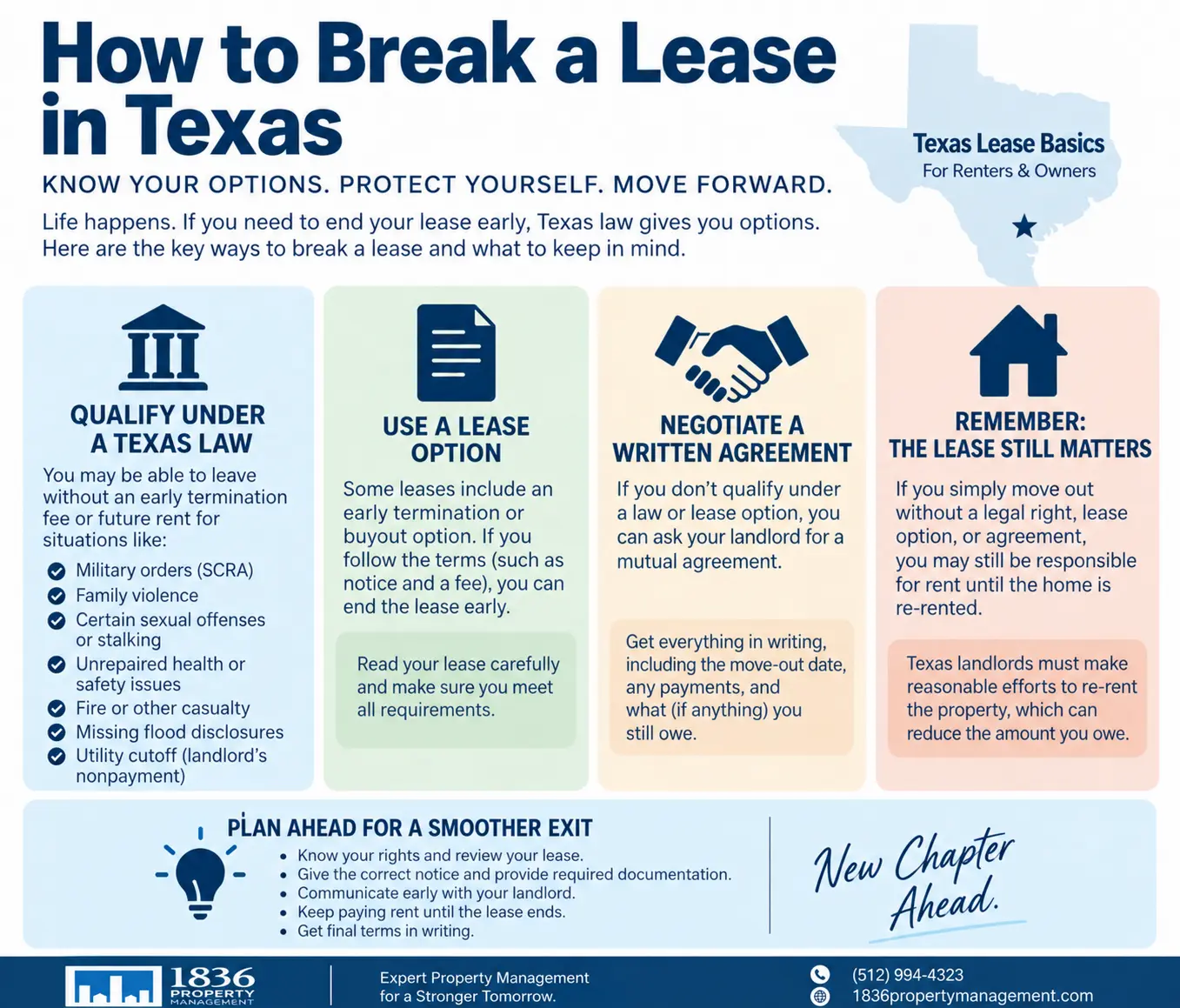
A residential lease is a binding contract, so signing it means you agreed to pay rent for the full term. However, Texas law gives tenants several ways to end a lease early without owing future rent, and it limits what a landlord can collect when a tenant leaves for a reason the law does not protect.
There are two paths:
- A statutory exit. If you qualify under a Texas or federal statute (a written law), you can leave without paying an early termination fee or future rent. Military orders and family violence are the best-known grounds.
- A contractual or negotiated exit. Otherwise, your lease and your negotiation skills decide what you owe. The good news is that Texas landlords must take reasonable steps to mitigate damages, usually by re-renting the home, which can significantly reduce the amount you ultimately owe.
Both paths work better when you act early and keep paying rent until the lease actually ends.
Legal Grounds to Break a Lease in Texas Without Penalty
Texas Property Code Chapter 92 lists specific situations where a tenant can terminate a lease and avoid future rent. Each has its own paperwork rules, and a landlord can hold you to the lease if you skip a step.
Military Orders and the SCRA
Servicemembers get protection from two laws that work together. The federal Servicemembers Civil Relief Act, 50 U.S.C. §3955, applies nationwide. Texas Property Code §92.017 mirrors it at the state level and covers dependents too.
Covered situations include:
- Entering active military service after signing the lease,
- Receiving permanent change of station (PCS) orders while in service, or
- Receiving deployment orders for 90 days or more.
The statutes list other qualifying circumstances as well, so check the full text if your situation is different.
To use this exit, give the landlord written notice and a copy of your orders, or a letter from your commanding officer confirming them.
Timing matters. The lease ends 30 days after the next rent due date that follows your notice. For example, if rent is due on the 1st and you deliver notice on May 10, the next due date is June 1, so the lease ends July 1. Rent is due through the effective termination date, but no future rent is due after it. Other lawful amounts already owed under the lease may still remain. The landlord cannot charge an early termination fee, and any rent paid in advance for the period after termination must be refunded within 30 days.
Family Violence, Sexual Assault, or Stalking
Texas Property Code §92.016 lets a tenant terminate a lease and avoid future rent after family violence. Section 92.0161 does the same for victims of certain sexual offenses or stalking, including a parent or guardian who lives with the victim.
For family violence, you must give the landlord a copy of a qualifying court order, such as a protective order or an emergency protection order, or documentation from a licensed health care provider, a licensed mental health provider, or a family violence advocate. A sexual offense must have occurred within the past six months. For stalking, the conduct must have occurred within the prior six months on the premises or at a dwelling there. The tenant must provide either a qualifying protective order, or provider documentation together with a law-enforcement incident report, or another qualifying law-enforcement record if an incident report is unavailable.
The process works the same way under both sections. You deliver the documentation, give written notice of termination at least 30 days before the lease ends, wait out that 30-day window, and move out. One important exception: if the person who committed the family violence is a co-tenant or occupant of the home, you do not have to give the 30-day notice, provided you supply the qualifying documentation that §92.016(c-1) allows for that situation. Not every order type qualifies for the exception.
These rights cannot be waived, and a landlord who interferes with them owes actual damages, one month’s rent plus $500, and attorney’s fees. The National Domestic Violence Hotline (1-800-799-7233) can connect you with local advocates who handle this paperwork every day.
The Landlord Failed to Make a Health or Safety Repair
Texas Property Code §92.056 gives tenants a way out when a landlord will not fix a condition that materially affects health or safety. Think of a broken heater in January, a sewage backup, or no running water. Cosmetic problems do not count.
The steps are strict:
- Give the landlord written notice of the problem. You must be current on rent when you send it.
- Wait a reasonable time. The law presumes seven days is reasonable, but the presumption can shift based on how serious the problem is and how available labor, materials, and utilities are. Seven days is not an automatic deadline.
- Send a second written notice if nothing happens. You can skip the second notice if you sent the first one by certified mail, registered mail, or another tracked delivery service.
- If the landlord still has not made a diligent effort to repair, you may terminate the lease.
If you terminate this way, you are entitled to a prorated refund of rent from the day you move out and a refund of your security deposit under the normal rules. You can choose repair-and-deduct or a lawsuit instead, but not every remedy at once.
Other Statutory Exits in Texas
Several less common situations also let a tenant, or the tenant's estate, end a lease early. Each requires written notice and has its own conditions.
| Situation | Statute | Key requirement |
|---|---|---|
| Fire or other casualty makes the home totally unusable, not caused by the negligence or fault of the tenant, a member of the tenant's family, or the tenant's guest or invitee | §92.054 | Either side may terminate by written notice before repairs are finished; prorated rent and deposit refunded |
| Utilities cut off because the landlord failed to pay the bill | §92.301 | Written notice and move-out within the statutory window; the landlord can cure by proving payment first |
| Landlord failed to disclose floodplain status or prior flooding, and the tenant suffered substantial flood loss | §92.0135 | Written notice within 30 days after the loss |
| Lockout or utility shutoff that violates the statute | §92.0081 and §92.008 | Tenant may terminate and recover one month's rent plus $1,000, damages, and fees |
| Death of a tenant who was the dwelling's sole occupant | §92.0162 | The estate representative must give written notice, remove the deceased tenant's property as the statute requires, and sign an inventory if requested. Termination is effective on the later of the 30th day after notice or the date all statutory conditions are met |
Our guide to a rental property fire covers the casualty rule in more detail for owners and residents.
The One Lease Sentence That Changes What You Owe
Here is a detail almost no one talks about. Sections 92.016, 92.0161, and 92.017 each set a condition on delinquent rent. A landlord keeps the right to collect rent that was already past due from a tenant who terminates under one of those sections only if the lease contains language substantially equivalent to a specific sentence telling tenants that they may have special statutory rights to end the lease early in cases of family violence, military deployment or transfer, or certain sexual offenses or stalking. Most professional lease forms, including the Texas Realtors and Texas Apartment Association leases, include that language.
If the lease lacks it, a tenant who terminates under one of those sections is released from all delinquent rent owed on the termination date, not just future rent (§92.016(f), §92.0161(g), and §92.017(g)). For tenants, that means checking the lease before you settle a back-rent claim. For owners, it means a self-drafted or outdated lease can quietly erase money you were counting on. This is one reason our legal and compliance review starts with the lease form itself.
How to Get Out of a Lease Without a Statutory Reason
Most people who want to break a lease do not have a protected reason. A new job, a breakup, or a home purchase is a normal life event, not a legal exit. Instead, the lease controls. Read it first and look for four things: an early termination or buyout clause, a reletting charge, the notice requirement, and the subletting rule.
Use the Buyout Clause if You Have One
Some Texas leases include an early termination option. A typical clause asks for 30 to 60 days' written notice plus a set fee specified in the lease. In exchange, your liability ends on a set date. This is usually the cleanest and most predictable way to get out of a lease. Follow the clause to the letter, and get written confirmation that the landlord accepted your termination.
Negotiate a Written Release
If there is no buyout clause, ask for one. Landlords care about one thing above all: keeping rent flowing without a long vacancy. Therefore, the strongest offer combines early written notice, rent paid on time until the home is re-rented, a clean home available for showings, and a fixed payment, such as one month's rent, in exchange for a signed release. The release should state the termination date, what you are paying, what happens to the deposit, and that no future rent is owed. A text that says "should be fine" is not a release.
Subletting and Lease Assignment
Under Texas Property Code §91.005, a tenant may not sublet without the landlord's prior consent, and nearly every lease requires that consent in writing. Subletting also does not release you. If your subtenant stops paying or damages the home, you are still the person on the lease. Assignment, where a new tenant formally takes over the lease, is safer, but the landlord must agree and will screen the new person like any other applicant.
Meanwhile, letting a friend move in "temporarily" without approval creates a different problem. Texas has no fixed number of days before a guest becomes an occupant with rights, so learn who qualifies as a tenant before anyone else gets keys.
Month-to-Month Leases
Month-to-month tenants have the easiest exit. Under Texas Property Code §91.001, either side can end the tenancy by giving notice, and it ends on the later of the date in the notice or one month after the notice is given, unless the lease sets a different period in writing. Leases that convert to month-to-month after the fixed term often keep a 30- or 60-day notice requirement, so check the holdover section.
Notice Rules: How Much Notice Do You Have to Give?
Texas has no single notice period for ending a fixed-term lease early, so the rules depend on why you are leaving.
| Situation | Notice required | When the lease ends |
|---|---|---|
| Fixed-term lease, no statutory ground | Whatever the lease requires, usually 30 to 60 days in writing | On the date in your buyout clause or written release; otherwise vacancy rent usually ends when a replacement term begins, though a rent differential and other lease damages can run through the original term |
| Month-to-month | One month, unless the lease says otherwise (§91.001) | The later of the date in the notice or one month after notice |
| Military orders | Written notice plus a copy of orders | 30 days after the next rent due date following delivery |
| Family violence, sexual assault, or stalking | Written notice plus qualifying documentation, at least 30 days before termination | After the 30-day window expires and you move out (no 30-day notice if the abuser is a co-tenant or occupant) |
| Failure to repair | Two written notices (or one by tracked mail), plus a reasonable time to fix it | When you give notice of termination after the landlord fails to act |
| End of the lease term | Check the lease; many require 30 to 60 days even at the end | On the expiration date, if you gave the required notice |
Whichever row applies, give notice in writing and deliver it in a way you can prove. Most of our leases, for example, require at least 60 days' written notice from either side, and that window lets us line up a screened replacement before the old rent stops.
How Much Does It Cost to Break a Lease in Texas?
This is the question everyone asks, and the answer depends on three things people constantly mix up. A buyout fee, a reletting charge, and rent until the home is re-rented are separate concepts, and knowing which one your lease uses is the key to predicting your bill.
| Cost | What it is | Typical amount | Does it end your liability? |
|---|---|---|---|
| Early lease termination fee (buyout) | A contract option that lets you end the lease on a set date for a set price | A set fee specified in the lease, plus required notice | Yes, if the lease includes the option and you follow it |
| Reletting charge | A fee for the landlord's cost of finding a replacement tenant | Up to 85% of the highest monthly rent under the TAA lease; other leases vary | No. It covers only the cost of re-renting |
| Rent until re-rented | Vacancy rent for the days the home sits empty after you leave, plus any provable shortfall if the replacement rent is lower | Depends on how quickly the property is re-rented and the remaining lease term | Vacancy rent usually ends when the replacement term begins; a provable rent differential and other lease damages can continue through the original term |
Early Lease Termination Fee
An early lease termination fee is a buyout. You pay a fixed amount, give the required notice, and the lease ends on a set date. Texas law does not require landlords to offer a buyout or set one standard amount. If your lease has this option, the fee is usually worth it because it removes uncertainty.
Reletting Charge
People often ask how to break a lease on an apartment legally, as if apartments follow different rules. They do not, but the paperwork is different. Most Austin apartment communities use the Texas Apartment Association (TAA) lease, which includes a reletting charge of up to 85% of the highest monthly rent during the lease term. Under that lease, the charge applies if you fail to give the required written move-out notice, move out without paying rent in full for the entire term or renewal period, move out at the landlord's demand because of your default, or are judicially evicted. Here is the part many websites get wrong: the reletting charge is not a cancellation fee. The lease says so directly. It covers the landlord's cost of finding a replacement, and you still owe vacancy rent until a replacement tenancy begins.
Rent Until the Home Is Re-rented
If you leave without a statutory reason or a buyout, you owe rent for the rest of the term. However, Texas Property Code §91.006 applies when a tenant abandons the home in violation of the lease, and a lease cannot waive it. The landlord must take objectively reasonable steps to mitigate damages. A replacement tenancy prevents double recovery and usually ends vacancy-rent damages when the replacement term begins, but the former tenant may remain liable for a provable rent differential and other recoverable lease damages through the original term.
How long that takes depends on local demand and pricing, which our Austin housing market update tracks. For example, at $2,000 a month with six months left, a home re-rented at the same rent 45 days after you leave costs you about $3,000 in vacancy rent plus any reletting charge, not the full $12,000. Walking away and going silent is the most expensive choice, because the balance keeps growing until the landlord finds a tenant, and the unpaid amount can end up in collections or in justice court.
Your Security Deposit
Breaking a lease does not automatically forfeit your deposit. Under Texas security deposit laws, the landlord must refund the deposit or send an itemized list of deductions within 30 days after you move out and provide a forwarding address. The landlord may deduct unpaid rent, reletting charges, and other amounts you legally owe under the lease, but not normal wear and tear. Because those deductions add up fast, the deposit usually gets applied to your lease-break balance.
One warning: do not skip your last month's rent on the theory that the deposit covers it. Under Texas Property Code §92.108, a tenant who does this is presumed to have acted in bad faith, a presumption the tenant would have to rebut, and a bad-faith tenant is liable for three times the rent withheld plus the landlord's attorney's fees. For deduction disputes, our guide to wear and tear vs. property damage explains where the line sits.
How Much Does Breaking a Lease Affect Your Credit?
Breaking a lease does not automatically create a negative credit-report entry. Credit damage usually comes from unpaid rent, collections, or other reported debt. If the landlord sends the balance to a collection agency, the account can appear on your credit reports for up to seven years. Court judgments no longer appear on standard credit reports, but tenant screening companies pull eviction filings and judgments directly from court records, so a judgment can follow you to your next rental application. Some property managers also report rent payments to the bureaus, so missed months can show up as late payments.
To protect your credit, settle the balance before it goes to collections and get a written release that states you owe nothing further.
Tenant Rights When Breaking a Lease in Texas
Even when you are the one ending the lease early, knowing your tenants rights keeps a stressful move-out from turning into an expensive one.
- The landlord must take objectively reasonable steps to mitigate damages, and a lease cannot waive that duty (§91.006).
- Self-help removal is illegal: a landlord cannot remove doors, shut off utilities, or change the locks to force you out (§92.0081 and §92.008). The one exception is a lock change for unpaid rent, which the lease must allow and which requires advance written notice, and even then the landlord must give you a new key when you ask for one.
- The landlord cannot retaliate within six months after you request repairs or exercise another legal right, for protected good-faith conduct, subject to statutory exceptions (§92.331 and §92.332).
- Statutory termination rights for military service, family violence, and sexual offenses or stalking apply even if your lease never mentions them.
The Texas State Law Library’s guide to ending a lease links to every statute in this article, and local legal aid offices can review your notice before you send it.
Under What Circumstances Can a Landlord Terminate a Lease in Texas?
Landlords ask the reverse question just as often, and the answer is narrower than most owners expect. A landlord cannot end a fixed-term lease early simply because they want the home back. Common situations in which a landlord may seek to terminate a fixed-term lease early include a tenant breach (most often unpaid rent), a casualty such as a fire that makes the home totally unusable (§92.054), and an early termination clause in the lease that the tenant agreed to. For a breach, the landlord must deliver a written notice to vacate, at least three days unless the lease sets a different period, and then win an eviction case in justice court.
A voluntary sale is generally not one of those situations either. In most cases the buyer takes over as landlord and must honor the lease. Once the buyer acquires title, the buyer becomes liable for returning the security deposit and must give the tenant the statutory acknowledgment, while the former owner can remain liable until that transfer is complete (§92.105). Foreclosure follows separate rules, and §92.105 does not apply to a mortgage lienholder that takes title through foreclosure. A landlord who wants the home empty before the term ends must negotiate a buyout, sometimes called cash for keys, and the tenant is free to say no. A month-to-month tenancy is different: either side can end it with proper notice under §91.001, and the landlord does not need a reason, as long as the real reason is not discrimination or retaliation.
What Landlords Should Do When a Tenant Wants to Break a Lease
On the owner side, a lease break is a compliance test and a cash-flow problem at the same time. Handle it in this order:
- Get the request in writing, with the move-out date and the reason.
- Check for a statutory ground. If the tenant cites military orders, family violence, repairs, or another protected reason, ask for the documentation the statute requires and nothing more.
- Check your lease. Confirm it contains the statutory termination-rights language that preserves your claim to delinquent rent, and read your own buyout, reletting, and notice terms before you quote a number.
- Send a written statement of what the tenant owes and how it will be calculated.
- Start marketing immediately and document every effort. Listing date, showings, applications, and price changes are your proof of mitigation if the balance ends up in court.
- Screen every replacement, including a tenant the departing resident found, under the same written criteria. Our guide to tenant screening covers the Texas rules.
- Account for the deposit within 30 days with an itemized list, then decide whether a demand letter or a justice court claim (up to $20,000) makes sense for any remaining balance.
If the tenant simply leaves and stops paying, the timeline changes. Our guide on what to do when a tenant stops paying rent covers the notice to vacate and the court process.
How 1836 Handles Lease Breaks for Austin Owners
Lease breaks are where a focus on legal and compliance work pays off. Our team keeps its lease forms current with the Texas Property Code, puts every move-out balance in writing, and documents mitigation from the day notice arrives. That discipline keeps move-out balances defensible and keeps disputes out of court.
The best lease break, of course, is the one that never happens. Residents who feel heard and live in a well-maintained home renew, which is why we work to reduce tenant turnover long before a renewal date. If you would rather not manage notices, mitigation, and deposit accounting on your own, professional property management is built for exactly this. Get started online or schedule a call with our team.
Frequently Asked Questions About Breaking a Lease in Texas
Can a Landlord Terminate a Lease Early to Sell the Property?
Usually not. A voluntary sale generally does not by itself cancel an existing fixed-term lease; in most cases the buyer becomes the landlord and must honor it. The lease's own terms and other law can matter, and foreclosure follows separate rules. An owner who wants possession earlier should have counsel review the lease and proposed buyout.
How Much Does It Cost to Break a Lease in Texas?
It depends on your lease. With a buyout clause, you pay the set fee written into the lease. Without one, you owe vacancy rent until a replacement tenancy begins, plus any reletting charge and any provable rent shortfall, and the landlord must take reasonable steps to mitigate.
Can I Break a Lease by Giving 30 Days' Notice?
Not on its own. Notice does not release you from a fixed-term lease unless a buyout clause, a statute, or a written agreement says it does. Month-to-month tenants can end the tenancy with one month's notice under §91.001, and one month is not always exactly 30 days.
Can I Break My Lease if My Landlord Won't Make Repairs?
Yes, but only for conditions that materially affect health or safety, and only after following Texas Property Code §92.056. You must be current on rent, give written notice, allow a reasonable time (presumed seven days), and send a second notice unless the first went by tracked mail. Then you may terminate.
How Much Does Breaking a Lease Affect Your Credit?
Breaking a lease does not automatically create a negative credit-report entry. The damage usually comes from unpaid rent sent to collections, which can stay on your credit report for up to seven years, or from a court judgment that appears on tenant screening reports.
Can My Landlord Keep My Security Deposit if I Break the Lease?
The landlord can apply the deposit to amounts you legally owe, such as unpaid rent and reletting charges, but must send an itemized list within 30 days after you move out and provide a forwarding address. Normal wear and tear cannot be deducted.
Can I Sublet My Apartment in Texas to Get Out of My Lease?
Only with the landlord's prior consent, which almost every lease requires in writing (§91.005). Even with approval, subletting does not release you from rent or damage if your subtenant fails to pay. A landlord-approved lease assignment is the safer route.
Is a Reletting Fee the Same as an Early Termination Fee?
No. An early termination fee is a buyout that ends your liability on a set date. A reletting fee, which is capped at 85% of the highest monthly rent in the Texas Apartment Association lease, only covers the landlord's cost of finding a replacement. You still owe vacancy rent until a replacement tenancy begins.
Can I Cancel a Lease Before Moving In?
Usually not without cost. A signed lease is binding even if you never picked up the keys, and Texas has no general cooling-off period for residential leases. Contact the landlord right away and ask about a release. The landlord must still take reasonable steps to mitigate, usually by re-renting the home.
This article is for general informational purposes only and does not constitute legal advice. Laws change, and every lease is different. Consult a licensed Texas attorney about your specific situation.