




A rental property fire is one of the few events that can take a performing investment offline overnight. At 1836 Property Management, we have spent 19 years managing rental homes across Austin and Central Texas. With more than 900 homes currently under management, our team regularly coordinates urgent maintenance issues, property damage, resident communication, vendors, and insurance documentation. From what we have seen, the owners who come through a fire in the best shape are the ones who understood the sequence of steps before they ever needed it.
This guide walks through that sequence. You will learn who to call first, who pays for what, what happens to the lease, what insurance covers, when a home is considered uninhabitable, and how to get it back on the rental market. We wrote it for landlords across the United States. However, because these rules change from state to state, we also included a section on Texas and Austin, where our team works every day.
Key Takeaways
- Safety comes first. Get residents out, call 911, and do not enter the property until officials say it is safe.
- Notify your insurer and document everything. Open the claim quickly and save reports, photos, communications, estimates, receipts, and a clear timeline.
- Do not assume who is responsible. The landlord usually manages the building claim, but financial responsibility depends on the cause, lease, insurance, and state law.
- A fire does not automatically end the lease. What happens next depends on whether the home is usable, the lease terms, and applicable law.
- Landlord and renters insurance cover different losses. Landlord coverage generally applies to the structure and may cover lost rent, while renters insurance may cover belongings, temporary housing, and liability.
- Do not rush the rebuild. Preserve evidence, use qualified contractors, complete required permits and inspections, and confirm the home is safe before reoccupying or relisting it.
Table of Contents
The First 48 Hours After a Fire
The first two days set the tone for everything that follows. Move through these steps in order.
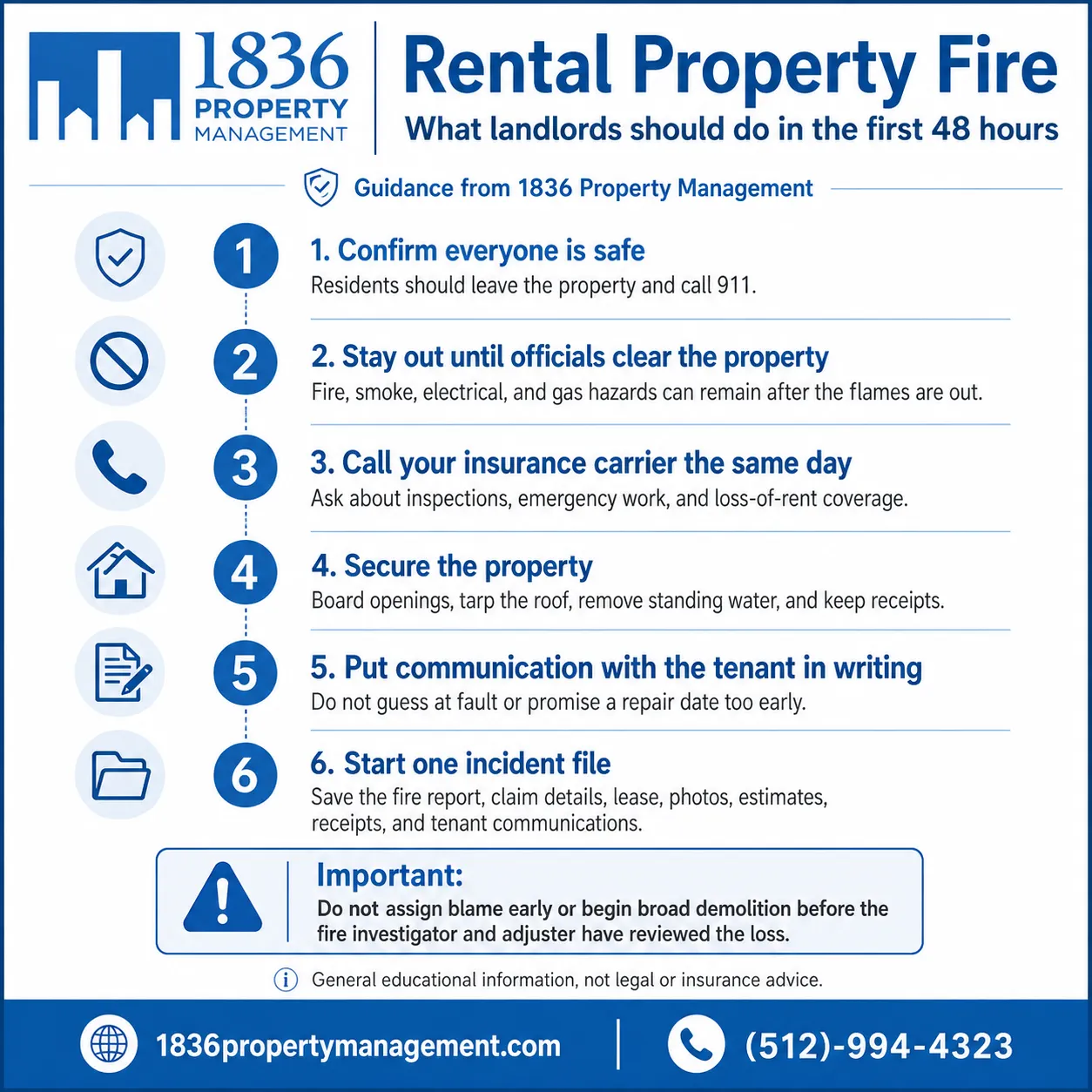
1. Confirm that everyone is safe. Residents should leave the building and call 911 from a safe place. They should not go back inside for belongings, pets, or documents. At 1836, our resident emergency instructions follow the same order: contact emergency services first, then notify property management.
2. Stay out until the fire department clears the property. Structures stay dangerous long after the flames are out. Floors weaken, wiring becomes a live hazard, gas lines can fail, and smoke leaves behind toxic residue.
3. Call your insurance carrier the same day. Do not wait for a damage estimate. Most policies require prompt notice. Ask whether the insurer wants to inspect before debris is removed.
4. Get the fire department report. Request the incident number on scene, then order the full report. That report can become an important part of the claim and liability review.
5. Secure the property. Board up openings, tarp the roof, extract standing water, and change the locks if doors were forced. Insurers expect owners to prevent further loss, so keep every receipt.
6. Avoid broad demolition before the investigation is complete. Emergency work to prevent further damage is one thing. Clearing damaged materials before the fire investigator and adjuster have looked is another, because evidence gets lost that way.
7. Put communication with your tenant in writing. Confirm where they are staying and what happens next. Do not guess at fault, promise a repair date, or promise to pay for a hotel before reviewing the lease and your policy.
8. Call a restoration contractor. Water sitting in a structure turns into mold within days. Fast mitigation protects both the building and your claim.
An experienced property management company can coordinate many of these steps, keep the parties moving, and give the owner one central point of contact.
Start One Incident File
Create a single digital folder on day one. Scattered records can slow a claim and make the process harder to manage.
Save the following:
- Fire department report and incident number
- Insurance claim information and correspondence
- Lease, rent ledger, and pre-loss condition records
- Photos, videos, maintenance records, and smoke alarm history
- Tenant communications
- Estimates, invoices, receipts, and inspection records
Add a simple timeline as you go. Record who contacted whom, what was reported, when access was allowed, and what work was approved. Keep notes objective, and avoid stating that someone caused the fire unless an investigation supports it.
Who Is Responsible for Accidental Fire Damage to Rental Property
This is the question owners ask first, and the answer is more layered than most articles suggest.
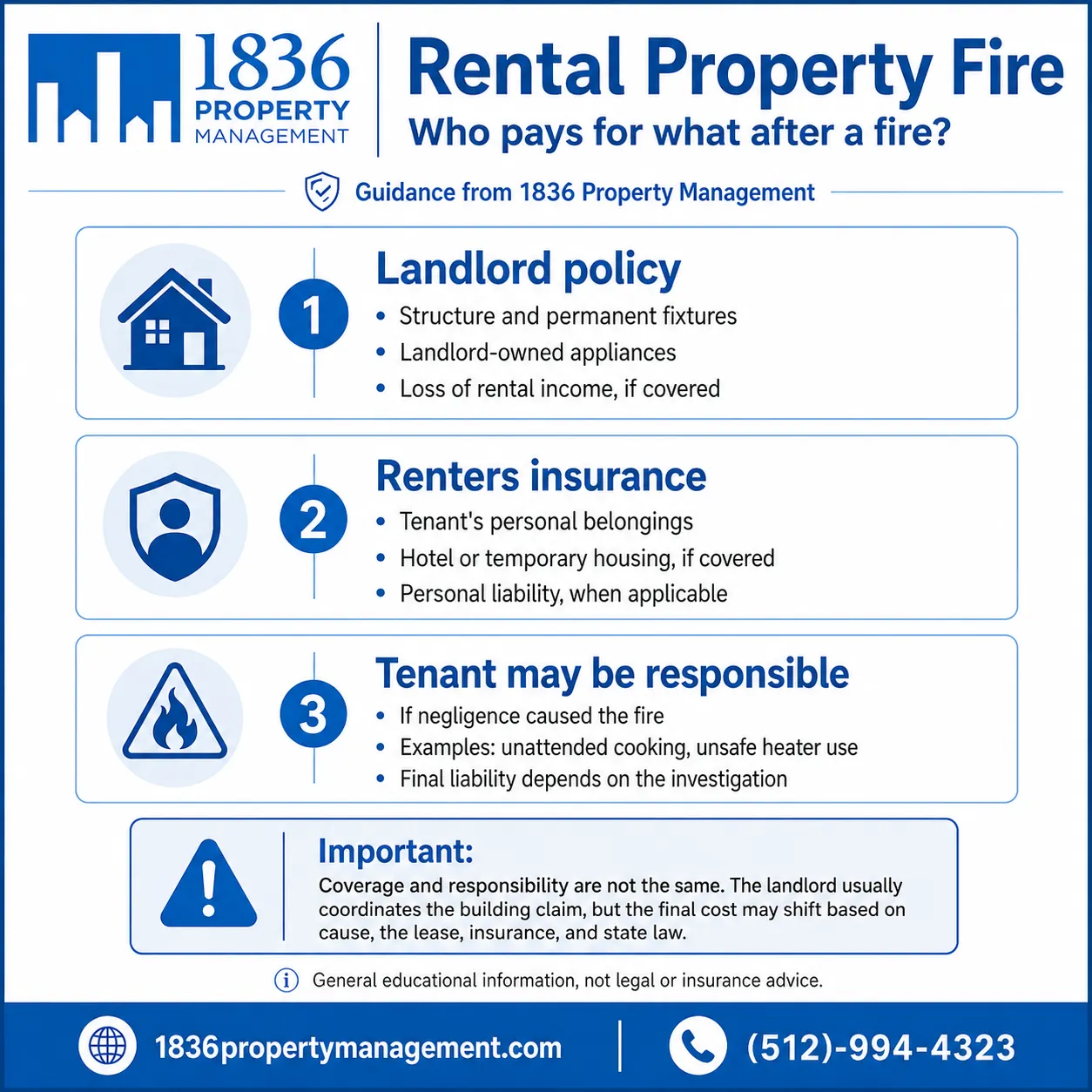
Because the landlord owns and insures the structure, the landlord will usually coordinate the building claim and any restoration needed to return the property to service. However, that does not mean the landlord is financially responsible in every case. If a tenant, household member, or guest caused the fire, the lease, state law, and insurance policies may shift some or all of the cost to the responsible party.
In other words, two separate questions are in play. Who manages the building claim and the rebuild? And who ultimately bears the cost? Those often have different answers.
Here is how the pieces typically sort out:
- The building, fixtures, and landlord-owned items. Handled through the landlord's property policy.
- The tenant's furniture, clothing, and electronics. A landlord's property policy generally does not cover these. The tenant normally files those losses under renters insurance. That said, liability may still depend on who caused the fire.
- A fire caused by tenant negligence. The tenant may be held financially liable, and the landlord's insurer may pursue recovery directly through a process called subrogation.
Examples of negligence may include leaving cooking unattended, using a heat source unsafely, smoking where the lease forbids it, overloading electrical equipment, or allowing a guest to create the hazard.
Even so, a bad result does not prove negligence. A faulty appliance or electrical problem does not automatically establish responsibility. Investigators may consider who owned the equipment, whether the problem had been reported, how it was maintained, and what caused the failure. Shared fault is also possible.
For all of those reasons, do not assign blame early. Let the fire investigator determine origin and cause, then let your insurer decide how to pursue it. Our guide to damage caused by tenant negligence walks through the same liability questions in the context of water damage.
What Happens to a Lease After a Fire
A fire does not automatically cancel a lease. That surprises most owners, and it surprises tenants even more.
Start with the lease itself. Nearly every standard residential lease includes a casualty clause covering fire, storm, and similar damage. Read that paragraph, along with the repair, rent, and termination sections, before you say anything to your resident. In many states, including Texas, the lease can modify what the default statute would otherwise require.
From there, three general patterns are possible. The exact result depends on state law and your lease.
The home is fully unusable. State law may allow the landlord, the tenant, or both to end the lease. Notice requirements, refund rules, and timing vary. The landlord may need to return prepaid rent for the period after the tenant moves out, and security deposit rules still apply.
The home is partly unusable. The lease may continue, and the tenant may be entitled to a rent reduction in some states. Do not treat a home as usable just because one bedroom looks untouched, since smoke, soot, water, and damaged utilities can affect areas far from the flames.
The damage is cosmetic or limited. The lease generally continues at full rent, and repairs happen like any other maintenance item.
Whatever you decide, put it in writing. Verbal agreements about rent abatement or termination are the source of most post-fire disputes we see.
Does the Landlord Have to Pay for the Tenant's Temporary Housing?
There is no single nationwide rule requiring every landlord to pay for a hotel after every fire. The answer may depend on the lease, state and local law, the building type, and the cause of the fire.
In practice, temporary housing is most often covered by the tenant's renters insurance. Additional living expense coverage, sometimes called loss of use, may pay for a hotel, meals, or another rental while the home is repaired, subject to policy limits.
Tell your tenant to contact their renters insurance carrier immediately. If the tenant has no coverage, local disaster relief organizations may be able to help. Meanwhile, do not promise to pay for housing before reviewing your lease, your policy, and local law.
If the lease does end, your deposit obligations do not disappear. Review the texas security deposit laws that govern refund deadlines and lawful deductions before closing out the account.
When Is a Rental Property Uninhabitable After a Fire?
A property may be uninhabitable when people cannot live there safely or lawfully. Importantly, that decision is not based only on how much of the home visibly burned. A kitchen fire contained to one room can still render an entire house unusable.
Watch for these conditions:
- Structural or access hazards. Compromised framing, floors, load-bearing walls, stairs, or blocked exits.
- Electrical or gas hazards. Damaged wiring, a compromised panel, or any suspected gas issue.
- Missing essential utilities. No safe water, power, heat, or sanitation.
- Significant smoke or soot contamination. Soot travels through HVAC systems and settles in rooms the fire never reached.
- Water damage or environmental hazards. Firefighting water creates a second restoration problem, and mold can develop within days. Older homes may also involve lead or asbestos.
- Government occupancy restrictions or active construction. A red tag controls the answer regardless of how the home looks, and ongoing demolition can make a sound structure unusable.
Understand who decides what. The fire department controls entry immediately after the event. Building officials then determine whether permits, inspections, or occupancy approvals are required. Insurers and contractors also inspect, but their role is different. A claim approval is not a government approval to occupy the home.
Fire Insurance for Rental Property
Many owners search for fire insurance for rental property. In practice, fire coverage is usually part of a landlord or dwelling policy rather than a standalone fire policy.
What Landlord Insurance May Cover
Many landlord or dwelling policies include coverage for the structure, detached structures, landlord-owned contents such as appliances, debris removal and emergency mitigation, liability, and loss of rental income.
One common mistake creates real exposure. If a home is still insured under an owner-occupied homeowners policy after it became a rental, a carrier may reduce or deny a claim. Our full guide to rental property insurance explains how these policies are structured and where the gaps usually appear.
| Coverage question | Landlord policy | Renters insurance |
|---|---|---|
| Structure and permanent fixtures | Typically covered | Not covered |
| Landlord-owned appliances | Typically covered | Not covered |
| Tenant's personal belongings | Generally not covered | Typically covered |
| Tenant's temporary housing | Generally not covered | Often covered as loss of use |
| Owner's lost rent during repairs | Often covered as loss of rents | Not applicable |
| Liability for injuries on the property | Typically covered | Covers tenant liability |
Always confirm details against your own policy, since terms and limits vary by carrier.
Loss of Rental Income After a Fire
Many landlord policies include loss-of-rent coverage, which pays rental income while a covered loss makes the home unlivable. A serious fire can take months to fully restore, so this coverage often matters more than owners expect.
Two limits catch owners off guard. First, loss of rent applies to physical damage, not to a tenant who simply stops paying. Second, coverage is usually capped, either as a dollar amount or as a number of months.
Ask your carrier now rather than during a claim:
- Is loss of rent included, and what triggers it?
- Is there a waiting period before it starts?
- How long can benefits continue?
- What records are needed to prove the lost income?
Renters Insurance and Fire Damage
Renters insurance typically covers the tenant's belongings after a covered fire, along with additional living expenses and personal liability. It does not cover the structure.
For that reason, we recommend requiring renters insurance in every lease, with a minimum liability limit and the owner listed as an interested party. Landlords should not value or promise payment for a tenant's belongings. Direct the tenant to their own insurer and keep the building claim separate.
Common Claim Problems
Claims get harder when a property has been vacant, when the policy has the wrong occupancy type, when damage exceeds policy limits, or when required maintenance was ignored. Code upgrades can also add cost during reconstruction, so ask whether your policy includes ordinance or law coverage. In Texas, insurers must follow specific deadlines for acknowledging and deciding a claim, which the Texas Department of Insurance outlines in its home insurance guide.
Rental Property Fire Rules in Texas and Austin
Texas gives landlords and tenants a specific framework after a fire, and it differs from what many owners assume. The sections below come from Chapter 92 of the Texas Property Code. This is an overview rather than legal advice, and the facts of your fire and the terms of your lease can change the result.
What Texas Law Says About Fire and Casualty Loss
Section 92.054 governs what happens after fire, smoke, explosion, and similar events.
Start with timing. When a condition results from an insured casualty loss, the repair period does not begin until the landlord receives the insurance proceeds. In practice, the clock is tied to your carrier rather than to the date of the fire.
Next, the extent of the damage determines the options. If the home is as a practical matter totally unusable, and the tenant, the tenant's family, or a guest did not cause the loss, either party may terminate the lease by written notice at any time before repairs are finished. If the home is only partially unusable and the tenant was not at fault, the tenant may be entitled to a proportionate rent reduction. Here is the part most articles get wrong. That reduction is not automatic. Under Section 92.054(c), it applies only on judgment of a county or district court, and the parties may agree otherwise in a written lease.
| Situation | Who can terminate | What happens to rent |
|---|---|---|
| Totally unusable, tenant not at fault | Either landlord or tenant, by written notice | Prorated refund from move-out date, plus deposit refund |
| Partially unusable, tenant not at fault | Lease generally continues | Proportionate reduction, but only by court judgment unless the lease says otherwise |
| Loss caused by tenant, family, or guest | The statutory termination right does not apply the same way | Rent obligations generally continue under the lease |
Cause matters for repairs as well. Section 92.052 generally requires landlords to make a diligent effort to repair conditions that materially affect health or safety, after proper notice from a tenant who is current on rent. However, unless the condition was caused by normal wear and tear, that duty does not extend to a condition caused by the tenant, a lawful occupant, a family member, or a guest. After a fire, then, the cause can change your legal obligations and not just who pays.
Because this wording is specific, review the cause, the lease, and the insurance findings with a Texas attorney before sending a termination notice or deciding how rent will be handled.
Texas Smoke Alarm and Fire Extinguisher Rules
Subchapter F sets out smoke alarm duties for Texas rentals, and it is stricter than most owners realize. Your duty to install a smoke alarm cannot be waived. Your duty to inspect and repair alarms can only be waived by specific written agreement. In general, alarms belong in each separate bedroom, near bedrooms that share a corridor, and on each level of a multi-level home. Tenants carry duties too, since a resident who disables an alarm takes on liability of their own.
Our overview of smoke detector requirements covers how these items fit into a rent-ready property. From what we have seen, noticing a device on the ceiling is not enough. Verify that each required alarm is present, correctly placed, working, and documented.
Fire extinguishers work differently. Texas does not broadly require landlords to install extinguishers in every single-family rental. However, if you have installed a qualifying residential extinguisher under a local ordinance or other law, Texas law requires inspection at the start of each tenancy and within a reasonable time after a written tenant request, plus repair or replacement at your expense in certain situations.
Austin Permits After a Fire
Austin permits and inspections can affect the repair timeline, depending on the type and extent of the damage.
According to the City of Austin’s emergency permit guidance, a permit related to emergency repairs for fire and smoke damage is required when structural components need repair and the footprint and layout of the structure are not changing. A building permit is required to remove debris and rebuild to the same footprint and layout.
Two details catch Austin owners off guard. If the gas was shut off by the utility or by the Austin Fire Department, you will need a plumbing permit and must follow the pulled gas meter procedures before service is restored, since no gas work is exempt from a permit. Additionally, hazardous materials including asbestos, lead, and refrigerant must be removed and disposed of by a professional. Electrical, plumbing, mechanical, and structural work may each require separate permits and inspections, so confirm what applies before demolition begins.
1836 Insight
In 19 years of managing rental homes across Central Texas, we have seen the full spectrum of maintenance and property damage events. The pattern that separates a manageable claim from a painful one is almost always documentation created before the loss.
We walk every managed property at least twice a year, inside and out, with photos. If a major loss occurs, those records can help establish the condition of the property beforehand and give the owner and adjuster a much clearer pre-loss record. Self-managing owners should build the same kind of documentation into their process.
Fire Regulations for Rental Properties and How to Lower Your Risk
Cooking remains one of the leading causes of residential fires, so prevention should start with smoke alarms, cooking safety, electrical maintenance, and clear resident reporting procedures.
Focus on the following:
- Install, test, and document smoke alarms. Photograph them at every turnover, and replace expired units.
- Service the range hood and clean the dryer vent. Both are cheap, and both are frequent ignition points.
- Respond quickly to electrical, heating, and appliance complaints. A documented fast response is your best defense if cause is ever disputed.
- Use licensed vendors for electrical and gas work. Unpermitted work creates both fire risk and claim risk.
- Set clear lease rules for grills, candles, and smoking. Clear lease rules are easier to communicate and enforce consistently.
- Require renters insurance and verify it annually.
- Give residents clear reporting instructions. They should report burning odors, hot outlets, and damaged cords, and treat an active fire as a 911 emergency rather than a maintenance request.
Do rental properties need fire extinguishers? Fire extinguisher requirements vary by state, city, and property type. Even where none is required, a kitchen extinguisher is a smart, inexpensive addition. Just remember that once you install one, inspection and maintenance duties may follow, and residents should understand that an extinguisher is only for a small contained fire when they have a clear escape route.
Getting the Property Back on the Rental Market
Restoration follows a predictable order. First comes emergency mitigation, which means water extraction, drying, and board-up. Next is removal of unsalvageable materials, followed by smoke and odor remediation. Then permits get pulled, the rebuild happens, and the property goes through final inspections.
Build a complete scope before construction starts. Fire and smoke can affect wiring, framing, insulation, roofing, HVAC systems, plumbing, finishes, and indoor air quality, and firefighting water creates its own restoration problem. Ask contractors to separate emergency work from permanent reconstruction, and to identify permit, engineering, and inspection needs up front.
Expect the insurer's estimate and your contractor's estimate to differ. Review the differences line by line, and ask what documentation could change a coverage decision. Contractor availability and selection can significantly affect the timeline, so get bids in writing and use established local companies. 1836 maintains a network of preferred vendors for renovation and maintenance work, which means our owners are not sourcing a restoration contractor under pressure.
After construction, the home still needs a full make-ready: deep cleaning, paint, flooring, a locksmith visit, and fresh photography. Smoke odor deserves particular attention, since a home that smells like a fire will not lease at market rent no matter how good the drywall work is.
Before relisting, confirm that all required inspections are complete, utilities are safe, life-safety devices are working, and any occupancy restrictions have been lifted. Complete a new property condition report with photos, then price the home against current market conditions rather than simply returning to the pre-fire rent.
Frequently Asked Questions
Who is responsible for fire damage in a rental property?
It depends on the cause, the lease, insurance coverage, and state law. The landlord typically coordinates the building claim because the landlord owns and insures the structure, but that is not the same as being financially responsible. Do not assume fault before the investigations are complete.
What happens to a lease after a fire?
The lease may continue, end, or require a written agreement about repairs and rent. The result depends on whether the home is fully or partly unusable, who caused the fire, and local law. Texas addresses this in Property Code Section 92.054.
Can a tenant break the lease after a fire in Texas?
In specific circumstances, yes. If the home is as a practical matter totally unusable and the tenant, their family, or a guest did not cause the loss, either party may terminate by written notice before repairs are complete. The tenant is then entitled to a prorated rent refund and the security deposit required by law.
Does the landlord have to pay for the tenant's hotel after a fire?
There is no single nationwide rule requiring it. The answer may depend on the lease, state and local law, the building type, and the cause. In most cases, temporary housing falls under the tenant's renters insurance as additional living expense coverage.
Does renters insurance cover fire damage?
Renters insurance commonly covers a tenant's belongings damaged by fire or smoke, subject to policy limits. It may also cover additional living expenses and personal liability. It does not cover the structure, and the tenant must file a separate claim.
Does landlord insurance cover loss of rental income after a fire?
Many landlord policies include loss-of-rent coverage, which pays rental income while a covered loss makes the home unlivable. Coverage is usually capped by dollar amount or number of months. It applies to physical damage, not to a tenant who stops paying rent.
Can a landlord charge a tenant for fire damage?
Possibly, when reliable evidence shows the tenant, a household member, or a guest caused the fire and the charge is permitted by the lease and by law. Document the cause and costs, account for insurance payments so the same loss is not charged twice, and follow your state's security deposit rules.
Do rental properties need fire extinguishers?
Requirements vary by state, city, property type, and building code. Texas does not broadly require them in single-family rentals. However, when a landlord installs a qualifying extinguisher under a local ordinance or other law, Texas law requires inspection at the start of each tenancy and repair or replacement in certain situations.
How long does it take to repair a rental property after a fire?
There is no standard timeline. Minor fires may need limited repairs, while structural damage can take months. In Texas, the repair period for an insured casualty loss does not begin until the landlord receives the insurance proceeds. Permits, contractor availability, material lead times, and hidden smoke or water damage all affect the schedule.
Talk to a Local Team Before You Need One
A fire is a bad time to learn your policy limits, your lease language, and your contractor list all at once. The owners who handle it well built those things in advance.
1836 Property Management manages more than 900 homes across Austin and Central Texas as a licensed Texas brokerage. Our team handles emergency response, vendor coordination, resident communication, insurance documentation, and the make-ready work that follows.
If you own a rental in Austin or Central Texas, schedule a call with our team or get started today.
This article provides general educational information for rental property owners and is not legal or insurance advice. State laws, lease terms, insurance policies, and local codes vary and change over time. Speak with a licensed attorney, a licensed insurance professional, and the appropriate building officials about a specific loss.