






At 1836 Property Management, Austin landlords ask us this question all the time: when does a guest become a tenant in Texas? Matt Leschber founded our Texas-licensed brokerage (License No. 9000329) in 2007 with a single client. Today, we manage more than 900 properties across Central Texas, and our annual eviction rate is less than 0.5%. That track record comes from catching small lease issues early, before they turn into legal problems. A long-term guest is one of the most common examples.
Quick answer: Texas does not set a fixed number of days after which a guest becomes a tenant. Instead, status depends on the lease, whether the person had permission to live there, and evidence such as rent payments, permanent access, personal belongings, mail, and use of the property as a primary home.
That answer surprises many landlords. It also means your lease is your best protection. In this guide, we explain what makes a guest a tenant, how Austin's rules differ, and what to do about a long-term guest right now.
Key Takeaways
- Texas has no set number of days that turns a guest into a tenant. Status depends on the lease, permission, and how the person uses the home.
- Watch for the warning signs: mail, belongings, their own key, paying toward rent, and no other residence.
- A guest who pays your tenant to stay may be an unauthorized subtenant under Texas Property Code Section 91.005.
- Never use lockouts, utility shutoffs, or belonging removal. An invited occupant who claims tenant status may need to go through formal eviction.
- Austin no longer caps how many unrelated adults can share a home, so your lease is now your main control.
- The best protection is a clear guest clause, screening for every adult, and consistent enforcement.
Table of Contents
The Short Answer: Texas Has No Magic Number of Days
Many states are the same way, but landlords still expect a clear rule. In Texas, there is no statute that says a guest becomes a tenant after 14 days, 30 days, or any other set period. Instead, Texas Property Code Chapter 92 defines a tenant as someone authorized by a lease to occupy a dwelling. However, a lease does not have to be a formal document. It can be written or oral, and the parties' actions may provide evidence about whether the person had permission to use the property as a home.
That last part is the trap. If someone lives at the property with permission, and the parties' words or actions suggest an agreement allowing them to stay, the occupant may claim to be a tenant at will, even without a signed lease. A landlord's knowledge alone does not automatically create a tenancy. However, ignoring the situation can make the person's status much harder to resolve. As a result, the real question is not how many days someone stayed. The real question is what the facts show about permission and residency.
Guest, Tenant, Occupant, or Subtenant? Know the Difference
These labels sound similar, but they carry very different rights. Before you act, figure out which one you are dealing with.
| Status | Typical situation | Right to stay | Main landlord concern |
|---|---|---|---|
| Guest | Visits temporarily and has a home elsewhere | Temporary, through the tenant | Stays longer than the lease allows |
| Tenant | Lives there under a written, oral, or implied agreement | Yes, with full tenant protections | Must be removed through formal eviction |
| Unauthorized occupant | Appears to live there without landlord approval | Disputed | Guest policy or occupancy violation |
| Subtenant | Pays the named tenant to live there | Usually claims rights through the tenant | Subletting the landlord never approved |
These labels can also overlap. For example, a person can violate your lease as an unauthorized occupant and still claim the named tenant gave them permission to live there. As a result, never assume that "not on the lease" means "no legal rights."
What Makes a Guest a Tenant?
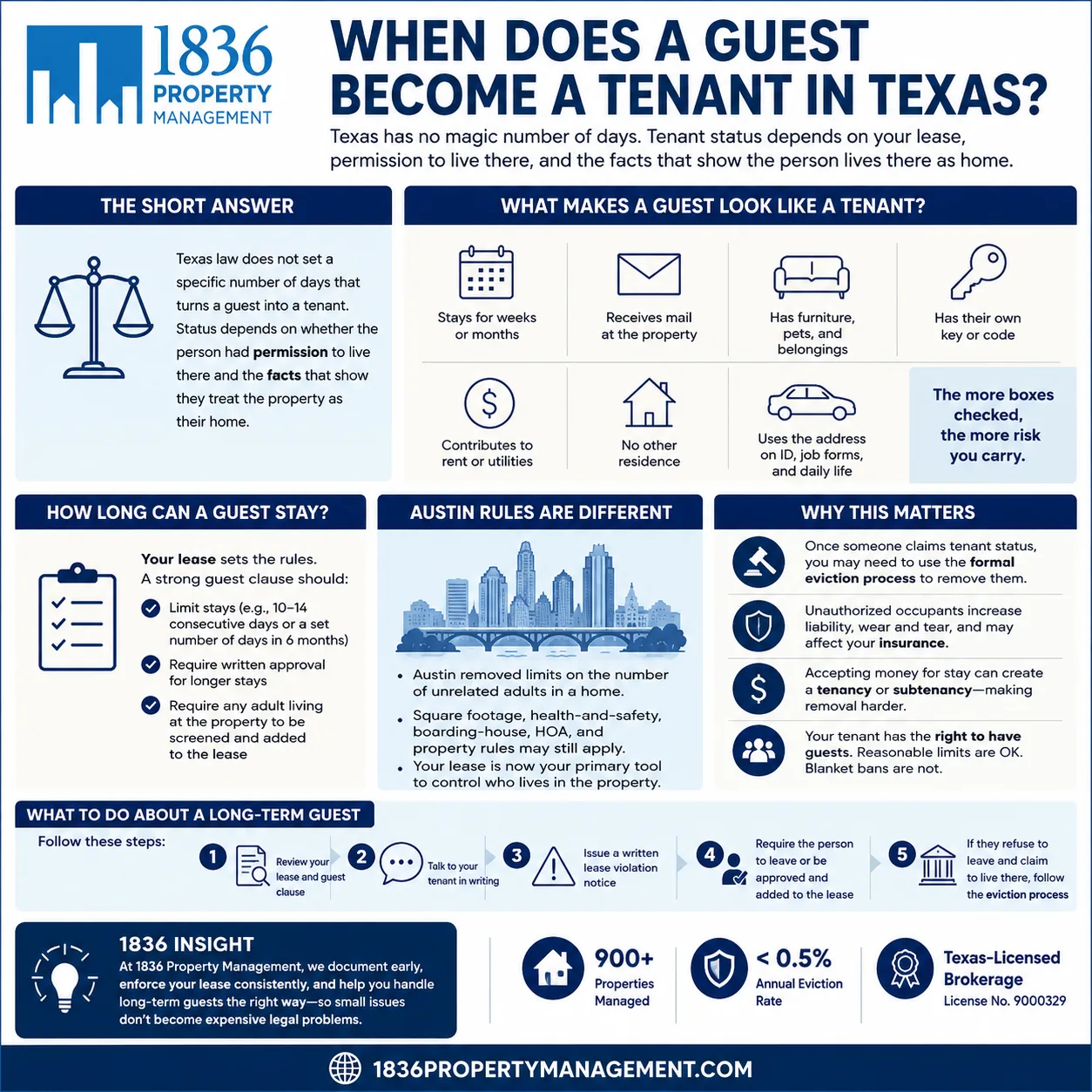
Courts and judges look at conduct, not the calendar. For example, a guest who visits for two weeks and goes home is just a guest. Meanwhile, a person who moves in belongings and gets mail at the property is starting to look like a tenant. Use this table as a quick gut check.
| Factor | Typical Guest | Looks Like a Tenant |
|---|---|---|
| Length of stay | Days, with a clear end date | Weeks or months, no end in sight |
| Mail and packages | None | Receives mail at the property |
| Belongings | A suitcase | Furniture, pets, and daily essentials |
| Keys and access | Let in by the tenant | Has their own key or code |
| Money | Pays nothing | Contributes to rent or utilities |
| Other home | Has their own address | No other residence |
| Daily life | Visits sometimes | Sleeps there most nights, parks there, uses the address on ID or job forms |
No single factor decides it. However, the more boxes someone checks in the right-hand column, the more risk you carry as the owner.
How Long Can a Guest Stay in a Rental Property?
Since state law will not draw the line for you, your lease has to do it. A strong guest clause usually does three things. First, it sets a limit on stays, such as no more than 10 or 14 consecutive days, or a set number of days within six months. Second, it requires written approval for anything longer. Third, it states that any adult living at the property must be screened and added to the lease.
Keep one thing straight, though. A guest who stays past the lease limit puts your tenant in violation of the lease. It does not automatically make the guest a legal tenant. The reverse is true as well. Even a short stay can create a dispute if the person pays to live there and calls the property home.
Also, be consistent. Enforce the same guest rules for every tenant, every time. Uneven enforcement creates fair housing risk, and it weakens your position if a dispute ever reaches a courtroom.
Can Someone Live With You Without Being on the Lease in Texas?
Physically, yes. A person can live at a property without being named on the lease. However, that does not make the arrangement allowed. An unapproved occupant usually puts the named tenant in violation of the guest, occupancy, or subletting terms. In addition, the named tenant remains responsible for the rent, any damage, and the conduct of everyone they let in. If the arrangement should continue, the fix is approval and a lease amendment, not silence.
Austin's Occupancy Rules Have Changed
Here is where Austin differs from much of Texas. For years, Austin's zoning code capped how many unrelated adults could share a home. That cap is gone. Under the city's HOME amendments, Austin removed its limits on the number of unrelated adults living in a housing unit. Basic occupancy is still governed by square footage standards in the city's Property Maintenance Code, but the old "unrelated adults" rule no longer does the work for you.
In other words, Austin landlords can no longer rely on the old zoning limit on unrelated adults. However, square footage, health-and-safety, boarding-house, HOA, and property-specific rules may still apply. The lease is now your main tool for setting guest and additional-occupant rules. If your Austin lease still assumes the old occupancy caps, it is time for an update.
One more Austin wrinkle. The city licenses rentals of fewer than 30 consecutive days as short-term rentals. That 30-day line is a licensing rule, not tenant law. It does not mean a personal guest becomes a tenant on day 30, so do not let that common mix-up drive your decisions.
Why the Guest vs. Tenant Question Matters
Once someone counts as a tenant, everything changes. You cannot simply tell them to leave by Friday. Do not use a lock change, utility shutoff, or removal of belongings to permanently force out someone who may be a tenant. Improper removal can expose you to legal claims and financial penalties.
There are other risks too. An extra adult in the home adds wear and tear. An unapproved occupant may also create insurance or liability concerns, depending on the terms of your policy. In addition, money makes things murkier. If a long-term guest starts handing you cash for rent, you may have created a tenancy by accepting it. If that person later stops paying, you are now addressing unpaid rent with someone you never screened.
Finally, keep your terms straight. A long-term guest is not a squatter. Squatters enter without any permission. Guests were invited, at least at first, so Texas treats the two situations differently. We break down that distinction, plus the state's newer removal laws, in our guide to squatters' rights.
What Rights Do Texas Tenants Have Regarding Guests?
Before you act, remember the other side of this issue. Ordinary visitors are different from additional people moving into the property. A clear lease should distinguish temporary guests from residents and set reasonable rules for overnight stays, noise, parking, pets, and additional occupants. Apply those rules consistently and in compliance with fair housing laws. That approach protects the property without creating needless conflict with good tenants.
Also note that an unauthorized occupant is usually your tenant's lease violation, not the guest's. That matters for how you respond. Your notices, conversations, and any cure deadlines go to the tenant on the lease.
Can Paying Rent Turn a Guest Into a Tenant or Subtenant?
Money changes everything in these disputes. Texas law is strict about subletting. Under Texas Property Code Section 91.005, a tenant may not rent the property to another person without the landlord’s consent. So when your tenant charges someone to live in the home, that is usually not a guest situation anymore. It may be an unauthorized sublease. Even then, the named tenant still answers to you for the rent, the damage, and the conduct of everyone they let in.
Your own actions matter just as much. In fact, a landlord can strengthen an occupant’s tenancy claim without meaning to. Accepting rent money from the person, adding them to the resident portal, giving them their own access credentials, or negotiating terms with them directly can all support their claim that an agreement exists. Therefore, do not take payments from an unapproved occupant, and respond promptly once you learn someone may have moved in. Waiting quietly can start to look like permission. Tenants sometimes propose an informal handoff as a way out of the lease, which does not work either. Our guide to how to break a lease in Texas explains why subletting never releases the original tenant and what a landlord-approved assignment requires instead.
What Should a Landlord Do About a Long-Term Guest?
If you suspect a guest has moved in, act early and follow a clear order of steps.
- Reread your lease. Find the guest clause, the occupancy terms, and the cure period for violations. Your lease controls what happens next.
- Document the facts. Note dates, vehicles, and what you observe during normal, lawful visits. Routine rental property walkthroughs are often how long-term guests get noticed in the first place.
- Talk to your tenant. Many cases end here. A new partner or a relative in a rough patch is common, and most tenants will fix the issue once it is raised.
- Send a written lease violation notice. Give the tenant a clear deadline to either end the overstay or start the approval process.
- Offer a path onto the lease. If the person plans to stay, require the full tenant screening process in Texas that you would use for any applicant. Once approved, the person can be formally added to the lease in writing.
- Escalate if nothing changes. If the tenant will not resolve it, you may be looking at when eviction may be necessary.
1836 Insight: At 1836 Property Management, we do not automatically assume that every frequent visitor is an unauthorized tenant. We begin by reviewing the lease requirements and documenting the available facts. If the person intends to live at the property, they must complete the applicable resident screening process. Once approved, the individual can be formally added to the lease and property management records.
How to Evict a Guest From Your Home in Texas
Sometimes the person will not leave, and no one will add them to a lease. At that point, be careful. An invited occupant who claims the property as their residence may need to be removed through the formal eviction process, even though they never signed the owner's lease. Also, calling the police rarely settles it, because officers may treat an invited occupant as a civil matter.
When formal eviction is required, the process generally begins with the appropriate written notice under Texas Property Code Chapter 24. The required notice period depends on the person's status, the reason for removal, the lease, and any other written or oral agreement. If the person still does not leave, the next step is an eviction suit, called a forcible detainer, filed in the local justice court. Texas also updated its eviction procedures under Senate Bill 38, which applies to eviction cases filed on or after January 1, 2026, so use current forms and deadlines. The Texas State Law Library's eviction guide is a reliable, current walkthrough of each step.
One more time, because it matters: never use a lockout, utility shutoff, or removal of belongings to permanently force someone out. Improper self-help removals usually cost far more than doing it right.
The Bottom Line for Texas Landlords
There is no set number of days when a guest becomes a tenant in Texas. Tenant status comes from your lease and the person's behavior, which means prevention beats reaction every time. A tight guest clause, screening for every adult, routine walkthroughs, and consistent enforcement will stop most guest problems before they start.
Of course, staying on top of all this takes time, and the legal steps leave little room for error. That is exactly the kind of work professional property management exists to handle. If a long-term guest situation is brewing at your rental, or you simply never want to deal with one, reach out to the 1836 Property Management team. We will help you protect your property, your lease, and your peace of mind.
Frequently Asked Questions
How long before a guest becomes a tenant in Texas?
Texas has no automatic timeline. A person may claim tenant status when there is a written or oral agreement allowing them to use the property as a home. Rent payments, permanent access, belongings, and the absence of another residence may be relevant, but no single factor decides every case. Your lease can and should set its own guest limits.
Does receiving mail make a guest a tenant?
No. Mail alone does not create a tenancy. However, regular mail combined with other signs, such as paying toward rent, keeping belongings at the home, holding a key, and having no other residence, can add up to real evidence that the person lives at the property.
How long can someone live with you without being on the lease?
Only as long as the lease allows. The lease may limit guests to 10 or 14 consecutive days, set a cumulative limit over a longer period, or use another standard. Once a guest exceeds the specific lease limit, the named tenant may be in violation, and an unscreened occupant becomes a legal risk for the owner.
Can I be evicted for having someone live with me?
Yes, it is possible. An unauthorized long-term occupant usually violates the lease's guest or occupancy clause. In Texas, a landlord can send a notice about the violation and, if it is not fixed, move toward eviction. Tenants who want a partner or family member to move in should ask the landlord first.
What is the difference between a guest, a tenant, and a squatter?
A guest visits with permission and has no ongoing right to stay. A tenant has the right to occupy the home under a lease, which can be written, oral, or implied. A squatter enters or remains with no permission at all. Each one is handled differently under Texas law, and using the wrong process can backfire.
How do I remove a guest who refuses to leave?
An invited guest who claims to live at the property may need to be removed through formal eviction procedures. Do not use a lockout, utility shutoff, or removal of belongings to force the person out. Because the proper notice depends on the facts and any occupancy agreement, get guidance from an attorney or a property manager before you act.
This article shares general information for Texas rental property owners. It is not legal advice. These disputes turn on the lease and the specific facts, so talk with a qualified Texas attorney before sending a legal notice or filing an eviction case.