




Key Takeaways
- Austin is in a correction, not a crash. The metro median sale price is about $440,000, roughly 20% below the 2022 peak but down only about 1% to 2% from a year ago.
- Buyers have the most leverage in years. Inventory sits near five months, homes take about 67 days to sell, and many listings have taken a price cut. Even so, pending sales are rising, so demand is holding up.
- Mortgage rates near 6.5% are the other half of the affordability picture. They remain more than double the pandemic-era lows, which keeps monthly payments high and has cooled buyer demand.
- Rents have fallen too. A large wave of new apartments pushed vacancy into the double digits, though new construction is now slowing and rents are expected to stabilize.
- For owners, the real question is rent or sell. With prices off their peak and high mortgage rates making a move costly, many owners are choosing to rent and hold rather than sell low.
- The long-term outlook stays strong. Jobs, the University of Texas, state government, and a deep tech base continue to support demand across the Austin housing market.
The Austin housing market has changed a lot in the past few years. At 1836 Property Management, we have managed Austin rental homes since 2006, and today we oversee over 900 properties across the metro. Because of that, we have watched this market climb during the pandemic boom and cool off in the years since. Our founder has even been recognized by Enterprise World as one of the most visionary leaders to watch in the real estate industry. So if you own a home here, plan to invest, or feel stuck choosing between renting and selling, this guide will walk you through what is really happening and what it means for you.
Table of Contents
Austin Housing Market Update: 2026 at a Glance
The short answer is this. Austin is going through a correction, not a crash. Prices have eased from their 2022 peak. Homes are taking longer to sell. Buyers now have more power than they have had in years. At the same time, people keep moving here, and the long-term outlook stays strong.
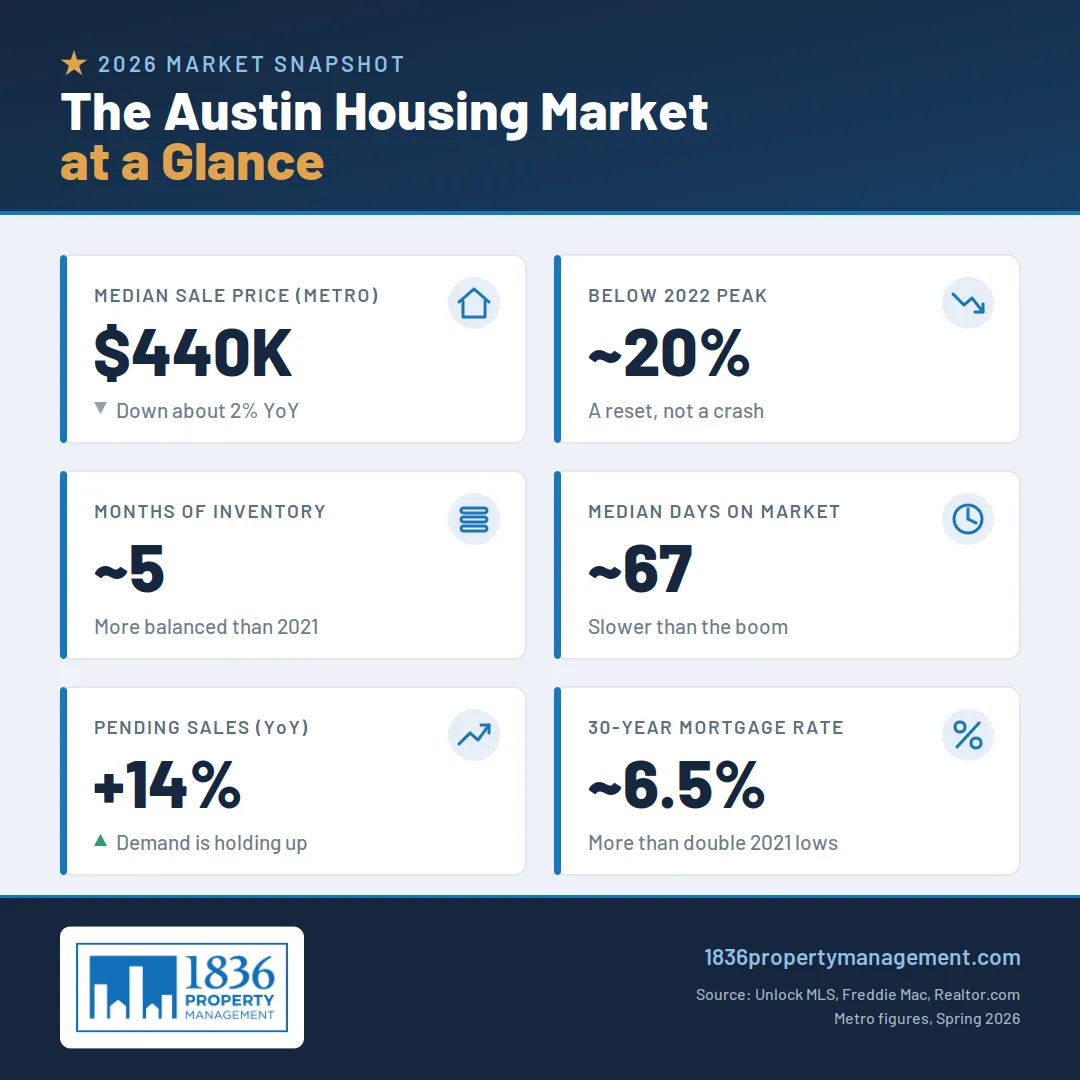
Here is a quick snapshot of the Austin real estate market in 2026. (Data current as of spring 2026.)
| Metric (Spring 2026) | Reading | What It Means |
|---|---|---|
| Median sale price, Austin metro | About $440,000 | Down about 1% to 2% from a year ago |
| Median sale price, city of Austin | About $574,000 | The city runs well above the metro |
| Change from the May 2022 peak (metro) | About 20% lower | Prices have reset from the high point |
| Months of inventory (metro) | About 5 months | Far more balanced than 2021 |
| Median days on market (metro) | Around 67 days | Homes sell slower than during the boom |
| Pending sales (year over year) | Up about 14% in May | Buyer demand is holding up |
Sources: Median prices, months of inventory, days on market, and pending sales from the Unlock MLS Central Texas Housing Reports, via KXAN (spring 2026). The change from peak compares the current metro median to its May 2022 high of about $552,000 (Unlock MLS); depending on the dataset, published estimates of the total decline range from about 14% to 24%. Different sources use different geographies (the city of Austin, the broader metro, or the Austin-Round Rock-San Marcos area) and methods, so figures will vary.
As the table shows, the market has cooled. However, it has not fallen apart. Let us break down each piece.
Austin Home Prices in 2026
Austin home prices have softened. As of spring 2026, the median sale price across the Austin metro was about $440,000, according to Unlock MLS data. That is down about 1% to 2% from a year earlier. One quick note on terms. The word "metro" covers the broader five-county Austin area, while "city" means Austin proper, so the two numbers will not match. Inside the city itself, the median was much higher at around $574,000. Different data sources also use different areas and methods, so you may see somewhat different numbers depending on where you look. You can track current figures on Redfin's Austin market page.
Prices look even more different when you compare them to the peak. Back in May 2022, the metro median sat near $552,000. So today's prices are about 20% below that high point. In some suburbs that saw the biggest pandemic gains, the drop has been even larger.
Why does this matter? Because the gap between 2022 prices and today's prices is the heart of the story. Many sellers still expect 2022 numbers. Buyers, on the other hand, know the market has moved. So, are home prices dropping in Austin? Yes, but slowly and in a controlled way. This is a gradual reset, not a sudden collapse.
Is the Austin Housing Market Going to Crash?
This is the question we hear most. With prices down and homes sitting longer, some owners worry about an Austin housing market crash. The data, though, points to a correction rather than a crash.
Here is the difference. A crash means a sharp, deep drop driven by forced selling and weak demand. A correction means prices ease back toward normal after rising too fast. Austin clearly fits the second description.
A few facts support this. First, demand is still present. Central Texas continues to attract residents and employers, although growth has cooled from the pandemic boom. Second, the local economy stays strong, with major employers like Tesla, Oracle, and Apple, plus a deep tech and biotech base. Third, while foreclosures have risen over the past year, they remain well below the levels seen in past housing crashes, according to ATTOM data. Finally, sales volume is actually rising, not falling. Pending home sales across the Austin metro were up by double digits year over year this spring, including about 14% in May, according to Unlock MLS reports.
In short, Austin overshot during the boom, and now it is settling. That is healthy, even if it feels uncomfortable for sellers.
Austin Real Estate Market Trends: Why Homes Are Taking Longer to Sell
Homes in Austin now sit on the market longer. As of spring 2026, the typical metro home took about 67 days to sell, according to Unlock MLS. The metro also held around 5 months of inventory. Real estate pros often see four to six months of supply as a balanced market, which means it favors neither side strongly. For Austin, though, this is a huge shift from the near-zero inventory of 2021.
Buyers have noticed. Depending on the source, somewhere between about a quarter and more than a third of active listings showed a recent price cut. Redfin put the share near 38%, while Realtor.com put it closer to 27% for the Austin-Round Rock-San Marcos area. Homes are also selling for a little under asking, as buyers negotiate. So buyers have real leverage, and many are winning.
A lot of this comes down to the seller expectation gap. Some sellers anchor to 2022 prices and refuse to budge. As a result, their homes sit, and some owners pull the listing and wait. This pattern is playing out across the country, and Austin is no exception.
Still, there are signs of strength. Pending sales keep rising, and buyers are active when homes are priced right. The lesson is simple. In this Austin real estate market, correct pricing matters more than ever.
What Makes Austin Different From the Rest of Texas and the U.S.
Austin does not move exactly like the rest of Texas or the nation. A few things make it unique.
For one, Austin rose higher and faster during the pandemic. Prices climbed well above what local incomes could support. Because the climb was steeper, the correction has been steeper too. In fact, Austin has seen one of the sharpest resets of any major Texas metro.
It also built far more new housing than most metros, especially apartments. This wave of supply cooled both home prices and rents faster than in many other cities.
On the rental side, rents have fallen more here than in most of the country. Average rents in the Dallas area now even top Austin rents for the first time in years, according to Zillow data. That is a big change for a city that was once one of the tightest rental markets in the nation.
Even so, Austin has a strong floor that pure boomtowns lack. The University of Texas, state government, and the area's deep tech and biotech base all support steady demand. So while the ride has been bumpy, the foundation stays solid.
The Austin Rental Market in 2026
The rental side of the Austin housing market tells its own story. For many owners, it may matter most.
Rents have come down too. Realtor.com put the Austin-Round Rock-San Marcos median asking rent at $1,371 in May 2026, down 4.3% year over year. Other rental trackers have reported steeper declines, with Austin rents down about 6% year over year and more than 20% from the 2022 peak. Single-family homes rent for more, often above $2,000, depending on size and location.
The main reason is supply. Austin has added a large wave of new apartments over the past few years. As a result, the apartment vacancy rate across the metro has climbed well into the double digits, far above the lows of a few years ago. To fill that space, many landlords now offer concessions like a free month of rent or a reduced deposit.
Here is the good news for owners. The supply wave is slowing. New apartment construction is expected to slow in 2026 compared with the past few years. So as fewer units come online, vacancy should ease and rents should stabilize later in the year.
Rental market sources: May 2026 median asking rent and year-over-year change from Realtor.com (Austin-Round Rock-San Marcos). Apartment List and some media reporting put the Austin-area annual decline closer to 6%, with rents down more than 20% from the 2022 peak. Vacancy and new-supply trends also reflect trackers such as Apartment List. Rent figures vary by source and by whether they cover apartments only or all rental homes.
It also helps to know where demand stays strong. Single-family homes may also lease faster than apartments when they are priced well and located in strong rental areas. Neighborhoods tied to major employers also hold up well. For example, we have created local guides for Tesla, Apple, and Meta employees, since these workers drive steady rental demand near their campuses. Areas like Mueller and Hyde Park also stay popular with families who want walkable schools and parks.
Renting vs. Selling Your Austin Home
This brings us to the biggest decision many owners face right now. Should you sell into a softer market, or rent your home and wait?
There is no single right answer. It depends on your goals, your timeline, and your finances. To help, here is a simple comparison.
| Factor | Selling Now | Renting It Out |
|---|---|---|
| Today's market | Buyers have leverage, and prices sit below the 2022 peak | Rents are soft but expected to stabilize, and you keep the asset |
| Income type | One-time proceeds from the sale | Ongoing monthly cash flow |
| Long-term upside | You exit before any further dip | You can hold for future appreciation |
| Effort required | Staging, pricing, and negotiation | Tenant placement, maintenance, and compliance, which a manager can handle |
| Best if | You need to move or need the cash, and your home shows well at market price | You can wait for values to recover and want income in the meantime |
If you need to move or you need the cash, selling may make sense, especially if your home shows well and is priced for today. But if you can wait, renting lets you keep the asset and earn monthly income while values recover. In fact, many owners who cannot get their 2022 price are choosing to rent for now.
If you go the rental route, a little planning goes a long way. New to this? Our guide on your first rental property walks through the basics. You will also want to pick the right strategy, so it helps to compare a long term lease vs. short term rental before you list. And to set the right expectations, learn what a healthy return looks like in this market.
Is It Smart to Buy a House in Austin Right Now?
For buyers and investors, 2026 looks like one of the better entry points in years. Prices sit well below the 2022 peak. Inventory gives you real choices instead of bidding wars. And buyers hold negotiating power that simply did not exist during the boom.
Mortgage rates are the other half of the affordability picture. As of mid-June 2026, the average 30-year fixed rate sat around 6.5%, according to Freddie Mac. That is down a little from a year ago, but still more than double the pandemic-era lows near 3%. Higher rates raise the monthly payment, which is one reason buyer demand cooled and prices reset. It is also why some owners choose to rent rather than sell, since trading a low-rate loan for a new one at today's rates rarely pencils out.
That said, no one can time the exact bottom. Some local experts expect a bit more softening early in the year, then a steadier second half. For example, a research adviser at Unlock MLS told Axios that home prices could ease by as much as 5% in the first half of 2026, while adding that Austin is still a place people want to live and work. So buyers who wait for the perfect moment may miss it. Buying during a correction can be a strong position when the rent, financing, reserves, and hold period make sense.
In short, the right move depends on your goal. Buyers and investors get better numbers now, sellers should price to today instead of 2022, and owners who can wait may do well to rent and hold.
One more factor to weigh is cost. Travis County property taxes run high, so investors should always include them in any plan. You can review current rates and rules through the Texas Comptroller's property tax resources.
Austin Housing Market Forecast for 2026 and Beyond
So where does the Austin real estate market go from here? Most forecasts agree on a few points.
In the near term, prices should keep easing or hold flat through 2026. Rents should stabilize in the second half of the year as supply slows. After that, many market watchers expect a more stable period once inventory, interest rates, and rental supply settle. However, Austin's exact growth rate will depend on mortgage rates, job growth, new construction, and buyer demand. Groups like the Texas Real Estate Research Center at Texas A\&M track these statewide and local trends.
The bigger picture stays bright. Austin keeps drawing people and jobs. Its tech base, university, and state-capital status give it real staying power. That is a big reason why Austin remains a strong long-term investment. The boom-and-bust swings may finally be settling into something more stable and more predictable.
How 1836 Property Management Helps in This Market
In a softer market, good management matters more, not less. When vacancy is high and renters have options, the right price and a fast lease-up protect your income. Remember, every extra week a home sits empty costs you money.
This is where we come in. Since 2006, our team has managed Austin rentals through every kind of market. Today we manage over 900 properties. We also use our own tool, the REI Monitor, to track each property's performance in real time. As a licensed Texas real estate brokerage and a past leader of the local NARPM chapter, we bring both deep local knowledge and proven systems. The Austin Business Journal has even named us one of the best places to work, several years running.
We also work hand in hand with our real estate partners from some of Austin's top firms. So whether you are buying, selling, renting, or managing, you have a full team behind you.
Ready to talk it through? You can schedule a call with our team, or get a free, data-driven rental analysis to see what your home could earn today.
Frequently Asked Questions
Are home prices dropping in Austin?
Yes. The Austin housing market has softened in 2026. The median home price across the metro is down about 2% year over year, and roughly 20% below the 2022 peak. The drop has been gradual, which points to a correction rather than a crash.
Is the Austin housing market going to crash?
Most signs point to a correction, not a crash. Prices are easing after rising too fast, but demand stays steady, jobs keep coming, and foreclosures remain well below crash-era levels. Those are not the conditions of a true crash.
Is it smart to buy a house in Austin right now?
For buyers who can hold for several years, 2026 offers one of the best entry points in a long time. Prices are below peak, inventory is healthy, and buyers have real negotiating power. Just do not expect to catch the exact bottom.
Is it better to rent or sell my house in Austin?
It depends on your goals. If you need to move or need the cash, selling may be best. If you can wait, renting lets you keep the asset and earn income while values recover. A property manager can run both sets of numbers with you.
How much can I rent my Austin home for?
It depends on the home's size, condition, and location. Single-family homes often rent above $2,000, but the right price changes by neighborhood. A free rental analysis is the fastest way to get an accurate number.
What is the Austin housing market forecast for 2026?
Many forecasters expect prices to ease or hold flat through 2026, with rents stabilizing later in the year. After that, many market watchers expect a more stable period, but Austin's exact growth rate will depend on mortgage rates, job growth, inventory, and rental supply.
Why are Austin rents falling?
A large wave of new apartments raised vacancy and gave renters more choices. As that supply slows in 2026, most experts expect rents to level off.
About 1836 Property Management
1836 Property Management is a full-service Austin property management company. We have served local and out-of-state investors since 2006, and we now manage over 900 residential and commercial properties across Central Texas. Our mission is simple: help our clients build financial freedom through real estate. To learn more or get started, schedule a call with our team today.