



If you have been priced out of the city, the affordable Austin suburbs are where the math starts working again. At 1836 Property Management, we have spent 19 years managing rentals across Central Texas, and today we care for more than 900 homes across the greater Austin area. Our founder, Matt Leschber, is a licensed Texas real estate broker who has invested in this market himself for more than 15 years. That combination matters here. We do not just study these suburbs from a spreadsheet. We lease homes in them, screen the residents who live in them, and see exactly which ones perform.
This guide covers 10 affordable suburbs in Austin’s orbit, what each one costs, and what we have seen actually work for owners.
Thinking about buying a rental in one of these markets? Get a free rental analysis from our team before you make an offer.
Key Takeaways
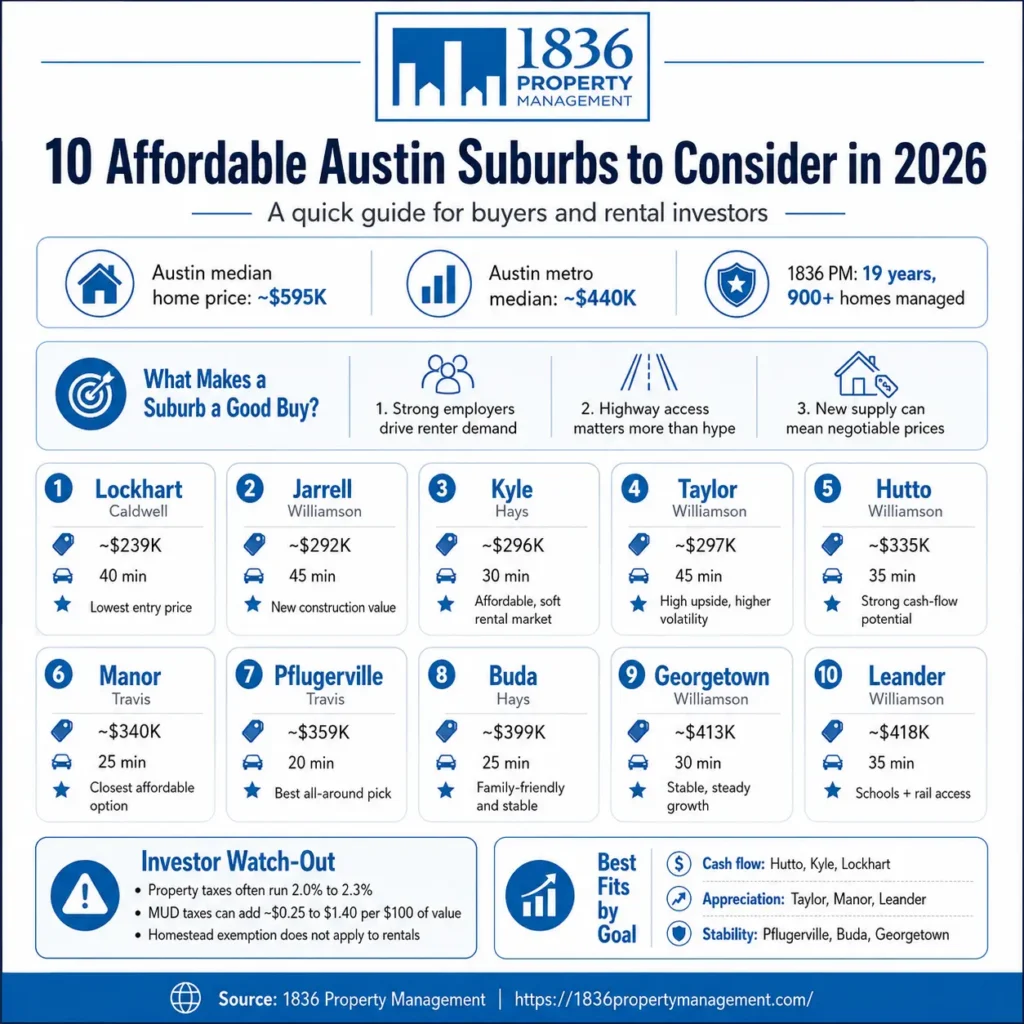
- Austin’s median sits near $595,000, but ten nearby suburbs range from roughly $239,000 to $418,000.Lockhart, Jarrell, Kyle, and Taylor all fall under $300,000.
- Cheapest is not the same as best. The suburbs that hold value are the ones anchored to a real employer, not just the ones with low sticker prices.
- Rents have softened across the suburbs, and homes are taking longer to lease. That makes purchase prices negotiable, but it also means pricing a rental at last cycle’s numbers is the fastest way to lose money to vacancy.
- Property taxes decide more than purchase price does. Effective rates run 2.0% to 2.3%, and a MUD district can add $0.25 to $1.40 per $100 of value, which can make a cheaper home cost more to hold than a pricier one.
- The homestead exemption does not apply to a rental, so your tax bill will likely be higher than what the previous owner paid.
- Match the suburb to the goal. Hutto, Kyle, and Lockhart lean cash flow. Taylor, Manor, and Leander lean appreciation. Pflugerville, Buda, and Georgetown lean stability.
Table of Contents
Why Affordable Housing in Austin Looks Different in 2026
The Austin market has changed a lot since 2022. Prices peaked, then reset. As of May 2026, the median home price inside the City of Austin sat near $595,000, while the wider metro median was closer to $440,000. Inventory has climbed too, with the Austin area running roughly 4.5 to 5 months of supply.
For buyers, that is good news. You have options and negotiating room that did not exist three years ago. We covered this in our breakdown of the Austin housing market.
However, rents have softened too. Median rents in several suburban markets are down slightly year over year, and homes sit longer before they lease. In our experience, that is not a reason to avoid these markets. It is a reason to price them correctly from day one. Owners who assume 2022 rents get burned. Owners who plan for today's numbers do fine.
What We Look At Before Calling a Suburb a Good Buy
A low price alone does not make a suburb worth buying. In our experience, three things separate a suburb that holds its value from one that is simply cheap.
Employers, not train stations. Samsung's plant in Taylor, Tesla's Gigafactory in southeast Travis County, Apple's Parmer Lane campus, and AMD in south Austin each anchor a corridor. Renter demand follows the commute.
Highway access. Two road networks carry most of this growth. I-35 forms the spine, running from Jarrell in the north down through Georgetown and Round Rock, then south past Buda and Kyle. Meanwhile, the toll network of SH 130, Toll 45, and 183A opened up the eastern and northwestern edges, which is what made Manor, Hutto, Taylor, and Leander realistic options at all. Drive times vary widely by route and time of day, so test your actual commute at rush hour before you commit.
New supply. Builders have been aggressive in Kyle, Buda, Hutto, and Pflugerville. That inventory pushed rents flat. It also makes purchase prices negotiable right now.
Because of that, the best suburbs near Austin are not always the cheapest. They are the ones where a real employer keeps the rental pool full.
10 Affordable Suburbs Near Austin to Consider
Here is a quick comparison, ordered from lowest entry price to highest.
| Suburb | County | Median sale price | Approx. drive to downtown |
|---|---|---|---|
| Lockhart | Caldwell | ~$239,000 | 40 min |
| Jarrell | Williamson | ~$292,000 | 45 min |
| Kyle | Hays | ~$296,000 | 30 min |
| Taylor | Williamson | ~$297,000 | 45 min |
| Hutto | Williamson | ~$335,000 | 35 min |
| Manor | Travis | ~$340,000 | 25 min |
| Pflugerville | Travis | ~$359,000 | 20 min |
| Buda | Hays | ~$399,000 | 25 min |
| Georgetown | Williamson | ~$413,000 | 30 min |
| Leander | Williamson | ~$418,000 | 35 min |
Prices reflect recent Redfin medians and move month to month. Drive times are approximate and vary a lot by route and time of day. Always check current numbers before you write an offer.
1. Lockhart: The Lowest Entry Price in the Metro
Lockhart has the lowest median sale price among the markets on this list. At roughly $239,000, its citywide median is less than half of Austin's. The city also has real character, including a walkable courthouse square and a barbecue scene that draws visitors statewide.
The trade-off is distance. At roughly 40 minutes out, Lockhart does not work for a daily downtown commuter. Renters here tend to be local families, Caldwell County workers, and people who want land without a Travis County price tag.
For investors, the low purchase price is the appeal. It is one of the few places left where a single-family rental can be bought without a large down payment. Just plan for a smaller rent number to match.
2. Jarrell: New Construction at a Lower Entry Price
Jarrell sits north on I-35, past Georgetown. At a median near $292,000, it is one of the last spots in Williamson County where builders still deliver new homes at entry-level prices. As a result, buyers who want a newer home rather than an older one have more to choose from here than in most of the metro.
That said, Jarrell is a long drive to central Austin. In our experience, renters here skew toward remote workers, families employed in Georgetown or Round Rock, and households who want a newer home over a shorter commute.
Watch the property taxes closely in Jarrell. Many of these newer subdivisions sit inside special taxing districts, which we explain further down.
3. Kyle: Cheapest Big Suburb, but Price It Right
Kyle is consistently one of the most affordable large suburbs in Austin's metro, with a median sale price near $296,000. It sits on I-35 south, roughly 30 minutes from downtown, and feeds workers to AMD and other south Austin employers.
Here is the honest part. Kyle currently has one of the softest rental markets in the region. Median rent runs near $1,725, down slightly from last year, and homes take around 56 days to lease. We have seen owners here lose more to two months of vacancy than they would have by pricing $75 under target from the start.
Because of that, Kyle rewards discipline. Buy well, price to the market, and it cash flows. Chase last year's rent and it sits. We would rather see a leased home at a fair rent than an empty one at a great rent.
4. Taylor: The Highest Upside and the Highest Volatility
Taylor is the most interesting market on this list. The median sits near $297,000, and Samsung's semiconductor campus here represents one of the largest private investments in Texas history. Samsung committed a minimum of $17 billion to the initial facility, with roughly 1,800 direct jobs expected within the first decade. The town is being rebuilt around it.
That creates real appreciation potential. It also creates real risk. Fab timelines shift. Hiring ramps slower than announced. Meanwhile, builders have already priced in a lot of optimism.
In our experience, Taylor works best for owners with a long horizon and enough reserves to ride out a slow year. It does not work for someone who needs perfect cash flow in month one.
5. Hutto: The Samsung Spillover Play
Hutto has one of the strongest rent-to-price ratios we see in the metro. The median sale price sits near $335,000, while median rents run around $2,000. For a cash-flow-focused owner, that gap is hard to beat. Builder starting prices run below the median, so a new three-bedroom can come in under that number in an active section.
The driver is Samsung's massive semiconductor investment in neighboring Taylor. Construction workers, technicians, and suppliers all need housing, and Hutto has more of it than Taylor does. Homes here also lease reasonably fast, at around 43 days on market.
Still, Hutto is not risk free. The thesis leans on one employer's timeline, and builders keep adding inventory, which caps rent growth. We would call it a strong cash-flow market and a moderate appreciation bet.
6. Manor: The Closest Affordable Suburb
Manor is the shortest commute on this list under $350,000, with a median near $340,000. It sits about 25 minutes from downtown along US 290 and SH 130, and it is the natural housing market for Tesla's Gigafactory workforce.
We wrote a full guide to the best neighborhoods for Tesla employees, and Manor comes up repeatedly. The tenant pool here is younger, more mobile, and heavily employed by a handful of large operations along the eastern corridor.
The trade-off is that Manor is still growing into itself. Retail and dining lag the housing, and schools are improving but do not yet match Round Rock or Leander ISD. For a cash-flow buyer who values commute over amenities, though, it is one of the better values in Travis County.
7. Pflugerville: The Best All-Around Pick
If we had to name one suburb that balances everything, it would be Pflugerville. The median sits near $359,000, which is well under both the city and the metro median. It also offers access to several major employment centers across North and East Austin, Round Rock, and Williamson County.
Rentals lease quickly here, at roughly 40 days, among the fastest in the metro. The renter pool is also more diverse than in single-employer towns, so demand does not vanish if one company slows hiring.
Pflugerville is not the cheapest option here. However, when we look at total returns rather than purchase price alone, it is consistently one of the strongest performers we manage.
8. Buda: Small-Town Feel, Faster Leasing
Buda sits just north of Kyle, but it is a materially more expensive market. The median here runs near $399,000, roughly $100,000 above Kyle. In exchange, homes lease faster here, at around 41 days, which puts Buda among the tightest suburban rental markets in the region.
The difference is location and character. Buda is closer to Austin, has a charming downtown, and pulls families who want a small-town feel without a long drive. In our experience, that means longer tenancies and fewer turnovers, which matters more to returns than the headline rent does.
For families buying a primary home, Buda remains one of the best suburbs of Austin for quality of life, and it still prices below the metro median. For investors, the calculation is tighter. You are paying a real premium over Kyle, so the faster lease-up and lower turnover have to earn it back. In our experience they usually do, but run the numbers rather than assuming.
9. Georgetown: Affordable, Stable, and Growing Fast
Georgetown sits at a median near $413,000. That is toward the top of this list, but it is still well below the Austin median, and it offers something the cheaper markets do not: stability.
Georgetown has one of the prettiest historic squares in Texas, a large active-adult community in Sun City, and growth that has repeatedly ranked it among the fastest-growing cities in the country. Crime is low and schools are solid.
For a family buying a primary home, this is one of the best suburbs near Austin. For investors, expect slower appreciation than Taylor or Hutto, but more predictable rent and lower vacancy.
10. Leander: New Construction With a Commuter Rail Line
Leander is the northern end of Austin's commuter rail, which makes it the only suburb on this list with a real transit connection to downtown. It also offers some of the best new construction value in the metro, plus access to highly rated Leander ISD schools.
For families, that combination is hard to beat. For investors, Leander attracts longer-term family renters who stay put for school reasons, which cuts turnover cost.
At a median near $418,000, Leander is the most expensive suburb here. Even so, the school district and rail access support both rents and resale value, and it still prices below the Austin metro median.
Not sure which of these fits your budget and goals? Talk with a professional property manager before you buy, not after.
The Property Tax Trap in Affordable Austin Suburbs
This is the part most guides leave out, and the biggest mistake we see new investors make.
Texas has no state income tax. In exchange, property taxes are high. Effective rates across the Austin area generally run between 2.0% and 2.3% of assessed value. You can look up the exact rate for any taxing unit through the Texas Comptroller's statewide list of tax rates.
But there is a second layer. Many newer subdivisions in Hutto, Kyle, Jarrell, and Manor sit inside a Municipal Utility District, or MUD. A MUD is a special district that borrows money to build water, sewer, and drainage systems, then repays those bonds through an extra property tax. MUD rates commonly run from about $0.25 to $1.40 per $100 of assessed value.
Here is why that matters. A newer $340,000 home inside a high-rate MUD can carry a bigger annual tax bill than a $400,000 home in an established neighborhood with no MUD. We have watched owners buy the cheaper house, celebrate the price, then wonder why the cash flow never showed up.
Two more points worth knowing:
- The homestead exemption does not apply to a rental. Whatever the previous owner paid, yours will likely be higher.
- Sellers must disclose the MUD. Texas law requires a notice to purchasers for property inside these districts, under Texas Water Code Chapter 49. Read it. Do not skim it.
1836 Insight: When we build a rental projection for an owner, we pull the actual tax bill from the county appraisal district rather than using a rule of thumb. On homes inside newer MUD subdivisions, that one step has changed the projected annual return by thousands of dollars. Our clients track this in real time through our REI Monitor dashboard, which reports return on equity rather than just gross rent. If you want to understand the math yourself first, start with our guide to rental property ROI.
Matching a Suburb to Your Goal
Not every affordable suburb fits every buyer. Here is how we sort them.
If you want cash flow first: Hutto, Kyle, and Lockhart offer the lowest entry prices on this list, which is usually where the strongest rent-to-price ratios show up. Expect slower appreciation and more attention to pricing.
If you want appreciation first: Taylor, Manor, and Leander sit closest to major employment and infrastructure growth. Expect thinner cash flow in the early years.
If you want stability first: Pflugerville and Buda are among the fastest-leasing suburban markets in the region, and Georgetown offers steady, predictable demand even though homes there sit longer before selling. Expect a higher purchase price for that reliability.
If you are buying a primary home for your family: Georgetown, Leander, and Buda give you the strongest combination of schools, amenities, and community feel at a price well under Austin proper. Round Rock and Cedar Park are worth a look too if your budget stretches a bit further.
You can compare current price and inventory trends for each county through the Central Texas Housing Report published monthly by the Austin Board of Realtors and Unlock MLS.
Frequently Asked Questions
What is the cheapest suburb near Austin?
Lockhart typically has the lowest median home price in the Austin area, at roughly $239,000. Jarrell, Kyle, and Taylor follow closely, all clustered near $292,000 to $297,000. Keep in mind that the cheapest purchase price does not always produce the best return once taxes and vacancy are factored in.
Which Austin suburb has the best rental returns?
There is no single Austin suburb with the best rental return for every property. Purchase price, actual achievable rent, taxes, insurance, HOA costs, maintenance, and vacancy can all change the result significantly. Hutto, Kyle, and other lower-cost markets can offer attractive numbers, but investors should analyze the individual property before buying.
Are Austin suburbs a good investment in 2026 if rents are falling?
They can be, but only with realistic numbers. Suburban rents are flat to slightly down, and homes are taking longer to lease than they did in 2022. However, purchase prices have come down too, and sellers are more willing to negotiate. In our experience, the owners who do well right now are the ones who buy at today's prices and budget for today's rents, not last cycle's.
How much are property taxes in the Austin suburbs?
Effective rates generally fall between 2.0% and 2.3% of assessed value. Homes inside a Municipal Utility District pay an additional amount, often between $0.25 and $1.40 per $100 of value. Always pull the specific tax bill for the property you are considering rather than estimating.
What is a MUD tax and why does it matter for a rental?
A MUD is a special district that funds water, sewer, and drainage infrastructure in developing areas by issuing bonds. Property owners inside the district repay those bonds through an extra line on their tax bill. Because homestead exemptions generally do not reduce MUD taxes, and because you cannot claim a homestead exemption on a rental at all, a MUD can meaningfully cut into your net return.
Should I rent out a suburban Austin home short term instead?
It depends on the property. Both strategies can work, and the right answer comes down to the specific home, its neighborhood, and your own goals. Short-term rentals can produce higher gross revenue, but they also carry higher operating costs, more hands-on management, and more regulatory risk. Long-term rentals trade some of that upside for steadier income and much less day-to-day work. We break the tradeoffs down in our comparison of Airbnb versus long-term rentals.
I already own a home in one of these suburbs. Should I sell it or rent it?
That depends heavily on your mortgage rate. If you locked in a rate around 3% or 4%, holding the property as a rental is often the stronger financial move even in a softer market. We walk through the full comparison in our guide to deciding to buy or sell.
Can I invest in Austin suburbs if I live outside the United States?
Yes. We work with owners around the world, and the rules are more manageable than most people expect. Our guide for foreign investors covers withholding, FIRPTA, and what you need before closing.
Does 1836 Property Management serve suburbs outside Austin?
Yes. We manage properties across 26 Central Texas communities, including every suburb listed in this article. You can see the full list on our Central Texas service page.
Get the Numbers Before You Get the Keys
The affordable Austin suburbs offer something the city cannot right now: an entry price that leaves room for a return. Still, affordability alone does not make a good investment. Taxes, tenant demand, and leasing speed decide whether a cheap house becomes a profitable one.
We have managed rentals through the 2021 boom, the 2023 correction, and the softer market we are in today. That is why we tell owners the uncomfortable parts up front. A well-priced home in Kyle beats an overpriced one in Pflugerville every time.
If you are weighing a purchase in any of these suburbs, get a free rental analysis first. We will tell you what the home should rent for, how long it should take to lease, and what the tax bill will really look like. Then you can decide with real numbers instead of estimates.