




TL;DR
Rental property ROI measures how much your property earns compared to what you put in. Most residential investors target a 6% to 10% return after expenses, with 10% or more considered strong. To calculate ROI, divide annual net profit by total cash invested and multiply by 100. Beyond basic ROI, smart landlords also track NOI, cap rate, cash-on-cash return, and return on equity to see the full picture. Quick rules like the 1%, 2%, and 7% rules help screen deals fast, but never replace a full analysis. The strongest returns come from buying right, managing well, and tracking the numbers over time.
Rental property ROI helps you see if a rental home, duplex, fourplex, or apartment building is truly working for you. At 1836 Property Management, we have worked with over 900+ Austin real estate investors since 2007, helping owners understand the numbers behind rental performance, not just the rent check.
In this guide, we will explain what ROI means, how to calculate it, and what a good return can look like for residential landlords. We will also cover NOI, cap rate, and the rules of thumb investors use to screen deals, plus how to push your numbers higher over time.
Table of Contents
What is rental property ROI?
Rental property ROI stands for return on investment. It measures how much money your rental property earns compared to how much money you put into it. In simple terms, ROI answers this question: "For every dollar I put into this property, how much am I getting back?"
That sounds simple, but many landlords only look at rent. That is a mistake. Rent is not the same as profit, and a rental can collect strong rent and still produce weak returns if the expenses are too high.
For example, you need to account for repairs, vacancy, property taxes, insurance, mortgage payments, leasing costs, management fees, and future capital expenses. You also need to think about appreciation, loan paydown, tax benefits, and your time. Because of this, rental property ROI should be viewed as a full picture, not a single rent number.
What is a good ROI on rental property?
Many investors ask, what is a good ROI on rental property? The honest answer is that it depends on the property, the market, the risk, and your goals.
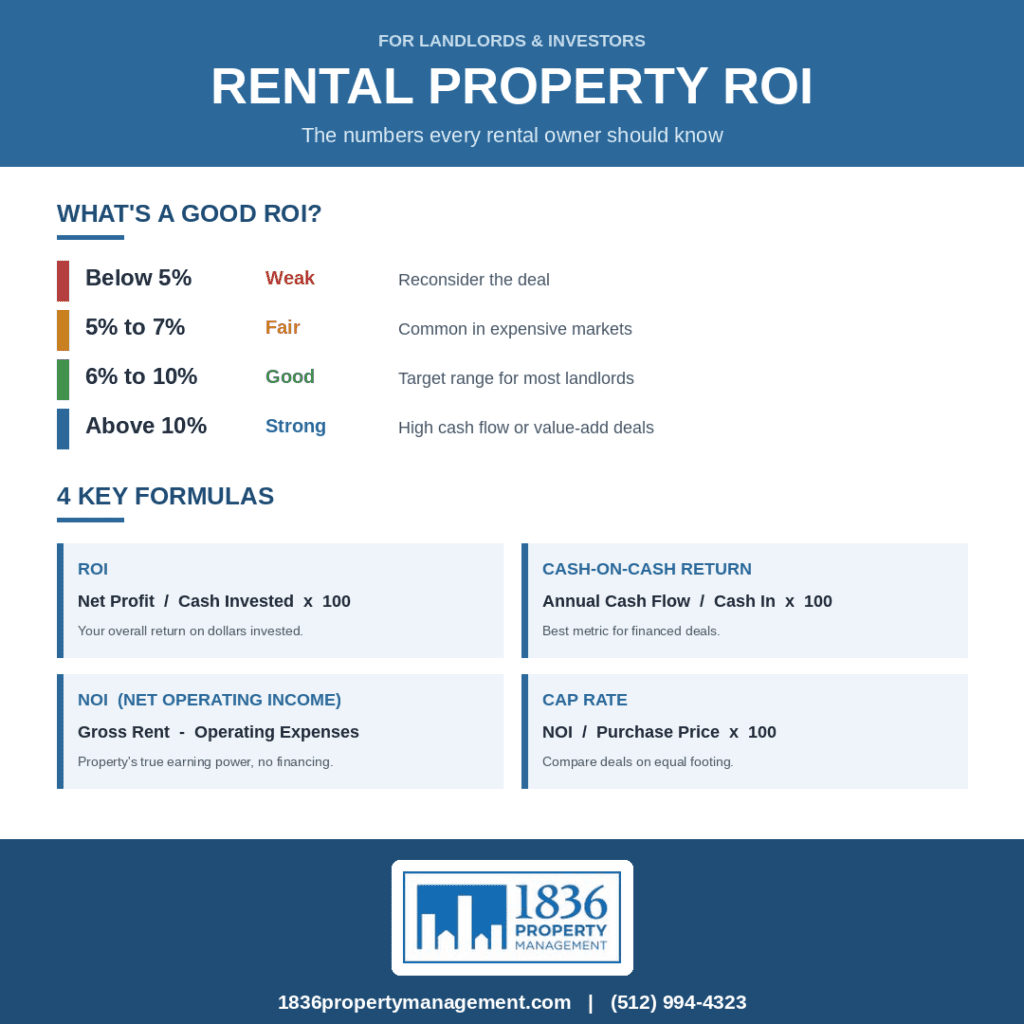
As a general guide, many residential investors look for a stable annual ROI around 6% to 10% after normal expenses. Some investors want 10% or more, especially if the property needs work, has more risk, or requires more active management. However, a lower first-year return may still make sense if the property has strong appreciation potential, low vacancy risk, or a clear long-term plan. Knowing how much to rent your property for is just one piece to the puzzle though.
A good return on rental property should do four things. First, it should cover your operating costs. Next, it should leave enough cash for repairs and reserves. Also, it should fit your risk level. Finally, it should help you build wealth over time.
In Austin and Central Texas, many investors look beyond first-year cash flow. They want a property that can grow in value, attract quality residents, and perform well over several years. That is why ROI should be measured with more than one metric.
How to calculate ROI on rental property
Here is the basic formula for how to calculate ROI on rental property: annual net profit divided by total cash invested, multiplied by 100.
For example, let's say you invest $100,000 in down payment, closing costs, and initial repairs. After all yearly income and expenses, your rental produces $8,000 in net profit. Your ROI would be 8%. The formula would look like this: $8,000 divided by $100,000 equals 0.08, then multiply by 100 to get an 8% ROI.
However, your formula is only as good as your numbers. Before you buy, estimate these costs as clearly as possible: monthly rent, vacancy, repairs, property taxes, insurance, HOA dues, utilities paid by the owner, leasing costs, property management, mortgage payments, and reserves. Also, remember that some costs do not happen every month. A roof, HVAC system, water heater, or major plumbing repair can change your return fast, so smart investors plan for both normal repairs and bigger future repairs.
A simple rental property ROI example
Let's look at a simple example. An investor buys a single-family rental for $400,000. The investor puts $80,000 down (a 20% down payment) plus $10,000 in closing costs and initial repairs, for a total of $90,000 invested. The home rents for $2,600 per month, or $31,200 per year.
Now subtract operating expenses. These may include property taxes, insurance, repairs, management, leasing, HOA fees, and vacancy. Let's say those costs total $12,000 per year, which leaves $19,200 before the mortgage. Next, subtract annual mortgage payments. If the yearly debt service is $15,000, the cash flow is $4,200. Divide $4,200 by the $90,000 invested, and you get a 4.7% cash-on-cash return.
At first, that may not look exciting. However, the full return may also include principal paydown, tax benefits, and appreciation. This is why investors should track more than cash flow alone.
How cash-on-cash return works
Cash-on-cash return is one of the most useful numbers for landlords with financing. It shows how much cash you earn compared to the cash you invested.
The formula is simple: annual pre-tax cash flow divided by total cash invested, multiplied by 100. For example, if you invest $80,000 and earn $6,400 in yearly cash flow, your cash-on-cash return is 8%.
This number matters because it shows how hard your actual cash is working. It is different from total ROI because it does not always include appreciation, tax benefits, or loan paydown. A cash-on-cash return analysis is helpful for comparing one deal to another, but it should not be the only number you use. A property with a lower cash-on-cash return may still be a strong long-term investment if it has low risk, strong demand, and good appreciation potential.
Net operating income (NOI) explained
Before you can measure return, you need to know what your property actually earns. Net operating income, or NOI, is the cleanest way to see that. It is the income left over after you subtract operating expenses from gross rental income, but before you subtract mortgage payments and income taxes.
The formula is: NOI = Gross Rental Income – Operating Expenses
Operating expenses include property taxes, insurance, repairs and maintenance, property management fees, vacancy losses, utilities paid by the owner, and HOA dues. They do not include the mortgage, capital improvements like a new roof, or depreciation. Those are separate categories.
Here is a quick example. Your property collects $36,000 in annual rent. After $12,000 in operating expenses, your NOI is $24,000.
NOI matters because it strips out financing and shows the true earning power of the property itself. Two investors can buy the same building, but one might pay cash and the other might use a 30-year loan. Their cash flow will look very different. However, the NOI will be the same. That makes NOI useful when you compare properties on equal footing, especially with multifamily and commercial deals. NOI also feeds directly into cap rate, which is the next number most investors check.
Capitalization rate (cap rate)
Capitalization rate, or cap rate, is one of the most common ways to compare rental properties, especially multifamily and small commercial deals. It shows what return a property would produce if you bought it in cash and ignored financing.
The formula is: Cap Rate = (NOI / Purchase Price) × 100
Using the earlier example, if your NOI is $24,000 and you bought the property for $400,000, your cap rate is 6%.
A higher cap rate usually points to more cash flow, more risk, or both. A lower cap rate often points to stable, lower-risk properties in desirable areas. In high-demand markets like Austin, cap rates run lower than national averages. Single-family rentals often fall in the 4% to 6% range, while small multifamily properties may run 6% to 8%. These ranges shift with interest rates, demand, and market conditions, so always check current local data.
Cap rate has limits, though. It does not factor in financing, appreciation, or tax benefits. It also depends on accurate NOI numbers. A seller’s pro forma NOI is rarely the same as the real one, so always verify income and expenses with actual statements before trusting any cap rate.
ROI vs. return on equity
ROI and return on equity are related, but they are not the same. ROI usually looks at your return compared to your original investment. Return on equity looks at your return compared to your current equity in the property.
This matters because your equity can grow over time as your loan balance goes down and your property value rises. As a result, your return on equity can change. For example, a property may have been a great deal when you bought it, but after several years, you may have a lot of equity sitting in the home. If the cash flow is low, your return on equity may be weaker than you think.
That is why we give investors tools to track your return on equity in real time. With better data, owners can make better decisions about holding, selling, refinancing, or improving a property.
Key performance indicators for rental property
Strong investors track trends, not single months. Beyond ROI, NOI, cap rate, cash-on-cash return, and ROE, the most useful key performance indicators for rental property include vacancy, days on market, renewal rate, delinquent rent, and maintenance costs. A high rent is not helpful if the property sits empty for two months, and a low maintenance month does not mean the property is cheap to own forever. A full year of clean data shows whether your property is improving or falling behind.
What impacts rental property ROI?
Several factors can raise or lower your ROI. Some are easy to see, others are hidden until they cost you money.
The first factors are purchase price and rent. If you overpay, it is harder to earn a good return. You also need enough income to support the property, but pushing rent too high can create longer vacancy. Vacancy itself is a major factor, since a vacant property produces no rent but still costs money. You still pay the mortgage, taxes, insurance, utilities, lawn care, and repairs. Reducing vacancy is one of the fastest ways to protect ROI.
Maintenance is another major factor. Many owners use the 1% rule for property maintenance as a starting point, which suggests setting aside about 1% of the property value each year. Older properties, luxury homes, and properties with older systems may need more.
Tenant quality and legal compliance matter too. A well-screened resident reduces missed rent, property damage, and legal costs, but landlords must follow fair housing rules. The HUD Fair Housing Act overview explains that fair housing protections apply to renting, buying, mortgage activity, and other housing-related actions. In Texas, Texas Property Code Chapter 92 covers repairs, security deposits, smoke alarms, and other rental rules. This is one reason professional management can be so valuable.
Single-family rental investing
Single-family homes are often a good starting point for new landlords. They are easier to understand than large apartment buildings, and they may also attract residents who want more space, a yard, and a longer stay.
With single-family rental investing, the biggest risk is simple. If the home is vacant, the property is 100% vacant. There is no second or third unit to help cover the cost.
Still, single-family homes can be strong long-term investments. They may offer appreciation, lower turnover, and broad resale demand. They can also be easier to finance than larger multifamily deals. For many Austin investors, single-family homes work best when the rent is realistic, the property condition is strong, and the owner has a clear plan for maintenance and renewals.
Investing in multifamily property
Multifamily properties include duplexes, triplexes, fourplexes, and apartment buildings. These properties can offer more income streams under one roof.
When investing in multifamily property, vacancy risk is spread across more units. For example, if one unit in a fourplex is empty, the other three may still produce income. This can make cash flow more stable.
However, multifamily properties also bring more work. There may be more maintenance requests, more leases, more resident issues, and more systems to manage. Repairs may also be more expensive because more people depend on the same building systems. Multifamily investors should review income, expenses, rent rolls, leases, repair history, insurance, taxes, and future capital needs before buying. A deal can look good on paper and still perform poorly if expenses are not measured correctly.
Real estate investor rules of thumb
Real estate investors often use simple rules to screen deals quickly. These rules help you size up a property in seconds, but they leave out taxes, insurance, repairs, vacancy, financing, and management. Always treat them as a starting point, not a final answer.
What is the 1% rule for rental properties?
The 1% rule usually says monthly rent should equal about 1% of the purchase price. For example, a $300,000 property would need about $3,000 in monthly rent. In many strong markets, this can be hard to find. Also, a property that meets the 1% rule may still have high repair costs or higher risk.
What is the 2% rule for properties?
The 2% rule says monthly rent should equal about 2% of the purchase price. This is rare in many modern markets. If you find a property that meets the 2% rule, look closely at condition, location, tenant demand, and safety. A high rent-to-price ratio can sometimes point to higher risk.
What is the 7% rule for rental properties?
The 7% rule often refers to gross rental yield. Under this rule, annual rent should equal at least 7% of the purchase price. For example, a $400,000 home that rents for $2,500 per month has $30,000 in annual rent, which creates a 7.5% gross yield.
Tax benefits and rental property ROI
Taxes can affect your return. Rental owners may be able to deduct certain expenses, including management fees, repairs, mortgage interest, insurance, and depreciation. The IRS explains rental income, expenses, and depreciation in Publication 527. You can also learn more about rental property tax deductions and the tax advantages of rental property.
That said, you should not buy a rental only for tax benefits. A rental property should make sense before taxes, because tax advantages can improve a good deal but cannot save a weak one. Always speak with a qualified tax professional before making tax decisions.
Location and Austin rental property performance
Location has a major impact on rental property ROI. A good property in the wrong location can struggle, while a simple property in a strong location can perform well. Look at job centers, school access, commute routes, nearby shopping, future development, crime trends, and tenant demand. Compare the rent to similar properties nearby, and do not rely only on national averages.
The U.S. Census Bureau publishes Housing Vacancies and Homeownership data, which can help investors understand broader vacancy trends. However, local data matters most when buying or pricing a rental. In Austin, neighborhood choice can shape both rent and long-term value. Investors can start by studying Austin's top neighborhoods and then compare each area to their budget, cash flow goals, and risk level.
How property management can improve rental property ROI
A top-tier property management company cannot change a bad purchase price, but it can protect and improve the performance of a good rental property in several ways.
First, professional pricing reduces vacancy by using market data, property condition, and real demand. Strong marketing then attracts better applicants faster through good photos, clear listings, and quick response times. Tenant screening reduces risk by helping protect owners from missed rent, lease breaks, and avoidable problems, but it must be fair and consistent.
Maintenance systems matter too. Small repairs become large repairs when ignored, so clear communication, vendor coordination, and repair tracking protect both the property and the resident experience. Finally, reporting matters, because a landlord cannot improve what they do not measure. Through real estate investment management, we help owners track the right numbers and make better long-term decisions.
Building long-term wealth with rental property
Successful rental investing is not only about buying a property and collecting rent. It is about owning the right property, at the right price, with the right plan. A successful investor knows the expected rent, likely expenses, repair needs, vacancy risk, financing terms, and exit options. They also keep reserves and do not spend every dollar of cash flow.
For single-family homes, success looks like steady rent, low turnover, long-term appreciation, and a resident who takes care of the home. For multifamily properties, success looks like strong occupancy, clean books, fair market rents, controlled expenses, and planned capital improvements. In both cases, the goal is the same. You want a property that supports your financial goals without creating constant stress.
Rental property ROI is one of the most important numbers for landlords and investors, but it should not be the only number you review. If you are buying your first rental or growing a portfolio, we can help you understand the numbers behind the property. With local Austin experience, investor-focused reporting, and professional management systems, our team helps rental owners work toward stronger long-term performance.
FAQ
What is a good ROI on rental property?
A good ROI on rental property often depends on the market, property type, financing, and risk. Many investors look for 6% to 10% or more after expenses. However, a lower first-year return may still be acceptable if the property has strong appreciation, low vacancy risk, or a clear long-term plan.
How do you calculate rental property ROI?
To calculate rental property ROI, divide annual net profit by total cash invested. Then multiply the result by 100. For example, if your property earns $8,000 per year after expenses and you invested $100,000, your ROI is 8%.
What is NOI on a rental property?
NOI stands for net operating income. It is gross rental income minus operating expenses, but before mortgage payments and income taxes. NOI shows the true earning power of the property itself, separate from how it is financed.
What is a good cap rate for rental property?
Cap rate equals NOI divided by the purchase price. A good cap rate depends on the market and property type. In high-demand metros like Austin, cap rates often run 4% to 6% for single-family rentals and 6% to 8% for small multifamily, though these shift with interest rates and demand.
What is cash-on-cash return rental property analysis?
Cash-on-cash return measures annual cash flow compared to the cash you invested. It is helpful when you use a mortgage. For example, if you invest $80,000 and earn $6,400 in yearly cash flow, your cash-on-cash return is 8%.
What is the 7% rule for rental properties?
The 7% rule usually means annual rent should equal at least 7% of the purchase price. For example, a $400,000 property would need at least $28,000 in annual rent. That equals about $2,333 per month. This is only a quick screening tool, not a full ROI analysis.
What is the 2% rule for properties?
The 2% rule says monthly rent should equal about 2% of the purchase price. For example, a $200,000 property would need $4,000 in monthly rent. This is rare in many markets and may point to higher-risk properties. Always review expenses, condition, and tenant demand.
Is it wise to invest in a rental property?
It can be wise to invest in a rental property if the numbers work and you understand the risks. A strong rental can create cash flow, appreciation, tax benefits, and long-term wealth. However, a poor deal can create stress, repairs, vacancies, and losses. Always review ROI before buying.
Can property management improve rental property ROI?
Yes, strong property management can help improve ROI by reducing vacancy, pricing the rental correctly, screening residents, handling repairs, tracking performance, and helping owners avoid costly mistakes. Good management is not just an expense. It can be part of a stronger investment strategy.