






Key Takeaways
- Foreign owners are not exempt from U.S. tax on rental income. Rent from U.S. property is U.S. source income, so it is taxable here.
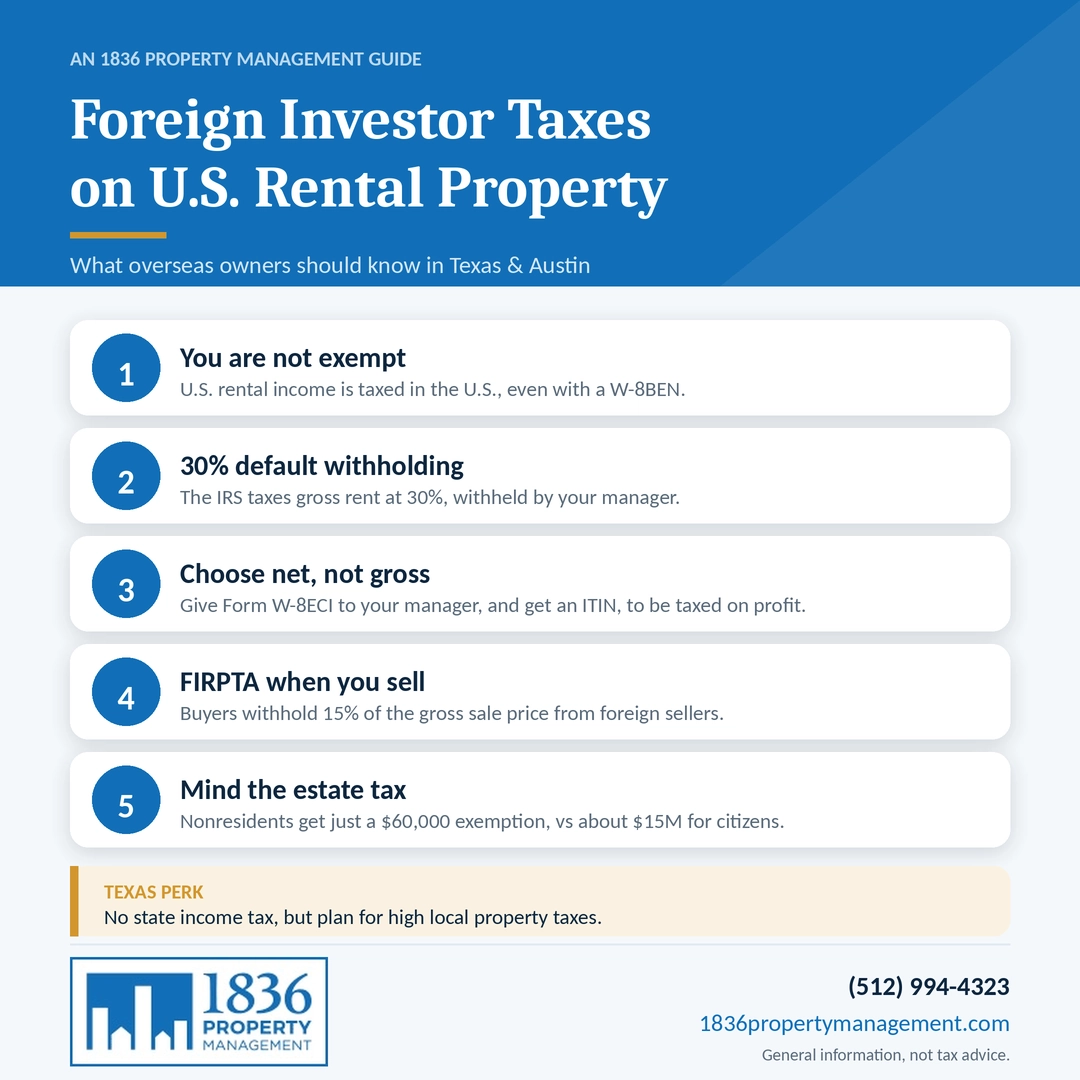
- By default, the IRS withholds 30% of your gross rent. However, you can elect to be taxed on net income instead, which usually costs far less.
- To make that election, file Form W-8ECI with your manager. You will need a U.S. tax ID first, an ITIN for individuals or an EIN for an entity.
- When you sell, FIRPTA withholds 15% of the gross sales price at closing. You often recover the extra after you file.
- U.S. estate tax hits foreign owners hard. Nonresidents get only a $60,000 exemption versus about $15 million for citizens, so ownership structure matters.
- Texas has no state income tax, but Austin-area property taxes can be high. Confirm the rate for your exact address before you buy.
If you live abroad and own a rental home in the United States, you probably have questions about foreign investor taxes on rental property. You are not alone, and the rules are not always clear. In fact, according to the National Association of Realtors, foreign buyers purchased about $56 billion of U.S. existing homes in one recent year. The good news is that rental income tax for foreign owners becomes manageable once you understand the basics. At 1836 Property Management, we have managed rental properties across the Austin area since 2006, and today we oversee over 900 properties. In addition, we work with investors from Canada, Mexico, the United Kingdom, and beyond, so our international investor experience shapes this guide. Below, we explain what you owe, which forms you need, and how Texas and Austin compare.
For Austin-area investors, the main tax picture includes federal rental income tax, IRS withholding rules, Texas property taxes, and FIRPTA when the property is sold. Texas does not have a state income tax, but Austin-area property taxes can still be a major cost to plan for before buying.
Please note that this article is general information, not tax or legal advice. International tax can get complicated, so always confirm your plan with a qualified CPA or tax attorney before you act.
Table of Contents
Are Foreign Owners Exempt From U.S. Tax on Rental Income?
This is the most common question we hear, so let us answer it plainly. No, foreign owners are not exempt from U.S. tax on rental income.
Many new clients tell us something like this: "I filled out Form W-8BEN, so I only pay tax in my home country." Unfortunately, that is a myth. Form W-8BEN does not remove your U.S. tax duty on rent. In fact, if your rental income from U.S. real property is not treated as effectively connected income, the IRS generally taxes it at 30%, or a lower treaty rate if one applies. Either way, the income is taxable in the United States.
Here is the key rule. Rental income from U.S. real estate, and the gain from selling that real estate, is always U.S. source income. So it is taxed in the United States. This is true no matter your personal tax status. A tax treaty does not usually make U.S. rental income disappear, although it may affect the rate or how double taxation is handled. In short, owning the property in the U.S. is what triggers the tax, not where you live.
In our experience, this misunderstanding can be costly. We had one client who received wrong information from a CPA about a W-8BEN form, and they spent months tied up straightening it out with the IRS. The lesson is simple. The W-8BEN myth is common, but it can be costly. So work with advisors who truly understand cross-border rules, and make sure your withholding and forms are correct from day one.
How Foreign Investor Taxes on Rental Property Work: The 30% Withholding Rule
By default, the IRS applies a flat 30% withholding tax to your gross rent. Notice the word "gross." That means the tax applies to every dollar of rent collected, before you subtract the mortgage, property taxes, repairs, insurance, or management fees. You can learn more on the IRS page about the taxation of nonresident aliens.
Now here is the part that surprises many property managers. The law makes the payor, which is the property management company, responsible for collecting and sending that 30% to the IRS. In tax language, a manager who collects rent for a foreign owner is a "withholding agent." A withholding agent is personally liable for tax that should have been withheld, plus interest and penalties. Because of this, a careful manager will not simply send all of the rent abroad without the right paperwork.
Each year, the manager must report the gross rent and any tax withheld on Form 1042-S. This form is due by March 15 of the following year. Also, the form is required even in years when no tax was withheld.
This is a big difference between foreign and domestic owners. A domestic owner reports rent on a normal tax return and pays tax only on the net profit. In addition, no one withholds 30% of a domestic owner's rent up front. So foreign owners face an extra step that local owners do not.
Rental Income Tax for Foreign Property Owners: The Effectively Connected Income Option
The 30% tax on gross rent is almost always a worse deal than it needs to be, because it ignores your expenses. Luckily, there is a better path. Foreign owners can choose to treat rental income as "effectively connected" with a U.S. trade or business. The IRS explains this choice on its page about effectively connected income.
When you make this election, the math changes in your favor. You are taxed on your net income, not your gross rent. So you can subtract deductible rental expenses like management fees, along with mortgage interest, property taxes, insurance, repairs, and depreciation. Then you pay tax on what is left, at the normal graduated rates. You report all of this on Form 1040-NR, the nonresident tax return. For many rentals, the taxable amount is small or even zero in the early years once depreciation is counted.
To stop the 30% withholding, you give your property manager a completed Form W-8ECI. Be careful here, because this is a different form from the W-8BEN. A valid W-8ECI requires a U.S. taxpayer identification number. One more point matters. Once you make this election, you generally cannot reverse it without the IRS giving permission, so make the choice with care.
In our experience, this election is the single biggest money-saver for our foreign clients. Most owners we work with move from the 30% gross tax to a much smaller net tax once their W-8ECI and tax ID are in place.
You May Need an ITIN, EIN, or Other U.S. Tax ID
To complete Form W-8ECI and file your tax return, you need a U.S. taxpayer ID. For most individual foreign owners who are not eligible for a Social Security Number, that means an Individual Taxpayer Identification Number, often called an ITIN. You apply for one with Form W-7. If you own through a company instead, the entity may need an Employer Identification Number, or EIN, rather than an ITIN. The IRS has a full guide to the Individual Taxpayer Identification Number.
There is one helpful exception. Some foreign owners already have a U.S. Social Security Number, perhaps from time spent studying at a U.S. university. If you have an SSN, you do not need an ITIN. Instead, you can use the SSN to complete your W-8ECI. Either way, once you receive your tax ID and submit the W-8ECI to your manager, the 30% withholding can stop.
This is another contrast with domestic owners. A U.S. citizen or resident already has an SSN and files a standard return. A foreign owner must take the extra step of getting an ITIN first. So planning early helps you avoid months of withholding while you wait.
Selling Later: FIRPTA and Foreigners Selling Property in the USA
Withholding does not end with rent. It also appears when you sell. A law called FIRPTA, the Foreign Investment in Real Property Tax Act, applies to a non-resident sale of residential property. Under FIRPTA, the buyer generally must withhold 15% of the gross sales price and send it to the IRS at closing. You can read the details on the IRS page about FIRPTA withholding.
Here are a few points to keep in mind for foreigners selling property in the USA:
- The 15% is a deposit against your real tax, not the final bill. Your true tax is based on your net gain, which you report on Form 1040-NR. So you often get a refund of the extra amount after you file.
- If you expect your real tax to be much less than 15% of the price, you can apply for a reduced withholding certificate with Form 8288-B. However, the IRS can take about 90 days to process it, so start early.
- If you reinvest in another property, a 1031 like-kind exchange can defer the gain. This can be a powerful tool, but the rules are strict, so plan it with a professional.
Once again, foreign and domestic sellers differ. A U.S. seller can sign a simple affidavit stating they are not a foreign person, and then no FIRPTA withholding applies. A foreign seller cannot use that shortcut, so the 15% rule kicks in unless an exception applies.
The Big Surprise: U.S. Estate Tax for Foreign Property Owners
This is the issue we most wish foreign owners understood sooner. U.S. estate tax for foreign property owners is very different from the rules for citizens.
A U.S. citizen or U.S. resident has a large estate tax exemption, about $15 million in 2026 under current law. A nonresident foreign owner, however, gets an exemption of only $60,000 on their U.S. assets. Directly owned U.S. real estate is generally treated as a U.S.-situs asset for estate tax purposes. So any value above that $60,000 can be taxed at rates up to 40% when the owner passes away. On top of that, the heirs must file Form 706-NA and get IRS clearance before they can fully access the property.
Because of this gap, the way you own the property matters a great deal. Holding U.S. real estate in your personal name puts the most value at risk. As a result, many international investors use a structure, often involving a U.S. entity, to manage this exposure. If you go this route, please get cross-border advice first, since the wrong structure can create more tax, not less.
One more compliance note belongs here. If you own through a U.S. LLC, be aware of the paperwork. A foreign-owned single-member LLC usually must file Form 5472 with a pro forma Form 1120 every year, even with no income. The penalty for missing it starts at $25,000 per year. So if you are setting up an LLC for your rental, make sure this filing is on your calendar.
Foreign Investor Taxes on Rental Property in Texas and Austin
Now let us look at the local picture, because this is where Austin works in your favor, with one catch.
First, the good news. Texas has no state income tax. The state also has no capital gains tax and no state estate or inheritance tax. So the income tax conversation above is purely federal. You will not stack a state income tax on top of it, the way you might in California or New York. This is a real advantage, and it is one reason why Austin remains a strong investment market.
Now the catch. Texas funds local services mostly through property taxes, and rates in the Austin area can be high. As the Texas Comptroller explains, Texas has no state property tax, and local taxing units set the rates instead. So Austin-area property tax rates vary by property location and taxing units. Because of this, investors should confirm the current rate for the exact address before buying. The bill can add up quickly, so plan for the full property tax amount in every deal.
Foreign owner property tax in Austin works the same as it does for local investors, which surprises some clients. The Texas homestead exemption only applies to a primary residence, so a rental property does not qualify for it. That is true for foreign and domestic investors alike. The good news is that you can protest your appraisal to lower the bill each year, and in a fast-rising market, a good protest can save real money.
Foreign vs Domestic Investors at a Glance
In our experience, a quick side-by-side helps owners see the extra steps clearly.
| Topic | Domestic investor | Foreign investor |
|---|---|---|
| Tax ID | Uses an SSN | Usually needs an ITIN (Form W-7) |
| Rental income tax | Pays tax on net profit | 30% on gross rent by default, or net tax with a W-8ECI election |
| Withholding by manager | None | 30% unless a valid W-8ECI is on file |
| Tax return | Form 1040 | Form 1040-NR |
| Selling the property | Signs a non-foreign affidavit, no FIRPTA | 15% FIRPTA withholding may apply |
| Estate tax exemption | About $15 million in 2026 | Only $60,000 on U.S. assets |
| Texas property tax | Same rules | Same rules |
Foreign Investor Tax Checklist for Austin Rental Property Owners
Before you buy or rent out an Austin property, run through this quick checklist:
- Confirm your U.S. tax status as a nonresident or resident, because it changes which forms you file.
- Apply for a U.S. tax ID early, an ITIN for individuals or an EIN for an entity.
- Ask your CPA about the Section 871(d) election, which lets you be taxed on net rental income instead of 30% of gross rent.
- Provide Form W-8ECI to your property manager if you make that election.
- Keep clear records of all rental income and expenses.
- Budget for Texas property taxes, and confirm the current rate for your exact address.
- Plan for FIRPTA before you sell, and ask about a 1031 exchange or a reduced withholding certificate.
Let's Make Your Austin Rental Simple
Owning U.S. rental property from abroad does not have to be stressful. With the right forms in place and a local partner on your side, you can stay compliant, avoid the 30% surprise, and keep more of your rental income. At 1836 Property Management, we have helped investors from across the world manage their Austin-area rentals with confidence.
So if you are ready for clear answers and hands-off management, contact our team today. We will walk you through your next steps and help you protect both your property and your peace of mind.
Frequently Asked Questions
Are foreign owners exempt from U.S. tax on rental income?
No. Foreign owners are not exempt. Rental income from U.S. real estate is U.S. source income, so it is taxable in the United States. This holds true even if you completed a W-8BEN and even if your country has a tax treaty with the U.S.
How are foreign investors taxed on rental income?
By default, the IRS withholds a flat 30% of your gross rent. However, you can elect to treat the rent as effectively connected income and provide Form W-8ECI to your property manager. Then you pay tax on your net profit at graduated rates, which is usually much lower.
What is the difference between Form W-8BEN and Form W-8ECI?
The W-8BEN does not stop withholding on rental income, despite a common myth. By contrast, Form W-8ECI lets you be taxed on net income and stops the 30% withholding. You need a U.S. tax ID to complete a valid W-8ECI.
Can foreign rental income be taxed twice?
Sometimes there is a risk of double taxation, since your home country may also tax the income. However, many tax treaties and foreign tax credits help offset U.S. tax against home-country tax. The result depends on your country, so a cross-border CPA can confirm your situation.
How are foreigners taxed when selling property in the USA?
Under FIRPTA, the buyer usually withholds 15% of the gross sales price at closing. This is a deposit, not the final tax. You report your actual gain on Form 1040-NR, and you often receive a refund of the extra amount after filing.
How do I get an ITIN as a foreign investor?
You apply for an Individual Taxpayer Identification Number using Form W-7. If you already have a U.S. Social Security Number, you can use that instead. Once you have a tax ID and give your W-8ECI to your manager, the 30% withholding can stop.
Does Texas tax rental income at the state level?
No. Texas has no state income tax, no capital gains tax, and no state estate tax. So your income tax duty is federal only. Keep in mind, though, that Texas property taxes are high, especially in the Austin area.
What estate tax do foreign property owners face?
A nonresident foreign owner has a U.S. estate tax exemption of only $60,000, while U.S. citizens and residents have about $15 million in 2026 under current law. U.S. real estate above $60,000 can be taxed up to 40%. Because of this, ownership structure and planning are very important.