



Key Takeaways
- Meta’s Austin offices are downtown (300 W 6th Street and Third + Shoal Tower)
- Best overall: East Austin
- Best for families: Mueller or Tarrytown
- Best value: Cedar Park or Round Rock
- Best luxury: Tarrytown or Westlake
- Rent for a year before buying. The 2026 market favors patient buyers.
If you work at Meta in Austin, or are about to, choosing where to live is one of the biggest decisions you will make. The best neighborhoods for Meta employees in Austin all sit close to downtown, where Meta's main offices are. Each one has a different vibe, price point, and tradeoff. If you are trying to decide where to live in Austin, this guide breaks down the best neighborhoods in Austin for Meta employees based on commute time, lifestyle, rent ranges, and long-term buying potential.
At 1836 Property Management, we have been helping Austin renters, buyers, and investors find the right neighborhood since 2006. We currently manage over 900 properties across the greater Austin area, including homes in Cedar Park, Round Rock, and Westlake, among many other neighborhoods covered in this guide. Our team lives and works in the same neighborhoods we cover. As a result, we have deep local knowledge of rental pricing, neighborhood character, and the practical tradeoffs that matter most when choosing where to live in Austin. We have pulled all of that into one guide so you can make the right call the first time.
If you also work in tech and want to compare options across employers, see our guide for Apple employees, which covers neighborhoods near Apple's North Austin campus instead.
Table of Contents
- Why Commute Matters Again in 2026
- Understanding Meta’s Austin Offices
- The Commute Reality for Meta Employees
- Best Overall Neighborhoods for Meta Employees
- How to Calculate What Your Commute Is Actually Worth
- Best Neighborhoods Near Meta’s Downtown Austin Offices
- Best Neighborhoods to Rent Near Meta’s Austin Offices
- Best Neighborhoods to Buy Near Meta’s Austin Offices
- The Rent-First-Then-Buy Strategy
- What If You Already Own a Home Somewhere Else?
- Frequently Asked Questions
- The Bottom Line
Why Commute Matters Again in 2026
A few years ago, Meta employees in Austin had a lot of flexibility about where to live. Many took advantage of remote work and lived far from the office. That window has narrowed.
Meta's "In-Person Time Policy" requires most employees assigned to an office to be there at least three days a week, as Entrepreneur reported. This has been the standard since September 2023. As of February 2, 2026, Instagram employees in the U.S. moved to a stricter five-day-a-week in-office mandate, according to CNBC. The rest of Meta, including Facebook, WhatsApp, and Reality Labs, remains on the three-day hybrid schedule for now. Apple, Google, and Amazon have all tightened their return-to-office policies, too.
Whether you spend three days or five days a week downtown, the commute really matters again. Below, we walk through where Meta's offices are, the commute reality, the math to run before signing a lease or making an offer, and the neighborhoods that make the most sense for Meta employees today.
Understanding Meta's Austin Offices
Meta's main Austin presence is in downtown Austin, not in The Domain or the north suburbs. This is a big shift from a few years ago. Meta previously leased Domain 12 in North Austin, but IBM officially took over that lease in January 2026. Today, Meta's Austin office presence is centered around two downtown buildings:
- 300 West 6th Street, in the heart of downtown
- Third + Shoal Tower at 607 West 3rd Street, four blocks away
According to reporting from The Real Deal, Meta has around 1,500 employees in the Austin metro, with most working out of these two towers. Meta also leases space at Sixth and Guadalupe (400 West 6th Street), but most of that space is currently subleased to other companies.
The downtown location really matters. Unlike Apple, which has a huge campus in far Northwest Austin, Meta's offices sit right in the urban core. That changes which neighborhoods make sense. Living in North Austin and commuting to downtown is doable but painful in traffic. Living in central, east, or south Austin puts you close to the office. We will cover all of this below.
The Commute Reality for Meta Employees
Austin traffic is notoriously bad, especially during morning and evening rush hours. A drive that takes 12 minutes at 6 a.m. can take 35 minutes at 5:30 p.m. Meta's downtown location sits at the intersection of several busy corridors, including Mopac (Loop 1), I-35, and Lamar Boulevard.
Three things are worth knowing before you pick a neighborhood:
Google Maps is often optimistic. Traffic estimates tend to run 10 to 20 percent low for Austin's worst corridors during real rush hour. Check your route during 7:30 to 9:00 a.m. and 4:30 to 6:30 p.m. for a realistic number.
I-35 construction runs through 2033. The Capital Express Central project is a $4.5 billion TxDOT effort that will add delays for any commute touching the interstate. Many downtown Austin commuters avoid I-35 entirely and use Mopac, Lamar Boulevard, or surface streets instead.
Living close to downtown means you can walk, bike, or scooter. This is a real advantage Meta employees have over Apple employees. Anyone living in downtown, Rainey Street, East Austin, Bouldin Creek, or Clarksville can often skip a car commute entirely. That changes the math on rent vs. mortgage in those areas.
Best Overall Neighborhoods for Meta Employees
Want the short answer before reading the full breakdown? Here are our top picks by category:
- Best overall: East Austin
- Shortest commute: Downtown or East Austin
- Best for families: Mueller or Tarrytown
- Classic Austin character: South Congress, Travis Heights, or Hyde Park
- Best value: Cedar Park or Round Rock
- Best luxury: Tarrytown or Westlake
- Lake access and Hill Country: Lakeway or Bee Cave
Although this guide is written for Meta employees, many of the same neighborhoods also work well for Austin tech workers based downtown. East Austin, South Congress, Mueller, Hyde Park, and Tarrytown all offer a strong mix of commute convenience, rental options, restaurants, and long-term resale appeal.
Keep reading for the full pros, cons, and price ranges of each.
How to Calculate What Your Commute Is Actually Worth
Most people think about housing as just a rent or mortgage number. That misses something important. A 30-minute longer commute each way costs you about 250 hours a year, or roughly six full work weeks. For a salaried tech employee, that time has a real dollar value.
The Math
Here is the simple math:
| Step | How to Calculate |
|---|---|
| Daily commute savings | (Longer commute minus shorter commute) x 2 trips |
| Annual hours saved | Daily savings divided by 60, then times 250 work days |
| Dollar value of your time | Annual hours times (your salary divided by 2,080 work hours) |
| Monthly time value | Dollar value divided by 12 |
| Compare to housing premium | If monthly time value beats the housing premium, the closer option wins |
Quick example. Say you earn $200,000 a year, which is about $96 an hour. You are choosing between a $2,800 a month apartment in East Austin with a 10-minute commute, and a $2,000 a month apartment in Round Rock with a 40-minute commute.
- Daily savings of the closer option: 60 minutes
- Annual hours saved: about 250 hours
- Time value: about $24,000 a year, or $2,000 a month
- Housing premium: $800 a month
- Net benefit of the closer apartment: about $1,200 a month in time value
Why This Matters More When You Buy
That math becomes even more important if you are buying. You will live in a home for years, not months. So a 30-minute longer commute compounds across the whole time you live there. If you are seriously considering a longer commute to save on housing, run the numbers before you sign anything.
The math is not just about money, either. A shorter commute means more sleep, less stress, and more time with family or for the things you actually enjoy. Research consistently links long commutes to lower happiness and higher rates of burnout. So the wellbeing case for living closer to work is real, even when the dollar math is close.
Run Your Own Numbers
Want to see the actual dollar cost of your commute, including gas, vehicle wear, and parking? The Commute Cost Calculator from CAPCOG is built for Central Texas. It gives you a monthly cost estimate based on your route and vehicle.
Best Neighborhoods Near Meta's Downtown Austin Offices
Because Meta's offices sit in downtown Austin, the best neighborhoods for Meta employees are almost all in central, east, and south Austin. If your priority is a short, reliable commute, this is the part of the city to focus on.
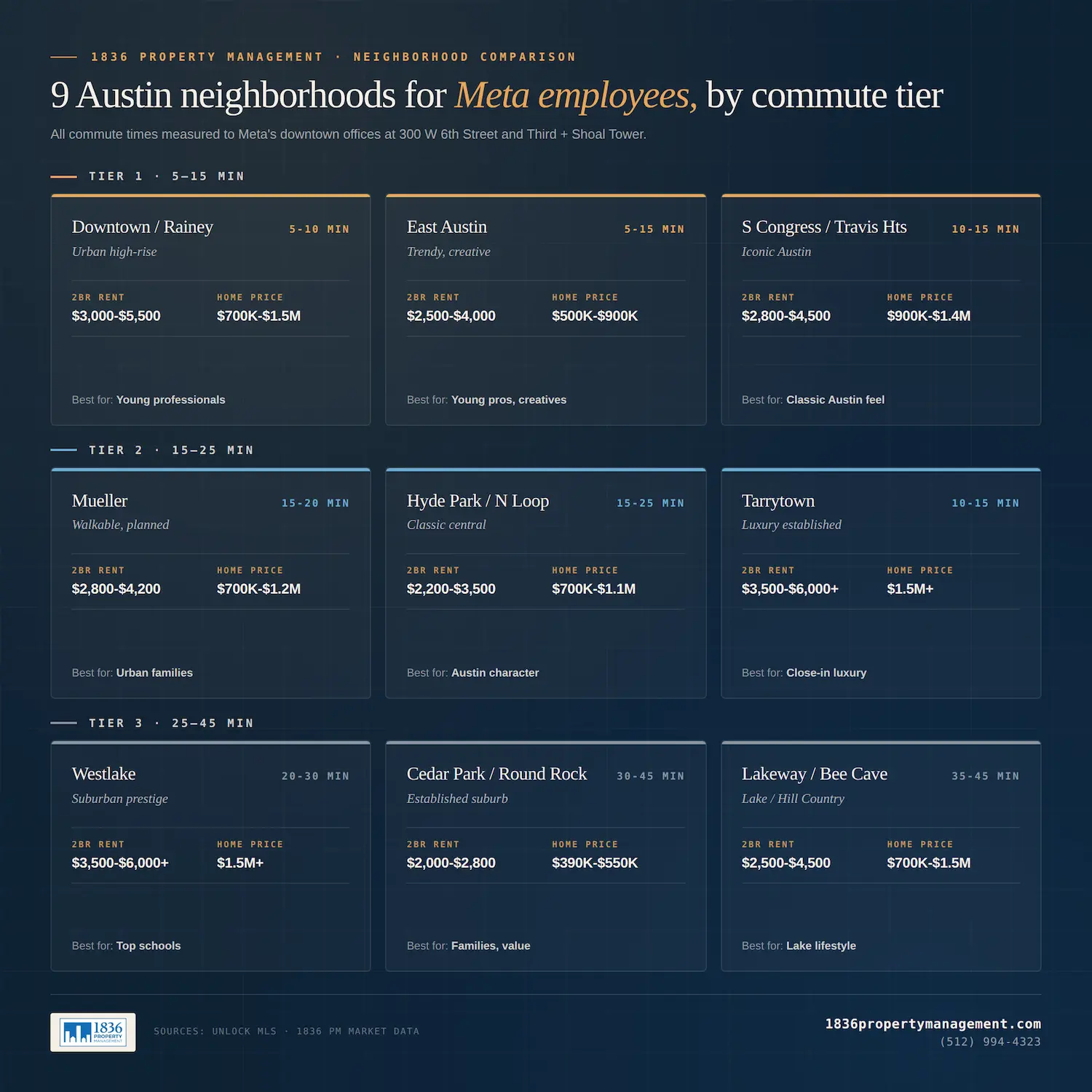
The most commute-friendly neighborhoods include Downtown, Rainey Street, East Austin, South Congress, and Travis Heights. Each one is within roughly 15 minutes of Meta's offices during typical traffic and offers a different mix of vibe and price. Just a bit further out, Mueller, Hyde Park, and Tarrytown stay within 20 to 25 minutes for most routes. We cover each in detail in the tier breakdown below.
If you are deciding between central Austin and the northern suburbs, the math almost always favors staying close in. Suburbs like Cedar Park, Round Rock, and Leander have great schools and more space per dollar. However, the 30 to 45 minute commute to downtown during rush hour is a real cost over the course of a year.
Best Neighborhoods to Rent Near Meta's Austin Offices
We have organized this list by commute time to Meta's downtown offices during typical rush hour. Every neighborhood has tradeoffs. We have tried to be honest about each one.
Commute times below are general estimates for typical rush-hour conditions. Always check your actual route during the times you expect to commute before signing a lease or making an offer.
Tier 1: 5 to 15 Minutes from Meta's Offices
Downtown Austin and Rainey Street
- Commute to Meta: 5 to 10 minutes (often walkable)
- Vibe: Urban high-rise living, walkable to everything. Restaurants, bars, music venues, Lady Bird Lake trail, the Whole Foods flagship, and quick access to the entire urban core. Rainey Street has its own walkable bar and food scene.
- Best for: Young professionals, couples without kids, anyone who wants city life and no car commute
- Rent range: Typically $2,200 to $3,500 for a 1BR, $3,000 to $5,500 for a 2BR
- The catch: The most expensive option. Limited single-family inventory. Weekend noise from the downtown bar scene can be significant.
East Austin (East Cesar Chavez, Holly, Cherrywood)
- Commute to Meta: 5 to 15 minutes via East Cesar Chavez or 7th Street
- Vibe: Trendy, creative, food and music scene, mix of bungalows and new builds. Some of the best restaurants and bars in the city. Easy access to Lady Bird Lake trail. Strong cycling infrastructure.
- Best for: Younger Meta employees and creatives who want walkable food, music, and nightlife
- Rent range: $1,800 to $2,800 for a 1BR, $2,500 to $4,000 for a 2BR or small house
- The catch: Still gentrifying in places. Some pockets feel rough at night. Parking can be tight.
South Congress and Travis Heights
- Commute to Meta: 10 to 15 minutes via South Congress
- Vibe: Quintessential Austin, walkable, mix of historic homes and apartments. Iconic shopping and dining on South Congress, easy walk to Lady Bird Lake, mature tree canopy, real neighborhood feel in Travis Heights.
- Best for: People who want classic Austin character right next to downtown
- Rent range: $2,000 to $3,000 for a 1BR, $2,800 to $4,500 for a 2BR
- The catch: Tourist crowds on weekends. Premium pricing. Limited new construction.
Tier 2: 15 to 25 Minutes from Meta's Offices
Mueller
- Commute to Meta: 15 to 20 minutes via I-35 or Airport Boulevard
- Vibe: Master-planned urban neighborhood with modern homes, parks, and a real town square. Walkable to restaurants, parks, and the weekly farmers market. Strong community feel. Mix of housing types.
- Best for: Families who want walkability plus newer homes
- Rent range: $2,000 to $2,800 for an apartment, $3,500 to $5,000 for a single-family home
- The catch: I-35 traffic into downtown can slow you in the morning. Pricier than older central neighborhoods.
Hyde Park, North Loop, and Crestview
- Commute to Meta: 15 to 25 minutes via Lamar or Guadalupe
- Vibe: Classic central Austin neighborhoods with bungalows, mature trees, and walkability. Walkable to coffee shops, music venues, local restaurants. Real neighborhood feel. Older housing stock with character.
- Best for: People who want quintessential Austin lifestyle with a manageable commute
- Rent range: $1,500 to $2,200 for a 1BR, $2,200 to $3,500 for a house
- The catch: Mopac during rush hour can be rough. Older homes mean older systems and quirks.
Tarrytown
- Commute to Meta: 10 to 15 minutes via Lake Austin Boulevard or Mopac
- Vibe: Established luxury, leafy, family-friendly. Older mansions and newer luxury homes, top private schools, access to Lake Austin, prestige neighborhood.
- Best for: Senior Meta employees and families who want luxury close to downtown
- Rent range: $2,800 to $5,000 for a smaller home, $5,000 and up for larger homes
- The catch: Among the most expensive rental markets in Austin. Limited inventory.
Tier 3: 25 to 45 Minutes from Meta's Offices
Westlake
- Commute to Meta: 20 to 30 minutes via Bee Cave Road or Mopac
- Vibe: Suburban luxury with Hill Country views, top-rated schools. Eanes ISD is consistently ranked among the top districts in Texas. Hilly, leafy, gated communities, golf, and Lake Austin access.
- Best for: Senior Meta employees and executives with families
- Rent range: $3,500 to $6,000 for larger homes
- The catch: Long, winding roads. Heavy traffic on Bee Cave Road and Mopac during rush hour.
To dig deeper into luxury options like Westlake, see our Austin's richest neighborhoods guide.
Cedar Park and Round Rock
- Commute to Meta: 30 to 45 minutes via Mopac, I-35, or 183
- Vibe: Fast-growing suburbs with newer construction and family amenities. Highly rated Round Rock ISD and Leander ISD schools, master-planned communities, growing dining and retail, easy access to weekend Lake Travis trips.
- Best for: Families who want more space, top suburban schools, and a lower price per square foot
- Rent range: $1,300 to $1,800 for apartments, $2,000 to $3,200 for a 3BR house
- The catch: Daily tolls on 183A or SH 45 can add $150 to $250 a month if you use them. Pflugerville and Leander offer similar profiles at slightly different price points.
Lakeway and Bee Cave
- Commute to Meta: 35 to 45 minutes via 71 or Bee Cave Road
- Vibe: Lake Travis lifestyle, golf, Hill Country setting. Lake Travis access, Lake Travis ISD schools, marinas, golf courses, and a strong family community.
- Best for: Meta employees who prioritize lake access, top schools, and Hill Country living
- Rent range: $2,500 to $4,500 for a house
- The catch: Long commute. The drive home in the evening can stretch past 45 minutes easily.
Ready to rent in one of these neighborhoods? Our team helps Meta employees and other Austin renters every week. Browse our current homes for rent, or reach out to us directly and we will help you find the right fit.
Best Neighborhoods to Buy Near Meta's Austin Offices
If you are planning to put down roots in Austin, buying gives you long-term equity, school stability, and predictable housing costs. The Austin metro is a strong market to buy in for the long haul.
According to the latest Central Texas Housing Market Report from Unlock MLS, the median home price in the Austin-Round Rock-San Marcos metro was $415,300 in Q1 2026, with inventory at about 5.5 months. That is a more balanced market than it has been in years, giving buyers real negotiating room.
Below are the best neighborhoods for Meta employees who want to buy, grouped by price range.
Best Value Buys (Under $600K)
The strongest combination of price and reasonable commute to downtown.
Cedar Park and Round Rock
- Commute to Meta: 30 to 45 minutes
- Median home price: Around $390,000 to $550,000
- Best for: Families and first-time buyers
- Why it works: Strong Round Rock ISD and Leander ISD schools, newer master-planned communities, family amenities, and the lowest price per square foot of any tier here. Pflugerville and Leander offer very similar profiles.
East Austin (further out, near Springdale)
- Commute to Meta: 15 to 20 minutes
- Median home price: Around $500,000 to $700,000 for single-family homes
- Best for: Buyers who want close-in living without paying Tarrytown prices
- Why it works: Walkable streets, food scene, new construction mixed with historic homes, and a short drive or bike ride to Meta's offices.
Premium Neighborhoods ($600K to $1.2M)
Close-in central Austin with strong long-term value.
Mueller
- Commute to Meta: 15 to 20 minutes
- Median home price: $700,000 to $1.2 million
- Best for: Families who want walkability and modern homes
- Why it works: Walkable urban planning, modern architecture, top-tier amenities, weekly farmers market, and a strong family community. One of the most popular destinations for Austin tech buyers with kids.
South Congress and Travis Heights
- Commute to Meta: 10 to 15 minutes
- Median home price: $900,000 to $1.4 million for single-family homes
- Best for: Buyers who want classic Austin character close to downtown
- Why it works: Short commute, walkable, strong neighborhood feel, iconic Austin shopping and dining, and high long-term appreciation potential.
Hyde Park, North Loop, and Crestview
- Commute to Meta: 15 to 25 minutes
- Median home price: $700,000 to $1.1 million for single-family homes
- Best for: Buyers who want classic central Austin character
- Why it works: Mature trees, bungalow charm, walkable to coffee and restaurants, and proximity to the University of Texas and downtown.
Luxury and Lake Living ($1.2M+)
Prestigious zip codes, top schools, and the most desirable areas in the metro.
Tarrytown and Old Enfield
- Commute to Meta: 10 to 15 minutes
- Median home price: $1.5 million and up
- Best for: Senior Meta employees and executives
- Why it works: Among the most desirable close-in luxury neighborhoods, top private schools, mature trees, and proximity to Lake Austin.
Westlake
- Commute to Meta: 20 to 30 minutes
- Median home price: $1.5 million and up
- Best for: Senior Meta families wanting the top public school district
- Why it works: Eanes ISD is consistently ranked Texas's top public school district, the area is leafy and prestigious, and homes have strong long-term value.
Lakeway and Bee Cave
- Commute to Meta: 35 to 45 minutes
- Median home price: $750,000 to $1.5 million-plus
- Best for: Buyers prioritizing lake access and Hill Country lifestyle
- Why it works: Lake Travis access, large lots, Hill Country views, top schools in Lake Travis ISD, and a strong sense of community. Steiner Ranch is a strong nearby alternative. The commute is the real tradeoff.
The Rent-First-Then-Buy Strategy
If you are new to Austin, or new to a specific area, we suggest renting for a year before you buy. Austin neighborhoods vary a lot in vibe, even when they are close together. A year in a neighborhood teaches you things a weekend tour never will. You learn traffic patterns at your actual commute times, how the neighborhood feels at night, where your dog wants to walk, and which grocery store you actually use.
A year of renting also lets the Austin market continue to recalibrate. Inventory now sits at over 5 months of supply, the most buyer-friendly the market has been in years. A patient buyer in 2026 or 2027 has real negotiating room.
If you decide to rent first, our team manages quality rentals across every neighborhood in this guide. You can also browse our homes for rent to see what is available now.
What If You Already Own a Home Somewhere Else?
A lot of Meta employees relocating to Austin own a home in California, Washington, New York, or somewhere else. You have a few options. You can sell. You can rent it out yourself. Or you can hire a property manager to rent it out for you while you settle in Austin. The same applies in reverse. If you buy in Austin and later get transferred back to Menlo Park or New York, you can hold your Austin home as a rental rather than sell.
If you are weighing the second option, our guide on how to choose the right property manager walks through what to look for. If you are deciding between short-term and long-term rental income, see our Airbnb vs. long-term rental guide. Both decisions have real tax, regulatory, and time-commitment implications.
If you want to know how much your property can rent for, our free rental analysis tool will give you a data-driven estimate based on current market conditions.
Frequently Asked Questions
How far is downtown Austin from Meta's offices?
Meta's offices are at 300 W 6th Street and Third + Shoal Tower (607 W 3rd Street). From the downtown core, it's a 5 to 10 minute walk. From East Austin or South Congress, it's typically 5 to 15 minutes by car.
What is the best neighborhood for Meta employees with families?
Mueller, Tarrytown, and Travis Heights offer the best mix of short commute, family amenities, and quality schools close to downtown. For top-rated schools further out, Westlake (Eanes ISD), Cedar Park, and Round Rock are strong picks.
Where do tech people live in Austin?
It depends where they work. Downtown-based workers like Meta employees cluster in East Austin, South Congress, Mueller, Travis Heights, and Hyde Park. Apple employees, based in far North Austin, lean toward Cedar Park, Round Rock, and Avery Ranch. See our guide for Apple employees for that breakdown.
What are the best neighborhoods in Austin for tech workers?
For downtown-based tech workers, East Austin, Downtown, South Congress, Travis Heights, Mueller, Hyde Park, and Tarrytown all hit the mark. Each offers a short commute plus strong rental options, restaurants, and walkability.
Can I live in the suburbs and commute to Meta?
What are the nicest neighborhoods in Austin?
It depends what you value. Westlake leads on prestige with top-rated Eanes ISD schools and homes starting around $1.5M. Tarrytown and Old Enfield offer luxury closer to downtown, with Tarrytown the strongest pick for Meta employees who want both. See our Austin's richest neighborhoods guide for more.
What are the best areas to live in Austin if you don't have a car?
Downtown, Rainey Street, East Austin, South Congress, and Hyde Park are the most car-optional neighborhoods near Meta's offices. All offer walkability, biking infrastructure, and CapMetro bus access.
How much should a Meta employee budget for housing in Austin?
A common rule of thumb is keeping housing costs at or below 30 percent of gross income. But factor in commute too. Even a 20 to 30 minute commute difference can be worth hundreds or thousands a month in time, gas, parking, and vehicle wear.
Should I rent or buy as a Meta Austin employee?
Rent first if you're new to Austin or unsure how long you'll stay. A year lets you test neighborhoods and the commute. Buy if you plan to stay at least 5 to 7 years and have a stable budget. The 2026 market favors patient buyers, with more inventory and real negotiating room.
Is downtown Austin safe for Meta employees?
Yes, especially around the office areas. Parts of 6th Street can feel rowdy late at night, like any urban core, but the neighborhoods next to Meta's offices, including Rainey Street, East Austin, and downtown's residential corridors, are generally safe and active.
The Bottom Line
The best neighborhoods for Meta employees in Austin depend on what you value most. If you want the shortest commute and a walkable urban lifestyle, look at Downtown, East Austin, or South Congress. If you want classic Austin character with a manageable drive, look at Travis Heights, Hyde Park, or Mueller. If you want luxury close to downtown, look at Tarrytown. If you want top schools or lake access and can accept a longer commute, look at Westlake, Cedar Park, or Lakeway.
What matters most is matching your neighborhood to the life you actually want to live, not just the rent or sale price you can afford. Run the commute math. Be honest about the tradeoffs. If you are unsure, rent for a year before you buy.
At 1836 Property Management, we have managed Austin rentals since 2006, currently oversee over 900 properties, and our local team can help you find the right home in any of the neighborhoods covered here. Whether you are renting your first place in Austin, planning to buy, or eventually need someone to manage a property you own, we are here to help.
Ready to start your search? View our available rentals or get started with us today.