





Key Takeaways
- The best neighborhoods for Tesla Gigafactory employees in Austin sit on the east and southeast side, close to the plant on Tesla Road in Del Valle.
- For the shortest commute, look at Del Valle or Southeast Austin; for new construction and family amenities, Easton Park, Manor, or Pflugerville; for walkability and Austin character, East Austin or Mueller.
- The most affordable options with more space and land are Bastrop, Elgin, Kyle, and Buda, in exchange for a longer drive.
- The 2026 market is balanced, with a metro median home price near $415,000 and about 5.5 months of inventory, so patient buyers have real negotiating room. SH 130 is the fast route to the plant, but it is tolled, so budget for it.
If you just landed a job at Tesla's Gigafactory in Austin, or you are about to, one of your first big questions is where to live. The best neighborhoods for Tesla Gigafactory employees in Austin all sit on the east and southeast side of town, close to the plant on Tesla Road. In practice, the right area depends largely on your commute to Tesla Gigafactory Austin, your budget, and the lifestyle you want. Tesla Austin has reshaped this side of the city, so each neighborhood comes with its own vibe, price point, and set of tradeoffs. This guide breaks them all down so you can choose with confidence.
At 1836 Property Management, we have helped Austin renters, buyers, and investors find the right neighborhood since 2006. Today we manage more than 900 properties across the greater Austin area, and our local team lives and works in the same communities we cover. Because of that, we have first-party data on where working professionals actually land, what they pay, and how long they stay. We pulled all of it into one guide so you can get the decision right the first time. This is the third post in our series for Austin tech workers, after our guides for Apple employees and for Meta employees.
Table of Contents
What Are the Best Neighborhoods for Tesla Employees in Austin?
The best neighborhoods for people working at Tesla Gigafactory Austin are:
- Del Valle
- Easton Park
- Southeast Austin
- East Austin
- Mueller
- Manor
- Pflugerville
- Bastrop
- Buda
- Kyle
In short, the closer you live to Tesla Road, the shorter your commute, so Del Valle, Easton Park, and Southeast Austin top the list for most Gigafactory employees. Meanwhile, Manor, Pflugerville, Bastrop, Buda, and Kyle trade a longer drive for lower prices and more space.
Why Commute Matters at the Gigafactory
For Gigafactory workers, the daily drive is not optional. Manufacturing work happens on site, every shift, so if you work the production floor you are at the plant in person. There is no remote option to fall back on. Even many salaried and engineering roles based at the Tesla Road campus expect several days a week in the building.
That makes your commute one of the most important parts of the housing decision, second only to price. A factory job often means early starts, late finishes, or rotating shifts, and a long drive on top of a long shift wears on you fast. So where you live directly shapes how rested you feel and how much of your day is your own.
Below, we walk through the campus location, the commute reality, the simple math you should run before you sign a lease or make an offer, and the neighborhoods that make the most sense for Gigafactory employees today.
Understanding the Tesla Gigafactory Campus
The thing that makes Tesla different from Austin's other big tech employers is location. Apple sits in far Northwest Austin, and Oracle sits near the lake on the south side. The Gigafactory sits on the opposite end of town.
Tesla's Gigafactory Texas, also called Giga Texas, is located at 1 Tesla Road in Southeast Austin, in the Del Valle area of unincorporated Travis County. The plant sits along the Colorado River, just off State Highway 130, and only a few minutes from Austin-Bergstrom International Airport and the Circuit of the Americas racetrack. In short, it is about 15 miles east of downtown, well away from the central and northern parts of the city.
The site is huge. It covers roughly 2,100 acres and serves as both a manufacturing plant and Tesla's corporate headquarters. The factory grew quickly after it opened, and Tesla became Austin's largest private employer, with a workforce in the tens of thousands. Headcount has gone up and down with hiring and layoffs since then, but the plant remains one of the biggest job centers in the region.
Over the past two decades managing Austin rentals, we have seen housing demand consistently follow major employment centers. Tesla's growth has been one of the most significant drivers of East Austin and Del Valle housing demand in recent years. So the pattern is clear, and it points to one takeaway for housing. Because the Gigafactory is on the east and southeast edge of Austin, the neighborhoods that make the most sense are also on the east and southeast side. Living far north or far west and commuting to Tesla Road is possible, but it is a long, traffic-heavy drive. We will cover why below.
The Commute Reality at the Tesla Gigafactory
Austin traffic is famously bad, and the main routes to the Gigafactory each come with their own quirks. Before you pick a neighborhood, here are four things worth knowing.
SH 130 is your friend, but it is a toll road. State Highway 130 is the fast, high-speed bypass that runs along the east side of Austin and feeds right into the area around the plant. It is far less congested than I-35. However, it is tolled, and drivers without a toll tag pay about 50 percent more. You can review current rates on the TxDOT Austin-area toll roads page. Daily tolls on a short commute segment are modest, but they add up over a year, so factor them into your rent or mortgage comparison.
Google Maps is optimistic. The traffic estimates you see tend to run low for Austin's worst stretches during real rush hour. To get a realistic number, check your route at the times your actual shift starts and ends, not just at midday.
Shift work can work in your favor. Plenty of Gigafactory jobs run on shifts that start or end outside normal rush hour. If you work an early or late shift, your real commute may be much shorter than peak-hour estimates suggest. As a result, a neighborhood that looks too far on paper might actually be a quick drive at your hours. Check your specific shift times before you rule anything out.
How to Calculate What Your Commute Is Actually Worth
Most people think about housing as just a rent or mortgage number. That misses something important. A 30-minute longer commute each way costs you about 250 hours a year, or roughly six full work weeks. For a salaried employee, that time has a real dollar value. Even for an hourly worker, that is time you could spend earning, resting, or with family.
The Math
Here is the simple version:
| Step | How to Calculate |
|---|---|
| Daily commute savings | (Longer commute in minutes – shorter commute in minutes) x 2 trips |
| Annual hours saved | Daily savings divided by 60, then times 250 work days |
| Dollar value of your time | Annual hours x (your pay divided by 2,080 work hours) |
| Monthly time value | Dollar value divided by 12 |
| Compare to housing premium | If the monthly time value beats the housing premium, the closer option wins |
Quick example. Say you earn $100,000 a year, which is about $48 an hour. You are choosing between a $1,900 a month apartment with a 12-minute commute in Del Valle and a $1,500 a month apartment with a 35-minute commute out in Bastrop.
- Daily savings of the closer option: 46 minutes
- Annual hours saved: about 192 hours
- Time value: about $9,200 a year, or roughly $770 a month
- Housing premium: $400 a month
- Net benefit of the closer apartment: about $370 a month in time value
In other words, the closer place looks more expensive on paper, but once you price in your time, it actually comes out ahead. The same logic works at any wage. Just plug in your own hourly pay.
Why This Matters More When You Buy
That math matters even more if you are buying. You will live in a home for years, not months, so a longer commute compounds the whole time you own the place. Therefore, if you are seriously thinking about a longer drive to save on the purchase price, run the numbers before you sign anything.
The math is not only about money, either. A shorter commute means more sleep, less stress, and more time for the things you actually enjoy. That matters a lot when you are already working long or rotating shifts. Research links long commutes to lower happiness and higher burnout, so the case for living closer to work is real even when the dollar math is close.
Run Your Own Numbers
Want to see the real cost of your commute, including gas, vehicle wear, and tolls? The Commute Cost Calculator from Commute Solutions is built for Central Texas and gives you a monthly estimate based on your route and vehicle.
Best Neighborhoods in East and Southeast Austin for Gigafactory Employees
Because the Gigafactory sits in Southeast Austin near the airport, the best neighborhoods for its employees are almost all on the east and southeast side of the metro. If your top priority is a short, reliable commute, this is the part of town to focus on.
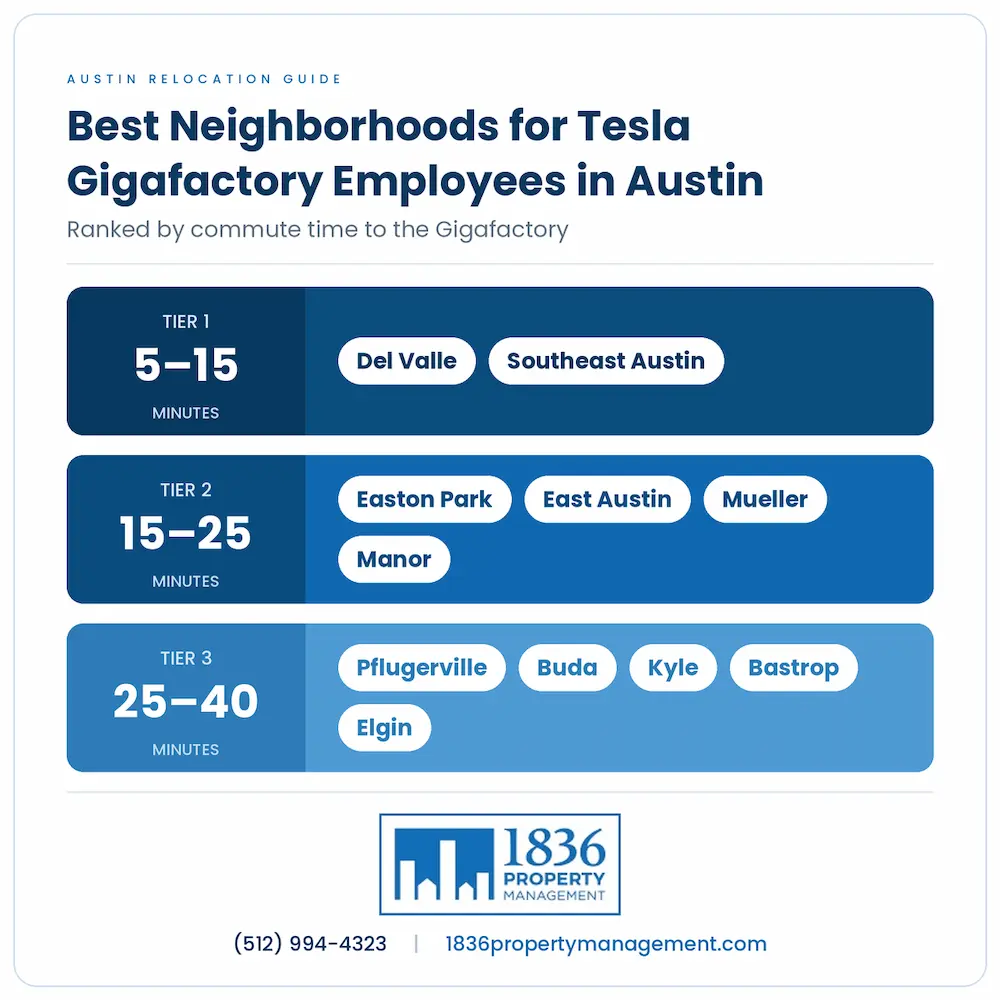
Based on leasing data from more than 900 Austin-area properties, Del Valle, Easton Park, and Southeast Austin have seen some of the strongest demand from workers seeking short commutes to Tesla Gigafactory Austin. Just beyond them, the value suburbs of Manor, Pflugerville, Buda, Kyle, Bastrop, and Elgin trade a longer drive for more space and lower prices. We cover each one in detail below.
If you are torn between the east side and a north or west neighborhood, the math almost always favors the east side. Places like Cedar Park or Westlake have plenty of appeal, but a 45-minute-plus drive to Tesla Road during rush hour is a real cost over the course of a year.
Best Neighborhoods to Rent Near the Tesla Gigafactory
We have organized this list by commute time to the Gigafactory during typical rush hour. Every neighborhood has tradeoffs, and we have tried to be honest about each one.
Tier 1: 5 to 15 Minutes from the Gigafactory
Del Valle
- Vibe: Rural and quiet, with a country feel and big-city access
- Best for: Anyone who wants the shortest possible commute and the lowest prices
- Lifestyle: Wide-open spaces, newer apartment communities, and easy access to the airport and COTA events. The trade is fewer shops and restaurants nearby.
- Rent range: $1,200 to $1,800 for apartments, $1,800 to $2,500 for a single-family rental
- The catch: Amenities are still catching up to the growth. You will drive for most shopping and dining.
Southeast Austin (Onion Creek and McKinney Falls)
- Vibe: Established suburban neighborhoods with mature trees and parks
- Best for: Families and anyone who wants a short commute with more services nearby
- Lifestyle: Close to McKinney Falls State Park, Onion Creek, and the Southpark Meadows shopping area. A solid mix of apartments and single-family homes.
- Rent range: $1,300 to $1,900 for apartments, $2,000 to $2,800 for a house
- The catch: Some pockets are more polished than others, so tour the specific street, not just the zip code.
Tier 2: 15 to 25 Minutes from the Gigafactory
Easton Park
- Vibe: Large master-planned community with new construction and modern amenities
- Best for: Families and first-time buyers who want a new home and lots of community perks
- Lifestyle: Resort-style pool, fitness center, miles of trails, and a busy events calendar. Homes are mostly newer builds from national builders, and the area is part of Del Valle ISD.
- Rent range: $1,900 to $2,600 for apartments and townhomes, $2,200 to $3,000 for a single-family rental
- The catch: Still growing, so some sections feel brand new and a little sparse. Worth confirming school assignments before you commit.
East Austin (East Cesar Chavez, Govalle, Holly)
- Vibe: Trendy, walkable, and full of Austin character
- Best for: Young professionals and anyone who wants nightlife, food, and music close by
- Lifestyle: Some of the city's best restaurants, bars, and coffee shops, plus quick access to downtown. A mix of historic bungalows, new builds, and modern condos.
- Rent range: $1,600 to $2,600 for apartments, $2,500 to $4,000 for a house
- The catch: One of the pricier options on this list, and parking and inventory can be tight.
Mueller
- Vibe: Master-planned urban neighborhood just east of central Austin
- Best for: Families who want walkability plus newer homes
- Lifestyle: Walkable to restaurants, parks, and a weekly farmers market. Strong community feel, modern architecture, and a mix of housing types.
- Rent range: $2,000 to $2,800 for apartments, $3,500 to $5,000 for a single-family home
- The catch: It is one of the more expensive rental markets here, and you are paying partly for the lifestyle rather than the commute.
Tier 3: 25 to 40 Minutes from the Gigafactory
Pflugerville
- Vibe: Established, family-friendly suburb with good value
- Best for: Families who want strong schools and a real suburban setup
- Lifestyle: Lake Pflugerville, Stone Hill Town Center, and a growing dining scene. Solid schools and lots of parks.
- Rent range: $1,300 to $1,700 for apartments, $2,000 to $3,000 for a single-family home
- The catch: A bit farther out, and the fastest route uses the SH 130 toll.
Buda and Kyle
- Vibe: Affordable, growing suburbs south of Austin
- Best for: Families chasing the most space per dollar
- Lifestyle: New master-planned communities, plenty of retail, and easy weekend trips to San Marcos and the river. Good for buyers who do not mind a longer drive.
- Rent range: $1,300 to $1,800 for apartments, $1,900 to $2,800 for a house
- The catch: The commute is real, especially if your route touches I-35.
Bastrop and Elgin
- Vibe: Small-town and rural, with historic main streets and lots of land
- Best for: Buyers who want acreage, a quiet pace, and the lowest prices in the region
- Lifestyle: Pine forests near Bastrop, a charming downtown, and room to spread out. This is the spot if you dream of a little land.
- Rent range: $1,200 to $1,700 for apartments, $1,700 to $2,500 for a house
- The catch: The longest commute on this list, and far fewer big-city amenities.
Best Neighborhoods to Buy Near the Tesla Gigafactory
If you plan to put down roots in Austin, buying gives you long-term equity, school stability, and predictable housing costs. The Austin metro is a good place to buy for the long haul.
According to the Unlock MLS Q1 2026 housing report, the median home price across the Austin-Round Rock-San Marcos metro was about $415,300, with inventory at 5.5 months of supply. That is a more balanced market than Austin has seen in years, which gives buyers real negotiating room. For more on why so many workers are buying here for the long term, see our breakdown of why to invest in Austin.
One thing to know up front: the Gigafactory corridor is different from the Apple corridor. The east and southeast side skews toward value and new construction rather than legacy luxury. So if your goal is a prestige zip code, you will likely look toward central Austin or accept a longer commute. We cover that below. Here are the best buys, grouped by price.
Best Value Buys (Under $400K)
The strongest combination of price, space, and reasonable commute distance.
Del Valle and Manor
- Commute to Gigafactory: 5 to 25 minutes
- Median home price: Roughly $330,000 to $430,000
- Best for: First-time buyers and families who want the shortest commute for the lowest price
- Why it works: Lower entry prices than most of the metro, fast routes to the plant, and steady new construction. Strong long-term upside as the east side grows.
Bastrop, Elgin, Kyle, and Buda
- Commute to Gigafactory: 25 to 40 minutes
- Median home price: Roughly $300,000 to $430,000, depending on the area
- Best for: Buyers who want the most square footage, newer homes, or a little land
- Why it works: These outer markets offer the lowest prices around the metro. Bastrop County homes often sell in the low $300,000s, and the Hays County side near Kyle and Buda runs a bit higher. The trade is a longer drive.
New Construction and Suburban Value ($400K to $600K)
Newer homes, family amenities, and a manageable commute.
Easton Park
- Commute to Gigafactory: 15 to 20 minutes
- Median home price: Roughly $430,000 to $580,000
- Best for: Families who want a new home in a full-amenity community close to the plant
- Why it works: This is one of the most popular landing spots for Gigafactory buyers. You get new construction, resort-style amenities, trails, and a short commute, all in Del Valle ISD.
Southeast Austin and Pflugerville
- Commute to Gigafactory: 10 to 30 minutes
- Median home price: Roughly $400,000 to $525,000
- Best for: Families who want an established neighborhood with parks and schools
- Why it works: More mature than the brand-new communities, with trees, parks, and a solid mix of home sizes. Pflugerville adds strong schools and a quick SH 130 route.
Austin Character and Premium ($600K and Up)
For buyers who want walkability, nightlife, or a prestige address and can accept a slightly longer drive.
East Austin
- Commute to Gigafactory: 15 to 20 minutes
- Median home price: Roughly $550,000 to $900,000 and up
- Best for: Buyers who want the most central, walkable, and lively part of the east side
- Why it works: Close to downtown, packed with restaurants and music, and still a short hop to the plant. Inventory ranges from restored bungalows to sleek new builds.
Central Austin (Travis Heights and South Congress)
- Commute to Gigafactory: 25 to 40 minutes
- Median home price: Roughly $900,000 to $2 million and up
- Best for: Senior staff and executives who want a prestige central address
- Why it works: Some of the most desirable neighborhoods in the city, with character, walkability, and strong long-term value. If prestige is your goal, this is where Tesla's higher earners often look. For a broader view of the metro's high-end areas, see our guide to Austin's richest neighborhoods.
At-a-Glance Comparison Table
| Neighborhood | Commute to Gigafactory | Vibe | Best For | Rent (2BR or House) | Median Home Price |
|---|---|---|---|---|---|
| Del Valle | 5 to 15 min | Rural, affordable | Short commute, value | $1,500 to $2,200 | $330K to $430K |
| Southeast Austin | 10 to 20 min | Established suburban | Families, value | $1,600 to $2,300 | $400K to $525K |
| Easton Park | 15 to 20 min | Master-planned, new | Families, new build | $1,900 to $2,600 | $430K to $580K |
| East Austin | 15 to 20 min | Trendy, walkable | Young professionals | $2,000 to $3,200 | $550K to $900K+ |
| Mueller | 20 to 25 min | Walkable planned | Urban families | $2,800 to $4,200 | $700K to $1.2M |
| Manor | 20 to 25 min | Growing suburb | Families, value | $1,600 to $2,400 | $330K to $420K |
| Pflugerville | 25 to 30 min | Established suburb | Families, schools | $1,700 to $2,500 | $375K to $475K |
| Buda and Kyle | 30 to 40 min | Suburban value | Space per dollar | $1,700 to $2,400 | $350K to $430K |
| Bastrop and Elgin | 25 to 40 min | Small-town, rural | Most affordable, land | $1,500 to $2,200 | $300K to $380K |
| Central Austin | 25 to 40 min | Urban, prestige | Executives, lifestyle | $2,200 to $4,000 | $900K+ |
All prices reflect early to mid-2026 market conditions and will vary by specific area, home size, and current inventory.
The Rent-First-Then-Buy Strategy
If you are new to Austin, or new to a specific part of town, we suggest renting for a year before you buy. Austin neighborhoods can feel very different even when they sit close together. A year in a neighborhood teaches you things a weekend tour never will. You learn the real traffic at your actual shift times, how the area feels at night, what the schools are like, and which grocery store you actually prefer.
Renting first also lets the market keep working in your favor. Inventory is now above 5 months of supply, which is the most buyer-friendly Austin has been in years. Therefore, a patient buyer in 2026 or 2027 has real room to negotiate.
If you decide to rent first, our team manages quality rentals across the east and southeast side. You can also browse current homes for lease to see what is available right now.
How to Choose the Right Neighborhood for You
Here is a simple way to match a neighborhood to what matters most to you:
- Shortest possible commute: Del Valle or Southeast Austin
- New construction and family amenities: Easton Park, Manor, or Pflugerville
- Walkability and Austin character: East Austin or Mueller
- Most space or land per dollar: Bastrop, Elgin, Kyle, or Buda
- Prestige central address: Travis Heights or South Congress
- Buying long-term for value: Del Valle, Easton Park, or Manor
- Buying long-term for lifestyle: East Austin or Mueller
What If You Already Own a Home, or Want to Rent One Out?
A lot of people moving to Austin for the Gigafactory already own a home somewhere else, in California, Nevada, or another state. You have a few options. You can sell it. You can rent it out yourself. Or you can hire a property manager to handle it while you settle into Austin.
The same idea works in reverse. Maybe you buy a home near the plant, then later get reassigned or decide to upgrade. Instead of selling, you can keep that first home as a rental and let it build wealth for you. Plenty of Gigafactory employees end up owning a second property this way, and renting to coworkers who want a short commute is often easy given how many people work at the plant.
If you go that route, two resources can help. First, our guide on how to find a quality property management company walks through what to look for. Second, if you are thinking about holding property as an investment, our explainer on setting up an LLC for rental property in Austin covers whether that structure makes sense for you. Either way, renting out a home well takes real local knowledge, especially in a fast-moving market like Austin. That is exactly what our team does every day, and our first-party leasing data helps us price and fill homes quickly.
Frequently Asked Questions
What is the closest neighborhood to Tesla Gigafactory Austin?
Del Valle is the closest neighborhood to Tesla Gigafactory Austin. Most of it sits within a 5 to 15 minute drive of the plant on Tesla Road, and several routes connect right to the site. Southeast Austin is the next closest, at roughly 10 to 20 minutes. Both are popular with workers who want the shortest possible commute.
Where do most Tesla employees live in Austin?
Most people who work at the Gigafactory live on the east and southeast side, close to the plant. The most common picks are Del Valle, Southeast Austin, Easton Park, East Austin, Mueller, Manor, and Pflugerville. Workers who want more space or land for less money often choose Buda, Kyle, Bastrop, or Elgin and accept a longer drive.
What is the best neighborhood for Gigafactory employees with families?
For most Gigafactory families, Easton Park, Manor, and Pflugerville offer the best mix of a short commute, family amenities, newer homes, and value. Southeast Austin is also strong if you want an established neighborhood with parks and trees. If you want more land or a lower price, Kyle, Buda, Bastrop, and Elgin are worth a look, though the commute is longer.
Is East Austin a good place for Tesla employees?
Yes, East Austin is a strong option, especially for young professionals. It sits roughly 15 to 20 minutes from the plant, and it offers the best mix of nightlife, restaurants, and walkability on this side of town. The tradeoff is price, since East Austin rents and home prices run higher than the suburbs farther out. If you want city energy and a short commute, it is hard to beat.
What are the most affordable neighborhoods near Tesla Austin?
The most affordable neighborhoods near Tesla Austin are Bastrop, Elgin, Kyle, and Buda. Bastrop County homes often sell in the low $300,000s, and rentals there are among the cheapest in the metro. Del Valle and Manor are also affordable and sit much closer to the plant, so they are worth comparing if a short commute matters to you.
How much should a Gigafactory employee budget for housing in Austin?
A good rule of thumb is to keep housing at or below 30 percent of your gross income. The right number depends a lot on your role, since pay at the Gigafactory ranges from hourly production jobs to senior engineering salaries. As a guide, many renters here land between $1,500 and $2,800 a month, and buyers often target homes between $330,000 and $580,000 on the east side. Higher earners clearly have more room.
Should I rent or buy as a Gigafactory employee?
Rent first if you are new to Austin or unsure how long you will stay. A year of renting lets you learn the city, test the commute, and watch the market. Buy if you plan to stay at least 5 to 7 years and you have a stable budget. The 2026 market favors patient buyers, with more inventory and more negotiating room than Austin has had in years.
Does Tesla offer relocation help or housing for Gigafactory employees?
Tesla does not provide housing, but it often offers relocation assistance, and the details depend on your role and level. Check with your recruiter or hiring manager for what is included. As a bonus, some apartment communities near the Gigafactory advertise discounts for Tesla and SpaceX employees, so it is worth asking when you tour.
The Bottom Line
The best neighborhoods for Tesla Gigafactory employees in Austin come down to what you value most. If you want the shortest commute, look at Del Valle or Southeast Austin. If you want new construction and family amenities, look at Easton Park or Pflugerville. If you want Austin character and walkability, look at East Austin. And if you want the most space or land for the money, look at Kyle, Bastrop, or Elgin.
What matters most is matching your neighborhood to the life you actually want, not just the rent or price you can afford. So run the commute math, be honest about the tradeoffs, and if you are unsure, rent for a year before you buy.
At 1836 Property Management, we have managed Austin rentals since 2006, currently oversee more than 900 properties, and our local team lives and works on the same east side we just covered. Whether you are renting your first place near the plant, planning to buy, or you need someone to manage a home you already own, we can help. Our first-party leasing data means we know what fills, what rents, and what it is worth.
Ready to start your search? View our available rentals or contact our team.