






Key Takeaways
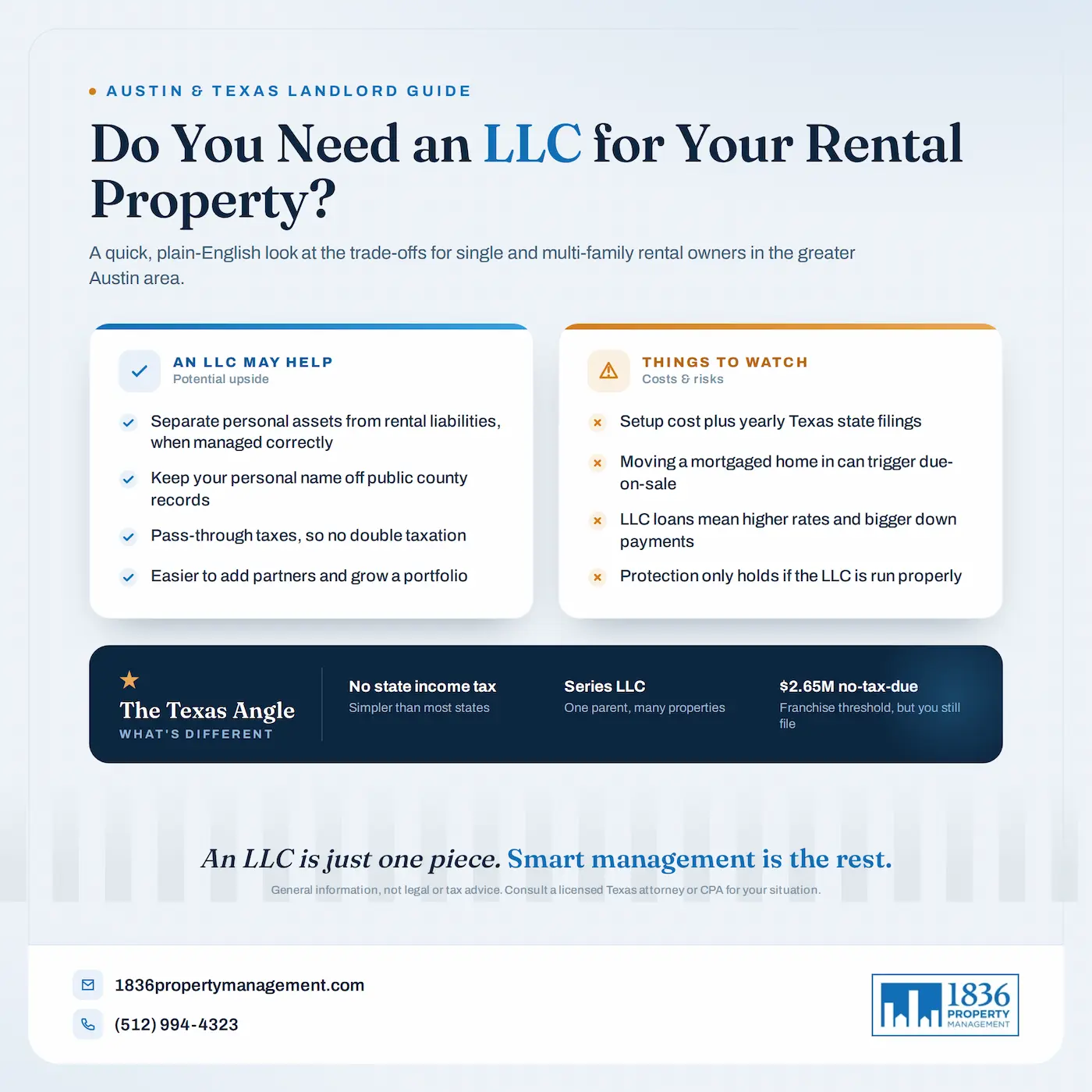
- You’re not legally required to use an LLC to rent out property in Texas, but many Austin landlords choose one for liability protection, especially if they plan to keep investing.
- The main benefit is separation: when set up and managed correctly, an LLC may help keep your personal assets apart from rental liabilities, plus it adds privacy and easy pass-through taxes.
- The main drawbacks are cost and financing: yearly filings, possible higher loan rates, and the risk of triggering your mortgage’s due-on-sale clause if you move a financed property into an LLC.
- Texas has unique advantages: no state income tax, the series LLC for holding multiple properties under one parent company, and a high franchise-tax threshold ($2.65M) though you still must file each year.
Thinking about setting up an LLC for rental property in the Austin area? You are not alone. We hear this question almost every week, especially from first-time owners who are about to rent out a home. At 1836 Property Management, we have managed rental properties across the Austin area since 2006, and today we have over 900 properties under management. In that time, we have seen what protects owners and what creates real headaches. We wrote this guide to give you a clear, honest starting point.
This is a Texas guide, written for Texas owners. We will cover the pros, the cons, the taxes, and the local rules that make Austin a little different. We are a property management company, not a law firm or a tax firm, so please treat this as a helpful starting point. For your exact situation, talk with a licensed attorney or CPA.
Table of Contents
Do I Need an LLC for Rental Property? Start Here
Here is the short answer. No law says you must use an LLC to rent out a home in Texas. Plenty of owners rent property in their own name and do just fine. However, for owners who plan to keep investing, an LLC often makes sense.
So the better question is this: how much risk are you comfortable with, and how big do you plan to grow? A single accidental landlord renting out one inherited house has different needs than an investor buying three duplexes a year. In our experience, owners who plan to hold property long term tend to lean toward an LLC. Owners testing the waters with one home often start simpler and add protection later.
LLC vs. Owning in Your Own Name: A Quick Comparison
Before we dig into the details, here is a side-by-side look at the two paths. Keep in mind that the right choice depends on your goals, your loans, and how you run things.
| Factor | Own in your own name | Own in an LLC |
|---|---|---|
| Liability | Personal assets may be exposed in a rental lawsuit | May help separate personal assets from rental liabilities when set up and run correctly |
| Privacy | Your name appears in public county records | The company name can appear instead of your own |
| Setup cost | None | State filing fee, plus possible registered agent and legal fees |
| Ongoing work | Minimal | Yearly filings, a separate bank account, and clean books |
| Financing | Standard home loans are available | May need a commercial or investor loan; transfers can trigger a due-on-sale clause |
| Taxes | Reported on your personal return | Usually pass-through, but a Texas franchise report is still required |
| Often best for | Testing the waters with one home | Long-term investors and multi-property owners |
This table is a starting point, not a verdict. So read on for the full picture, then confirm the details with your own attorney or CPA.
What an LLC for Rental Property Actually Does
An LLC, or limited liability company, is a legal business entity. When you put a rental into an LLC, the company owns the property, not you personally. You still control it, and you still get the income. But on paper, there is a wall between your personal life and the rental business.
That wall is the whole point. If a tenant or a visitor gets hurt and sues, the claim may be limited to the assets inside the LLC rather than reaching your home, your car, or your savings. This is called liability protection, and it is the number one reason owners form an LLC for rental property. Still, the protection is not automatic or absolute, as we explain below.
You can set one up as a single-member LLC, which means one owner. You can also set up a multi-member LLC, which means two or more owners, such as a married couple or business partners. Either way, the basic shield works the same.
The Pros of an LLC for Rental Property
There are several real benefits, and they add up fast for serious investors.
First, and most important, is asset protection. A lawsuit tied to the property may be limited to the LLC's assets, depending on the facts, insurance, guarantees, and how the LLC is managed. When the structure holds up, your personal assets stay separate. For many owners, that added layer of protection is worth it.
Second, an LLC helps you separate multiple properties. If you own several rentals, you can place them in different LLCs. That way, a problem at one property does not put the others at risk. We will explain a Texas-friendly way to do this in a moment.
Third is privacy. When you own property in your own name, that name shows up in public county records. An LLC keeps your personal name out of those records, which some owners prefer.
Fourth are the tax benefits of an LLC for rental property. By default, an LLC is a pass-through entity. That means the rental income passes through to your personal tax return, and the LLC itself does not pay separate federal income tax. The IRS treats a single-member LLC as a "disregarded entity", so your taxes often look similar to owning the property directly, just with the extra protection.
Finally, an LLC makes growth easier. It is simpler to add partners, bring in investors, or pass property to your family when the business is already its own entity.
The Cons and Disadvantages of an LLC for Rental Property
Now for the honest other side. An LLC is not free, and it is not always the right move.
To start, there is cost and paperwork. You pay to form the LLC, you may pay a registered agent, and you have yearly filings to keep up with. Miss a filing, and you can face penalties or even lose your liability shield.
There is also the financing problem, which is the biggest one owners overlook.
LLC for Rental Property With a Mortgage
This is where many owners run into problems. If you already have a normal home mortgage in your own name, moving that property into an LLC can cause trouble. Most mortgages include a “due-on-sale” clause. That clause lets the lender demand the full loan balance when the property changes hands. A federal law called the Garn-St. Germain Act protects some transfers, such as moving a home into a living trust. However, it does not protect a transfer to an LLC. So that move can count as a “sale” under your loan.
We have seen this play out the hard way. In our experience, one owner moved a mortgaged home into a new LLC without telling the lender first. A few months later, the bank noticed the title change and pointed to the due-on-sale clause. Suddenly the owner was facing pressure to pay off or refinance the whole loan. It became a stressful scramble that a quick phone call could have prevented.
So what should you do instead? You have a few options. One is to buy the property in the LLC from day one, which avoids the transfer issue. Another is to ask your lender for written approval before you move it. Some loans backed by Fannie Mae allow transfers to an LLC under certain conditions, so it is worth asking. Do not move a mortgaged property into an LLC without talking to your lender first.
One more note. Loans made directly to an LLC are usually commercial or investor loans. Those often come with higher interest rates and bigger down payments than a standard home loan. That is a real cost to weigh.
Texas and Austin: What Makes an LLC Different Here
Texas has a few features that change the math. This is where local knowledge really matters, whether you own a starter home in the suburbs or a property in one of Austin’s richest neighborhoods.
First, Texas has no state income tax. That keeps your rental taxes simpler than in many other states.
Second, Texas offers the series LLC. This is a powerful tool for owners with more than one property. A series LLC lets you create one “parent” company with separate “series” under it. Each series can hold a different property, and when it is set up and maintained correctly, one series is meant to be insulated from the others’ debts and lawsuits. So you get the benefit of separate LLCs without forming a brand new company for every door. Texas law allows this under the Business Organizations Code, Subchapter M. Many investors love it. We have seen it work well for owners who are scaling up or buying an apartment complex and adding units over time.
Third, the Austin market itself rewards a long-term plan. There are strong reasons for investing in Austin, and many of our clients build real portfolios here. An LLC structure supports that kind of growth.
Fourth, LLCs are popular with out-of-state and overseas owners. We work with many international investors, and most of them hold their Austin rentals through an LLC for both liability and tax reasons. Overseas owners also face extra federal tax rules, from the 30% rent withholding to FIRPTA when they sell, which we break down in our guide to foreign investor taxes on rental property.
Taxes: The Benefits and Implications in Texas
Let's dig a little deeper into the tax side, since it confuses a lot of owners.
As noted above, an LLC is usually a pass-through entity for federal taxes. Your rental profit lands on your personal return. The LLC does not pay its own federal income tax, which avoids double taxation. That is the core of the tax implications of an LLC for rental property.
Texas does add one item to watch: the state franchise tax. The good news is that the no-tax-due threshold is high. For 2026 and 2027, it is $2.65 million in annualized revenue, according to the Texas Comptroller. So most small landlords owe zero franchise tax. However, and this is the catch, you still have to file. Even at $0 owed, you must submit a Public Information Report each year. Skip it, and you face late penalties. We have seen owners get surprised by this, so mark your calendar for the May 15 deadline.
You may also have heard about "the LLC loophole." There is no magic loophole. An LLC does not erase your taxes. What it does is give you liability protection plus the normal pass-through treatment that real estate already enjoys. The real tax savings in rental property come from deductions like depreciation, repairs, and interest, and you can often claim many of those whether or not you use an LLC.
How to Create an LLC for Rental Property in Texas
If you decide to move forward, here are the basic steps. They are simpler than most people expect.
First, pick a name that is not already taken in Texas. Next, file a Certificate of Formation with the Texas Secretary of State and pay the state filing fee. Then, appoint a registered agent, which is the person or company that receives legal mail for your LLC. After that, create a company agreement, also called an operating agreement, that spells out how the LLC runs. Finally, get an EIN from the IRS, open a separate bank account, and keep your rental money completely apart from your personal money.
That last step matters more than people think. If you mix personal and business funds, a court can "pierce" your LLC and remove your protection. So keep clean books. The Texas Secretary of State's formation FAQ walks through the filing details if you want to read more.
What Kind of LLC Should You Use for Rental Property?
The best LLC for rental property depends on your goals, how many properties you own, and how you plan to grow.
For a single rental, a simple single-member LLC is usually enough. It is easy to run and gives you the core protection. For a married couple or partners, a multi-member LLC fits. And for owners with several properties, the Texas series LLC is often the smart choice, since it separates each property without the cost of many separate companies.
There is no one "best" answer for everyone. So this is a great question to bring to an attorney or CPA who knows your full picture.
Insurance vs. an LLC: Do You Need Both?
Here is something many owners miss. An LLC is not a replacement for insurance, and insurance is not a replacement for an LLC. They do different jobs.
An LLC limits what a lawsuit can reach. Insurance actually pays for claims, repairs, and legal defense. The strongest setup usually uses both. In fact, for a single property, a solid Texas landlord insurance policy, often paired with an umbrella policy, can deliver a lot of protection for less hassle than an LLC. Many of our owners start there and add an LLC as they grow. We have seen this combination protect owners again and again.
LLC or Property Manager: What Most Austin Owners Actually Need
So, should you get an LLC for your rental property? Maybe. But here is the bigger truth we share with every owner.
The LLC is only one piece of running a rental. You still have to find good tenants, handle repairs at midnight, follow Texas landlord law, collect rent, and stay compliant year after year. The legal shield does not do any of that. In our experience, the owners who feel the most "protected" are the ones who combine smart structure with smart management.
That is where we come in. A good property manager handles the daily work, keeps you compliant, and helps you avoid the costly mistakes that an LLC alone cannot prevent. If you are weighing your options, it helps to know how to choose the right property manager and to see how much your property can rent for before you decide.
Want a clear plan for your property? Schedule a call with our team, and we will walk you through your options in plain English.
Frequently Asked Questions
Do I need an LLC for rental property in Texas?
No, Texas does not require an LLC to rent out a home. However, many owners choose one for liability protection, privacy, and easier growth. Whether you need one depends on your risk comfort and how many properties you plan to own.
Does an LLC for rental property protect my personal assets?
It may help. When an LLC is set up and managed correctly, it can separate your personal assets from rental property liabilities. However, the protection is not absolute. A court can set it aside if you mix personal and business money, sign a personal guarantee, or fail to follow the rules. Insurance still matters too. For most owners, an LLC plus good insurance works better than either one alone.
Can I put a rental property with a mortgage into an LLC?
You can, but be careful. Moving a mortgaged property into an LLC can trigger the due-on-sale clause in your loan, since the Garn-St. Germain Act does not protect LLC transfers. Talk to your lender first, get written approval, or buy the property in the LLC from the start.
Is a Texas series LLC good for rental property?
It can be a strong fit for owners with more than one property. A Texas series LLC lets you keep each property in its own series under a single parent company, which is meant to keep one property's risks from reaching the others. It also avoids the cost of forming many separate LLCs. That said, a series must be set up and maintained correctly to work as intended, so this is a good topic for an attorney who knows Texas law.
What is the LLC loophole?
There is no secret "loophole." An LLC does not eliminate your taxes. It gives you liability protection plus normal pass-through tax treatment. The real savings in rental property come from standard deductions like depreciation, repairs, and mortgage interest.
What kind of LLC should I use for rental property?
For one property, a single-member LLC is usually enough. A married couple or partners may prefer a multi-member LLC. If you own several properties, a Texas series LLC can separate each one without forming many companies.
How much does it cost to start an LLC in Texas?
You will pay the state filing fee for the Certificate of Formation, plus possible costs for a registered agent and legal help. There are also yearly filing duties. Even when no franchise tax is due, you must still file a Public Information Report each year.
Should I get an LLC for my first rental?
It depends. If you plan to keep investing, an LLC early can save trouble later. If you are renting out one home for now, good landlord insurance may cover your main risks while you decide. Many owners start with insurance and add an LLC as they grow.
A Quick Note Before You Decide
We share this guide based on years of managing Texas rentals, but every owner's situation is different. This article is general information, not legal or tax advice. So before you form an LLC or move a property, please talk with a licensed Texas attorney and a CPA. They can tailor the right structure to your goals.
When you are ready to take the work off your plate, contact our team and we will help you protect and grow your investment.