






Key Takeaways
- Federal rules require a lead disclosure on most leases for homes built before 1978, and many repairs on those homes need an EPA-certified firm.
- A lead paint inspection by a Texas DSHS-certified inspector or risk assessor is the only way to show a home is free of lead-based paint.
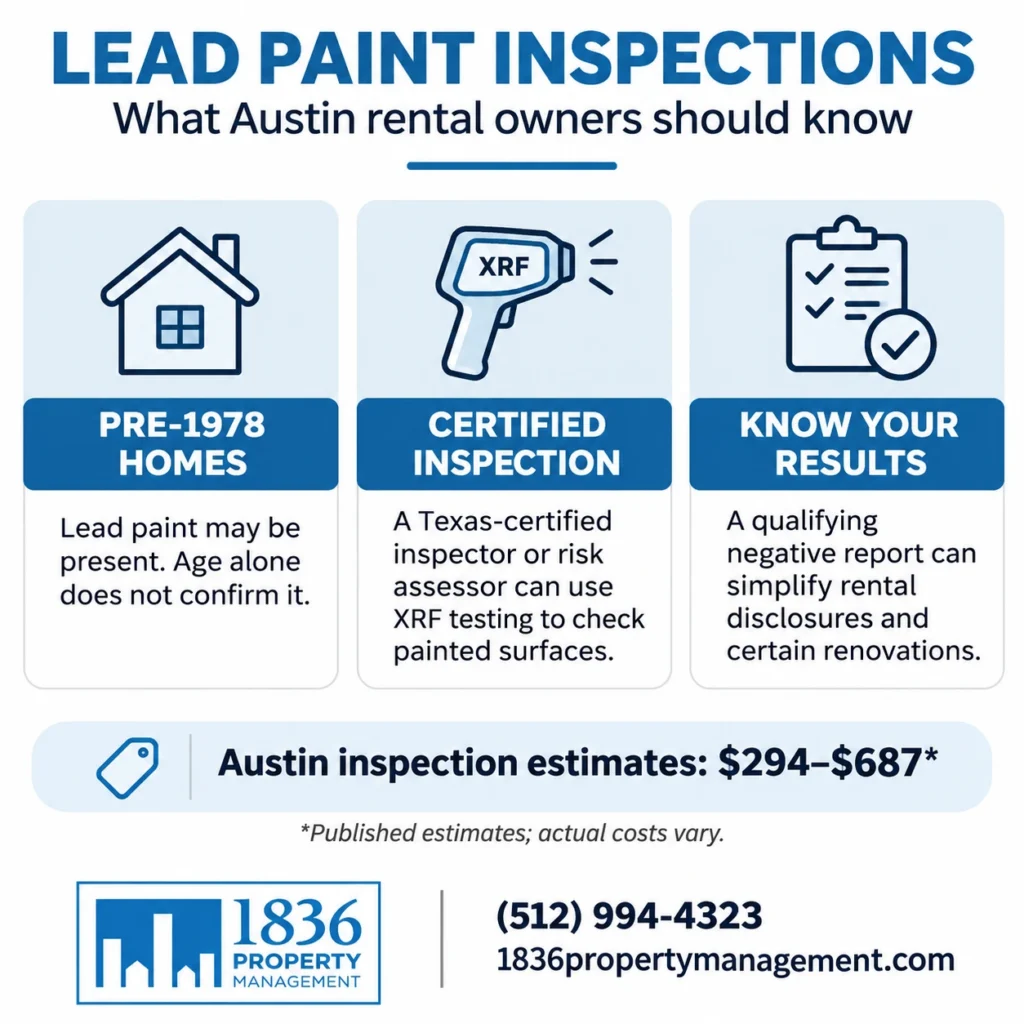
- In Austin, a lead paint inspection usually costs about $294 to $687, depending on the home’s size and the testing method.
- XRF testing can detect lead under newer layers of paint without damaging walls or trim.
- A report showing no lead-based paint exempts your leases from disclosure. If the report finds lead, you must disclose it to every future tenant and buyer.
- Texas lead rules don’t require landlords to test or to remove all lead paint, but peeling paint and other hazards still need to be fixed.
- Starting in 2027, 1836 will add $10 per month to the management fee for pre-1978 homes, unless an inspection report shows no lead-based paint.
A lead paint inspection is the only way to prove that an older Austin rental is free of lead-based paint. At 1836 Property Management, our team has 20 years of experience in Austin real estate, and we manage more than 900 homes across the area. Roughly 20% of those homes were built before 1978, so lead paint rules are part of our everyday work.
Here is why the year matters. Most leases on homes built before 1978 need a lead disclosure. In addition, federal renovation rules assume lead paint is present, so many repairs that disturb paint must be done by an EPA-certified firm. However, a certified inspection that finds no lead-based paint anywhere in the home exempts your leases from disclosure. It also lets regular vendors handle work on the surfaces it covers. About 28% of homes in Austin were built before 1980 (U.S. Census Bureau, American Community Survey 2020-2024 5-year estimates).
We do not take this risk lightly. At our old office, an EPA inspector once walked in unannounced and warned that refusing his questions could impede a federal investigation. Our attorney then referred us to a specialist who quoted $10,000 just for a brief consultation.
That risk is why our pricing is changing. Starting in 2027, managing a home built before 1978 will cost $10 more per unit each month. However, owners can avoid the charge with a lead paint inspection that shows no lead-based paint. Matt explains the change in the video below.
Not sure when your rental was built? Look up your address on the Travis or Williamson Central Appraisal District website.
Table of Contents
- What Is a Lead Paint Inspection?
- How Much Does a Lead Paint Inspection Cost in Austin?
- How Does XRF Lead Testing Work?
- Lead Paint Inspection vs. Risk Assessment vs. DIY Test Kits
- What Happens If Your Home Tests Positive or Negative?
- Lead Paint Rules for Pre-1978 Rental Properties in Texas
- How to Find a Certified Lead Paint Inspector in Texas
- What 1836 Property Management Is Doing for Owners of Older Rentals
- Frequently Asked Questions About Lead Paint Inspections
What Is a Lead Paint Inspection?
A lead-based paint inspection answers one question: does this home have lead paint, and if so, where? The Texas Department of State Health Services (DSHS) defines it as a surface-by-surface investigation by a certified lead inspector or certified lead risk assessor, including a written report of the results. A regular home inspector cannot do one unless they also hold that certification.
During a complete inspection, the professional evaluates interior and exterior painted components using approved testing procedures. These include walls, doors, trim, windows, cabinets, porches, and siding. The report identifies what was tested and the findings. Confirm that the service covers the whole property rather than selected rooms or repair areas. Most inspectors use an XRF scanner, although some send paint chips to an EPA-recognized lab.
In our experience, owners often expect a "lead-free certificate" with a state seal. In reality, the report itself is your proof. If a complete inspection finds no lead-based paint anywhere in the home, the property can be treated as lead-free.
In this guide, "lead-free" refers to a qualifying finding that no lead-based paint is present under federal standards. It does not mean the property has been tested for lead in dust, soil, or drinking water.
An inspection is not the same as a risk assessment, which we compare below.
How Much Does a Lead Paint Inspection Cost in Austin?
A lead paint inspection in Austin usually costs a few hundred dollars for a single-family home. According to Angi's 2026 cost data, the Austin average is about $491, and most jobs fall between $294 and $687. For a standard home of 1,000 to 2,500 square feet, Angi estimates roughly $345 to $490. While researching options for our owners, we received an initial quote of about $350. That is an early quote, not a final program price. We continue to hunt for a better bulk deal to provide for our clients.
Several factors move your lead paint inspection cost up or down:
- Home size and layout. More rooms mean more surfaces to test.
- Exterior surfaces. Siding, trim, porches, and railings all add test points.
- Testing method. Paint chip samples add lab fees, often $30 to $100 each.
- Number of units. A duplex or fourplex costs more than a single home.
- Add-ons. Dust or soil samples add cost.
Also, skip bargain "visual" lead checks. Angi lists them at $100 to $195 in Austin, but they cannot show that a home is lead-free.
We usually recommend scheduling the inspection during a turnover, when every room is easy to reach.
How Does XRF Lead Testing Work?
XRF lead testing uses a handheld X-ray fluorescence analyzer. It can detect lead beneath newer paint layers without removing the paint.
Most inspectors prefer XRF lead paint testing for three reasons:
- No damage. Nothing is cut or scraped.
- Fast results. Readings appear on the spot.
- A clear standard. Paint counts as lead-based at 1.0 milligram of lead per square centimeter, or 0.5% by weight.
Inconclusive readings may need a lab-tested paint chip, which adds time and cost.
Lead Paint Inspection vs. Risk Assessment vs. DIY Test Kits
These options answer different questions, and only one can show that a whole home is lead-free.
| Lead paint inspection | Lead risk assessment | DIY test kit | |
|---|---|---|---|
| What it answers | Is there lead paint, and where is it? | Is there a lead hazard right now? | Did this one spot test positive? |
| Who can do it in Texas | DSHS-certified lead inspector or risk assessor | DSHS-certified lead risk assessor | Anyone |
| Typical Austin cost | About $294 to $687 (Angi) | Usually more than an inspection | Usually under $50 |
| Can it show the home is lead-free? | Yes, if no lead-based paint is found | No | No |
| Can it clear repair work from lead-safe rules? | Yes, for surfaces found lead-free | Only for surfaces it tested | Only in the hands of an EPA-certified renovator |
A risk assessment makes sense when paint is peeling or a young child lives in the home. However, a home can pass one and still contain lead paint.
Can I Test for Lead Paint Myself?
Yes, you can buy a kit at most hardware stores. However, Texas health officials warn that kits can give false readings when used incorrectly. For a legal answer, a certified inspector or risk assessor has to do the testing.
There is one exception. Under federal rules, an EPA-certified renovator can use an EPA-recognized kit to clear the surfaces they are about to work on. That helps with one job, but it does not make the whole home lead-free. We often hear from owners who tested a few spots themselves. Unfortunately, those results do not count for leases or repairs.
What Happens If Your Home Tests Positive or Negative?
No Lead-Based Paint Found
A qualifying inspection that establishes the property is free of lead-based paint can exempt its leases from federal lead disclosure requirements. That exemption applies to leases, not a future sale. Repairs affecting components documented as free of lead-based paint may also be exempt from the RRP rule. Keep the report, share it with contractors before work begins, and send us a copy for review under our fee policy.
Some Lead-Based Paint Found
This often happens when original windows, doors, or trim were never replaced. The disclosure stays in your leases. Even so, you now know exactly which parts need lead-safe work. Work limited to surfaces documented as lead-free may be exempt from the RRP rule.
Lead-Based Paint Throughout
Disclosure continues, and larger repairs that disturb paint need an EPA-certified firm. However, Texas lead rules do not require you to remove all lead paint. According to DSHS, intact lead paint is usually not a hazard, except on doors, windows, and other surfaces that rub or get bumped. Not having to remove all lead-based paint does not mean a landlord can ignore peeling paint or other identified hazards.
One Tradeoff to Know Before You Test
Once a report finds lead, it becomes "known" lead-based paint. Federal rules then require you to disclose it, including its location and condition, to every future tenant and buyer. In our experience, the information is still worth having, because guessing does not lower your risk.
Lead Paint Rules for Pre-1978 Rental Properties in Texas
Most lead paint rules for Austin rentals are federal. Texas licenses the inspectors but does not require landlords to test. These rules sit right alongside the Texas Property Code requirements every Austin landlord follows.
Lead-Based Paint Disclosure in Texas
Under the federal lead disclosure rule, landlords of pre-1978 homes generally must do four things before a tenant signs a lease:
- Disclose any known lead-based paint or lead hazards in the home.
- Share any lead reports or records they have.
- Give the tenant the EPA pamphlet "Protect Your Family From Lead in Your Home."
- Include the required Lead Warning Statement, disclosures, acknowledgments, and signatures in the lease or an attachment. Keep the completed documentation for at least three years from the start of the leasing period.
In Texas, this is usually done with the Texas REALTORS Addendum Regarding Lead-Based Paint (TXR 2008), not the sales form. A renewal generally does not require a new disclosure if all required information was previously provided and the landlord has received no new lead-related information. We treat this addendum as a standard part of making a home rent ready.
Repairs and Renovations: The RRP Rule
The EPA's Renovation, Repair and Painting (RRP) rule covers paid work that disturbs paint in pre-1978 homes. It applies when a job disturbs more than 6 square feet of interior paint per room or more than 20 square feet outside. It also covers every window replacement. Work in the same room within 30 days counts as one job, and banned methods like torching paint cancel the small-job exemption. When it applies, an EPA-certified firm must use lead-safe practices like plastic containment and special cleanup. Because rent counts as payment, the rule also covers landlords who do repairs on their own rentals.
For owners, that means fewer eligible vendors, longer turnovers, and higher bids. Our make-ready standards call for clean paint and patched walls between tenants. On a pre-1978 home, that routine prep can trigger the RRP rule, and we have seen simple turnover paint jobs become certified jobs. For day-to-day repairs, see our maintenance expectations for owners.
Landlord and Property Manager Responsibilities
Federal law makes property managers responsible for making sure owners comply. Penalties can reach tens of thousands of dollars per violation, and the caps rise each year. A landlord who knowingly breaks the rule can also owe a harmed tenant three times their damages. That shared liability is why we price in the risk on older homes, and why the right landlord liability coverage matters.
How to Find a Certified Lead Paint Inspector in Texas
In Texas, lead paint inspection certification comes from DSHS. Both certified lead inspectors and certified lead risk assessors can perform a full inspection. Before you book anyone, look them up on the DSHS Find a Licensee page. Certified pros must also carry a state-issued ID card on the job.
Then ask these questions before you hire a lead paint inspector:
- Will you do a full lead-based paint inspection, or only a risk assessment?
- Will you use XRF, paint chips, or both?
- Does the inspection cover the exterior and porches, not just the inside?
- Will the report list every component tested and its result?
- How soon will I get the written report?
In our experience, the last two questions matter most, because a vague report is hard to use with vendors or buyers.
What 1836 Property Management Is Doing for Owners of Older Rentals
Starting in 2027, we will add $10 per unit, per month, to the management fee for homes built before 1978. This is an 1836 management charge, not an EPA fee or a Texas testing requirement. We are sharing this early because we would rather bring you a solution than a problem.
The charge covers the extra documentation, vendor screening, and compliance checks older homes need, since federal rules hold property managers responsible too. See our guide to what property management costs in Austin.
You can avoid the charge with a lead paint inspection report showing no lead-based paint. To make that easier, we are lining up a certified inspection partner with group pricing. We’re working to secure group pricing that could reduce inspection costs for participating owners. We will share pricing and next steps once the program is ready.
Here is what you can do now:
- Current owners: Already have a report? Send it to your property manager before paying for another inspection. Otherwise, just let them know you are interested.
- Owners considering 1836: Schedule a call to talk through your home and our pricing.
- Anyone who knows a great inspector: Send any certified lead inspector who uses XRF our way for our preferred vendors directory.
Frequently Asked Questions About Lead Paint Inspections
Do All Houses Built Before 1978 Have Lead?
No, and the odds depend on age. HUD's national housing survey found lead-based paint in most homes built before 1960. For homes built from 1960 to 1977, the rate was closer to 1 in 4. Still, federal renovation rules treat every pre-1978 home as if it has lead until testing shows otherwise.
Can I Live in a House With Lead Paint?
Yes. Many families live safely in older homes, because intact lead paint is usually not a hazard. The real danger is chipping paint and the dust it creates, especially for young children and pregnant women.
Should You Waive a Lead Paint Inspection?
Federal rules give buyers of pre-1978 homes 10 days to get a lead inspection or risk assessment, and many buyers waive it. If you plan to rent the home out, we usually advise against waiving it. The result affects your disclosures, your repair costs, and, with 1836, your monthly fee. Waiving it also does not waive the seller's duty to disclose known lead.
How Long Is a Lead Paint Inspection Valid?
Federal disclosure rules do not set an expiration date on a finding that a home is free of lead-based paint. Because lead paint has not been sold for homes since 1978, new paint will not change the result. Keep the report permanently. A risk assessment only reflects conditions on the day of the visit.
Who Pays for a Lead Paint Inspection on a Rental?
The owner usually pays, since the report stays with the property.
Is Lead Paint Testing Required in Texas?
No. The Texas Environmental Lead Reduction Rules do not require landlords to test older rentals or remove all lead paint. However, separate housing-program requirements and duties to address unsafe conditions may apply. Federal disclosure and renovation requirements still apply unless a specific exemption is available.
This article is general information, not legal advice. Lead paint rules can change, so confirm current requirements with the EPA, HUD, Texas DSHS, or a qualified attorney before you act.