






TL;DR
- Austin rental late fees follow Texas Property Code §92.019, not a separate city rule.
- A landlord can only charge a late fee if it is written in the lease, reasonable, and rent is unpaid for at least two full days after the due date.
- Caps are 12% of monthly rent for properties with four or fewer units and 10% for properties with five or more, and the cap includes both flat fees and any daily charges combined.
- A new 2026 Texas law gives tenants a limited one-time right to pay late rent and avoid eviction on a first-time miss during the current lease term, though the late fee itself still applies.
- Landlords should keep lease language clear and apply policies consistently; tenants should set up autopay, verify it activated, and compare any fee charged against the legal cap.
Late fees for rent in Texas are governed by clear rules under state law, and getting them wrong can be costly for landlords and confusing for tenants. As a full-service Austin property management company, 1836 Property Management oversees over 900 rental properties in 25+ service areas across Austin and Central Texas. Across that portfolio, Austin rental late fees are one of the most common compliance questions we hear from both owners and residents. Our team includes multiple Licensed Realtors and broker-licensed professionals who work daily with leases that must comply with Texas Property Code §92.019. This guide explains what landlords can legally charge, what tenants should expect, and how Austin compares to the rest of the state.
Table of Contents
- Austin Rental Late Fees: What Texas Law Actually Says
- What Is the Maximum Late Fee Allowed by Law in Texas?
- The Two-Day Grace Period Explained
- Are Austin Rental Late Fees Different from the Rest of Texas?
- Can a Landlord Ever Charge More Than the Safe Harbor Cap?
- What Happens When a Tenant Refuses to Pay Late Fees?
- How Many Days Late Can You Be on Rent Before Eviction?
- Penalties for Charging Illegal Late Fees in Texas
- Tips for Landlords: Staying Compliant with Texas Late Fee Law
- Tips for Tenants: What You Should Know
- Frequently Asked Question
Austin Rental Late Fees: What Texas Law Actually Says
In Texas, late fees on residential rentals are not left up to the landlord's discretion. Texas Property Code §92.019 controls residential late fees statewide. This law applies to every residential rental property in Texas.
Under this law, a landlord can only collect a late fee if three things are true:
- The lease includes a written notice of the late fee.
- The fee is reasonable.
- The rent has been unpaid for at least two full days after the due date.
If any of those requirements are missing, the landlord may not be able to collect the fee. In other words, a landlord cannot decide on a whim to start charging late fees, and they cannot charge them the moment rent is one day late.
What Is the Maximum Late Fee Allowed by Law in Texas?
This is the question we hear most often, and the answer depends on the size of the property.
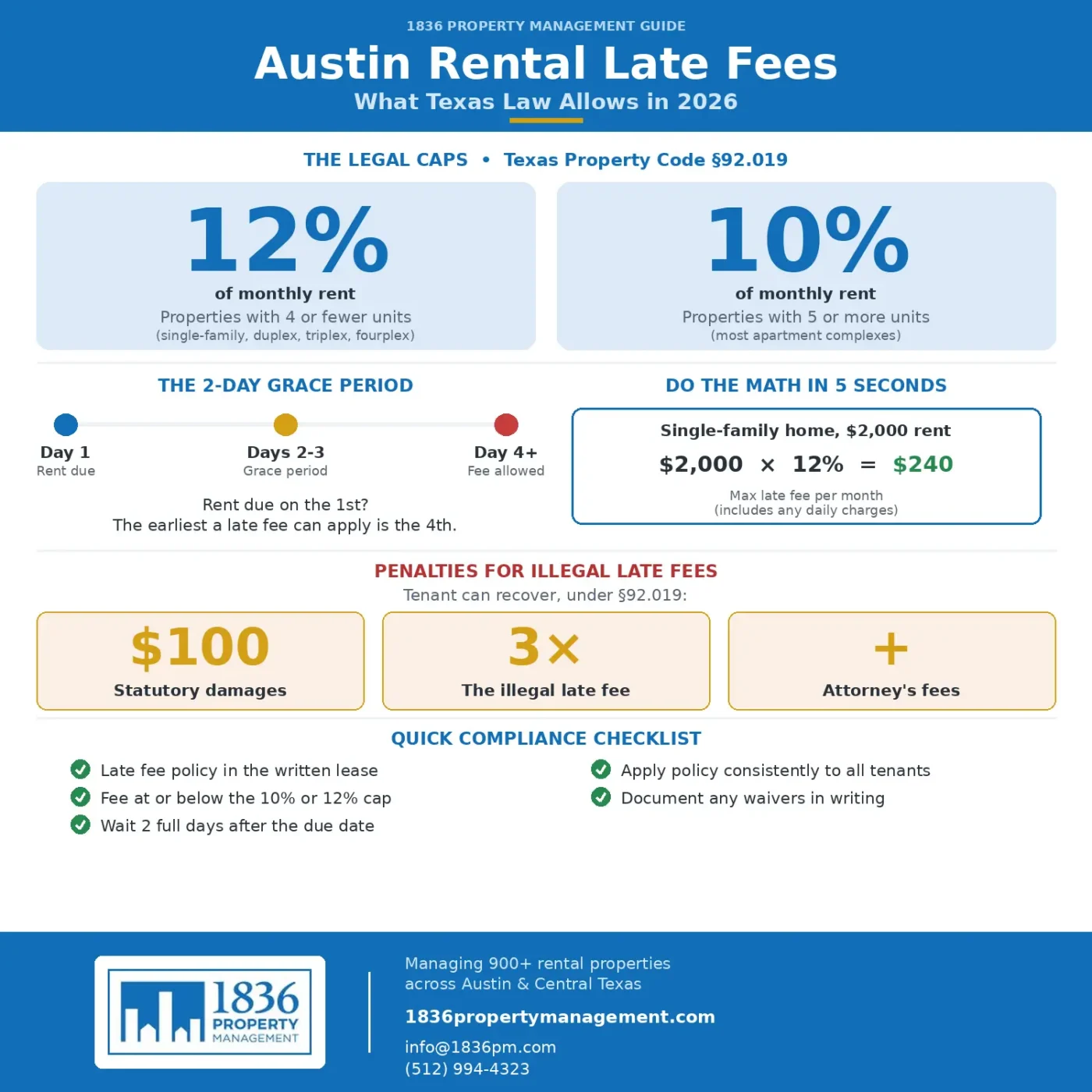
For properties with four or fewer units (this includes most single-family rentals, duplexes, triplexes, and fourplexes), the late fee cannot exceed 12% of the monthly rent.
For properties with more than four units (most apartment complexes), the cap drops to 10% of the monthly rent.
These percentages are known as the "safe harbor" amounts. As long as the fee stays within those limits, the law automatically considers it reasonable. The cap also includes any combination of an initial fee and daily late charges. For example, a landlord cannot charge a $75 initial fee and then add $10 per day if the total would push past the 10% or 12% ceiling.
You Don't Need a Rent Late Fee Calculator. Here's How to Figure Out What You Can Charge.
Many websites push rent late fee calculators, but the math is simple enough to do on your own.
- Take the monthly rent amount.
- Multiply it by 0.12 (for single-family and small properties) or by 0.10 (for larger apartment buildings).
- That number is the maximum the landlord can charge in late fees that month, including any daily fees.
So if rent is $2,000 a month on a single-family home in Austin, the most a landlord can charge in late fees is $240. If rent is $1,500 in a large apartment complex, the cap is $150.
Maximum Late Fee at Common Austin Rent Amounts
For quick reference, here is what the safe harbor caps look like in real dollars across typical Austin rent levels. These numbers represent the total combined cap for any initial flat fee and any daily fees added together.
| Monthly Rent | Single Family or Small Property (12% Cap) | Apartment Complex 5+ Units (10% Cap) |
|---|---|---|
| $1,500 | $180 | $150 |
| $1,800 | $216 | $180 |
| $2,000 | $240 | $200 |
| $2,500 | $300 | $250 |
| $3,000 | $360 | $300 |
| $3,500 | $420 | $350 |
A landlord may charge less than these caps, but never more. Any fee at or below these amounts is automatically considered reasonable under §92.019.
The Two-Day Grace Period Explained
Texas law builds in a short grace period before any late fee can apply. If rent is due on the 1st of the month, the landlord cannot charge a late fee until the 4th. That means rent must be unpaid for two full days before the fee kicks in.
This rule sometimes surprises both landlords and tenants. Some leases mistakenly try to charge a late fee on day two, but doing so violates the state code. Even if your lease lists a different start date, the law overrides it.
Are Austin Rental Late Fees Different from the Rest of Texas?
Short answer: no. Austin does not have its own separate cap or city-specific late fee ordinance. Texas rental late fee laws are the same and apply whether the property sits in downtown Austin, Pflugerville, Round Rock, Cedar Park, Buda, Georgetown, Lakeway, or any of the other cities in the greater Austin area.
This consistency is helpful for owners who hold multiple properties across the metro. The lease language can stay the same regardless of which city the home is in, as long as it complies with Texas Property Code §92.019.
Can a Landlord Ever Charge More Than the Safe Harbor Cap?
Technically, yes. The law allows a higher fee if the landlord can prove that the actual damages from the late payment exceed the safe harbor amount. These damages might include collection costs, administrative time, or other documented expenses.
However, this path is risky. The landlord must prove the higher amount in court if the tenant disputes it. In practice, most Austin-area landlords stay within the 10% or 12% safe harbor because doing otherwise invites a legal fight that is rarely worth it. We always advise the owners we work with to stay within the statutory cap.
What Happens When a Tenant Refuses to Pay Late Fees?
Late fees in Texas are considered separate from rent itself. In many cases, eviction is tied to unpaid rent or another lease violation, not late fees alone. That said, lease language matters: if the lease defines late fees as additional rent, the picture can change. When rent goes unpaid for an extended time, the standard next step is the eviction process. In Texas, this typically begins with a three-day notice to vacate, though leases can specify a different period. For a complete walk-through, see our guide on what to do when your tenant doesn’t pay rent.
How Many Days Late Can You Be on Rent Before Eviction?
There is no exact "magic number" of days that triggers eviction in Texas. However, here is the typical timeline:
- Day 1: Rent is due.
- Day 4: Late fee can be charged (after the two full days of grace).
- Day 5 to 10: Most landlords issue a written reminder or notice.
- After that: The landlord can issue a three-day notice to vacate, which is the legal first step toward eviction.
Many leases require a longer notice period before the notice to vacate is issued. The specific timeline depends on the lease, the landlord's procedures, and how quickly the tenant communicates. Eviction itself can take several more weeks after the notice is served.
How a Single Late Payment Adds Up
To see how the numbers work in practice, here is what a single late month looks like on a $1,800 single-family rental in Austin where the lease includes a $100 initial fee plus $10 per day:
- Day 1: Rent due. No fee yet.
- Day 4: Grace period ends. The $100 flat fee applies.
- Days 5 through 10: Daily fees of $10 accrue, adding $60 over six days.
- Day 10: Tenant pays. Total late fee owed: $160.
That $160 sits well under the 12% cap of $216 for a single-family rental at this rent level. If the same rent were $1,500 in an apartment complex, the cap would be $150, and daily fees would stop accruing the moment that ceiling was reached, even if rent was still unpaid. Knowing where the cap lands keeps both sides clear on what is and isn't owed.
New for 2026: The Right to Pay Late Rent and Avoid Eviction
A Texas law that took effect in January 2026 gives tenants a limited one-time right to pay late rent and avoid eviction. The right applies only when it is the tenant's first late payment during the current lease term and the tenant is only behind on one month of rent. In those cases, the landlord must issue a Notice to Pay Rent or Vacate before filing for eviction, giving the tenant a defined window to cure the missed payment.
This law does not erase the late fee itself, and it does not protect repeat late payments. But it does change the eviction calculus on a first-time miss, and Austin-area landlords should make sure their notice procedures align with the new requirement.
Penalties for Charging Illegal Late Fees in Texas
This is where Texas landlords need to pay close attention. If a landlord charges a late fee in violation of §92.019, the tenant can sue and recover:
- $100
- Three times the amount of the illegal late fee
- The tenant’s reasonable attorney’s fees
Even a small overcharge can result in a costly judgment. For instance, an extra $50 charged improperly can balloon into well over $250 plus attorney’s fees, which can often push the total past $1,000. This is why getting the lease language right matters so much, and why working with experienced Texas rental property compliance professionals reduces risk.
Tips for Landlords: Staying Compliant with Texas Late Fee Law
If you are an Austin-area landlord, here are the core rules to follow:
- Always include the late fee policy in the written lease. Verbal agreements are not enforceable.
- Set the fee at or below 12% (single-family and small multifamily) or 10% (larger apartments).
- Wait at least two full days after the due date before charging any fee.
- Apply your policy consistently across all tenants to comply with fair housing rules.
- Document any waiver decisions in writing.
- Review any “allocation of payments” clause in your lease. Some leases allow the landlord to apply a partial rent payment to outstanding fees first, which can leave the current month’s rent short and trigger another round of late fees the next month. This can create cascading charges that feel unfair to a tenant who thought they had paid, and it is a common source of disputes. Make sure the clause is clear, consistent with state law, and applied the same way for every resident.
If this is your first rental, our guide to renting for the first time covers the broader lease basics.
1836PM approach: While Texas law may allow late fees up to 10% or 12% of rent, 1836 Property Management takes a balanced approach. As part of our Resident Benefits Package, we waive our residents’ first late fee. In our experience managing nearly a thousand Austin and Central Texas rentals, a one-time miss is not always a sign of a serious problem. Clear lease terms, respectful communication, and strong resident placement help protect long-term owner returns.
Of course, this approach works best when the right resident is placed from the start. That is why reducing late rent issues often begins through thorough tenant screening, before the lease is ever signed.
Tips for Tenants: What You Should Know
If you are renting in Austin or the surrounding area, here is what protects you:
- Read your lease carefully and note the exact late fee terms.
- Confirm that your landlord is following the two-day grace period.
- Compare the fee charged against the 10% or 12% cap.
- Keep records of every rent payment and any communication about late fees.
- Set up autopay through your resident portal, and verify a few days before the first due date that it is actually active. Many late payments come from autopay enrollments that were never fully confirmed.
- If your paycheck schedule doesn’t line up well with a rent due date on the 1st, keep a small buffer set aside so your rent comes from last month’s pay, not this month’s.
- If you believe the fee violates Texas law, you can raise it directly with the landlord first or seek help from organizations like the Texas State Law Library or the Texas Tenant Advisor.
Some tenants use rent-splitting apps like Flex to pay rent in two installments per month. These services can help if your paycheck cycle genuinely doesn’t fit a single monthly payment, but they typically cost around $25 to $40 per month in fees, which adds up to several hundred dollars per year. For most renters, free options like autopay, calendar reminders, and a small rent buffer prevent the same late payments without the subscription cost. Worth running the numbers before signing up.
Frequently Asked Questions
What is the maximum late fee allowed by law in Texas?
The maximum is 12% of the monthly rent for properties with four or fewer units, and 10% for properties with more than four units. These limits include both initial fees and any daily fees combined.
What is a reasonable late fee for rent in Texas?
Any fee within the 12% or 10% safe harbor is automatically considered reasonable under Texas Property Code §92.019. Most Austin-area landlords set their fee between 5% and 10% of rent to stay safely below the cap while still encouraging on-time payment.
Does Austin have its own late fee rules?
No. Austin follows Texas state law. The same 10% and 12% caps apply citywide and in the greater Austin area, including Round Rock, Pflugerville, Cedar Park, Georgetown, Kyle, Buda, Lakeway, and surrounding cities.
Can a landlord charge a late fee on day one of being late?
No. Texas law requires at least two full days of late payment before any fee can be charged. If rent is due on the 1st, the earliest the fee can apply is the 4th.
How many days late can you be on rent before eviction in Texas?
There is no statewide "magic number." In many nonpayment cases, the process starts with written notice to vacate before an eviction lawsuit can be filed. Texas law generally requires at least three days' notice, unless the lease allows a shorter or longer period.
What happens if my landlord charges an illegal late fee?
Under Texas Property Code §92.019, a tenant can recover $100, three times the illegal late fee, and reasonable attorney's fees. Tenants can pursue this through small claims court or with the help of an attorney.
Are late fees considered rent in Texas?
By default, no. Late fees are separate from rent and usually cannot be used as the sole grounds for eviction. However, some leases define late fees as additional rent. Always check your lease for specific language.
Do late fee rules apply to short-term and commercial rentals?
Texas Property Code §92.019 applies to residential rentals. Commercial leases and short-term rentals follow different rules and generally allow higher fees that are negotiated between the parties.