






Can a landlord deny an emotional support animal? It is one of the most common questions we hear from rental property owners in Austin. And the honest answer is: usually no, but it depends on the situation and the documentation.
Getting this wrong has real consequences. A misstep can lead to a fair housing complaint, a discrimination lawsuit, and significant financial penalties. As a local property management company, we have been helping Austin-area landlords navigate exactly these situations for over 20 years. Our team manages more than 900 properties across the greater Austin area, and fair housing compliance is a standard part of everything we do.
Before you can answer whether you can deny an emotional support animal at your rental property, you need to understand the difference between a service animal vs emotional support animal. These two terms are often used interchangeably, but they are not the same thing. They are protected by different federal laws, they come with different documentation rules, and landlords face different obligations for each. Understanding that distinction is the foundation of everything in this guide.
TL;DR
- In most cases, a landlord cannot deny an emotional support animal if the tenant provides valid documentation from a licensed mental health professional.
- Service animals and emotional support animals are legally different and protected by different federal laws.
- Service animals are covered by the ADA. Emotional support animals are covered by the Fair Housing Act.
- Landlords cannot charge pet fees or deposits for either type of assistance animal.
- Landlords CAN request documentation for ESAs, but not for service animals.
- There are limited, specific situations where a landlord can legally deny an ESA.
- Texas has added its own penalties for misrepresenting an animal as a service animal.
Table of Contents
- What Is an Assistance Animal?
- Service Animal vs Emotional Support Animal: What Is the Difference?
- Can a Landlord Deny an Emotional Support Animal?
- Key Differences at a Glance
- ESA Landlord Rights: Federal Law Is the Foundation
- Assistance Animals and the Tenant Screening Process
- Protecting Your Property
- The Bottom Line for Austin Landlords
- Frequently Asked Questions
What Is an Assistance Animal?
Before getting into the differences, it helps to know the umbrella term. The federal Fair Housing Act (FHA) uses the term “assistance animal” to cover both service animals and emotional support animals. Under the FHA, an assistance animal is not considered a pet. That distinction matters a great deal when it comes to your pet policies, deposits, and fees.
There is also a third category that sometimes causes confusion: therapy animals. Therapy animals provide comfort in clinical or group settings, like hospitals or schools. They are not protected under the FHA or the ADA for housing purposes. If a tenant claims housing rights for a therapy animal, that protection does not exist under federal law. You can apply your normal pet policy.
Service Animal vs Emotional Support Animal: What Is the Difference?
This is the question at the heart of most landlord confusion. A service animal and an emotional support animal may look the same sitting on a tenant's couch, but legally they are very different.
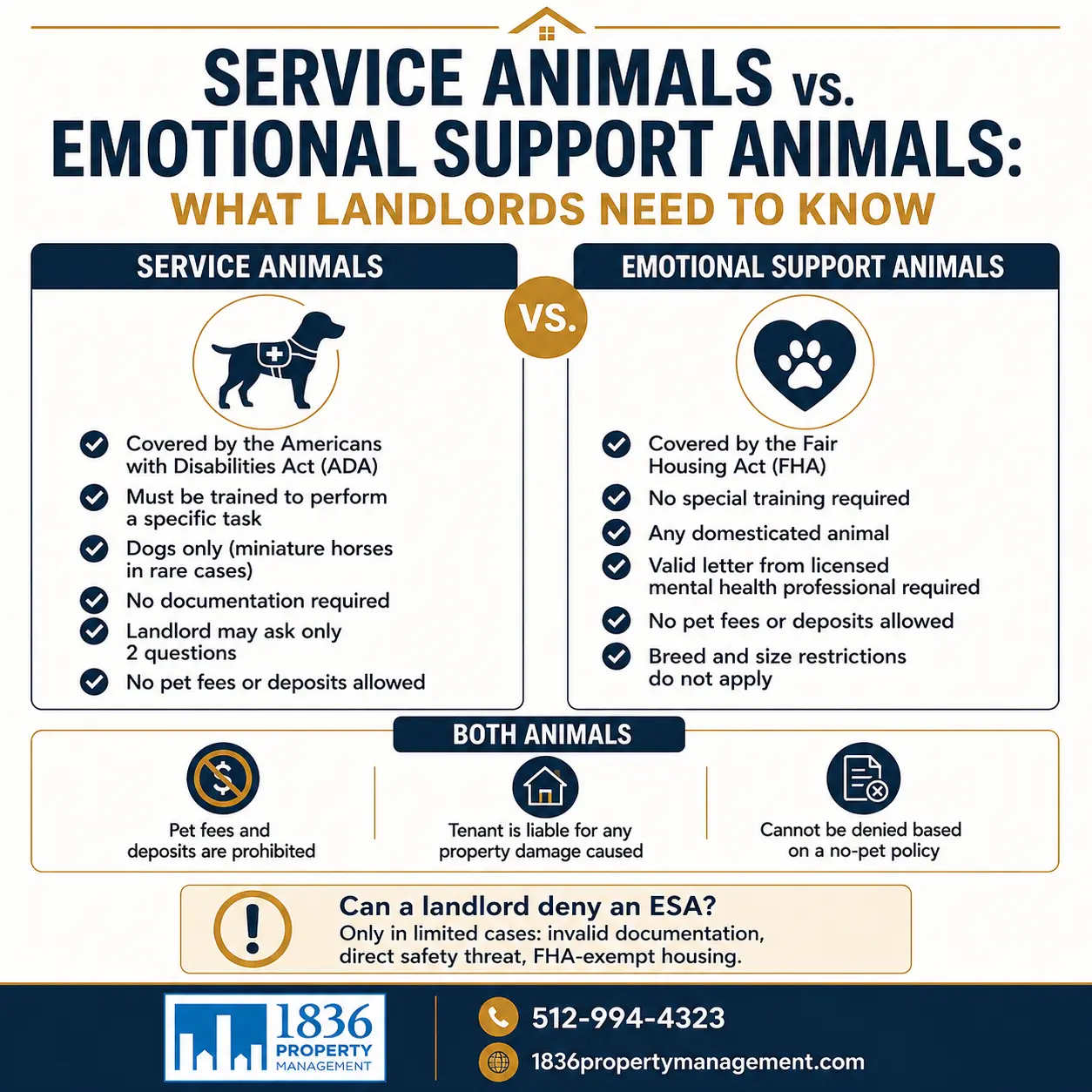
A service animal is trained to perform a specific task for a person with a disability. An emotional support animal provides comfort simply by being present and requires no specialized training. That difference in training is what drives the difference in legal protection, documentation requirements, and what you as a landlord are allowed to ask.
Let us break each one down fully.
Service Animals
What the Law Says
Service animals are defined and protected under the Americans with Disabilities Act (ADA). Under the ADA, a service animal is a dog that has been individually trained to perform a specific task directly related to a person's disability. In rare cases, a miniature horse may also qualify.
The key word is "trained." A service animal must perform specific work tied to the handler's disability. Common examples include:
- Guide dogs that assist people who are blind
- Hearing alert dogs for people who are deaf
- Seizure alert or response dogs
- Dogs trained to detect dangerous drops in blood sugar
- Psychiatric service dogs trained to interrupt self-harm or perform grounding tasks
Because service animals perform specific trained tasks, they carry very strong legal protections. As a landlord, your ability to question or deny them is extremely limited.
What Landlords Can and Cannot Do With Service Animals
Under the ADA, you are allowed to ask only two questions when a tenant or applicant presents a service animal:
- Is this a service animal required because of a disability?
- What task or work has the animal been trained to perform?
That is it. You cannot ask for documentation. You cannot ask for proof of training or certification. You cannot ask about the nature of the person's disability. Asking too many questions or the wrong questions can itself be considered a fair housing violation.
You also cannot:
- Charge a pet deposit or pet fee for a service animal
- Enforce breed or size restrictions against a service animal
- Deny housing because of your no-pet policy
- Require the animal to wear a vest or carry identification
The only situation where you can ask a service animal to be removed is if it is out of control and the handler is not correcting the behavior, or if the animal poses a direct and documented threat to the health or safety of others.
Emotional Support Animals
What the Law Says
Emotional support animals are different from service animals in several important ways. They do not need to be trained to perform a specific task. Their presence alone provides therapeutic benefit to their owner. And they are not covered by the ADA.
Instead, ESAs are protected under the Fair Housing Act and HUD guidelines. The FHA requires most landlords to make a reasonable accommodation for a tenant who has a qualifying disability and a documented need for an emotional support animal. This applies even if you have a strict no-pet policy.
Unlike service animals, ESAs can be almost any type of domesticated animal. Dogs and cats are most common, but birds, rabbits, hamsters, and fish can also qualify. Reptiles and barnyard animals generally do not.
What Landlords Can and Cannot Do With ESAs
This is where landlords have a bit more room to work compared to service animals. But that room is more limited than many landlords assume.
You CAN:
- Request a letter from a licensed mental health professional confirming the tenant has a disability and that the ESA is part of their treatment
- Verify that the letter comes from a real, licensed provider such as a therapist, psychologist, psychiatrist, or social worker
- Require that the letter be current. ESA letters are typically valid for one year.
- Contact the provider to confirm the letter is legitimate, without asking for medical details
- Deny an ESA request if the animal poses a documented, direct safety risk to others
- Hold the tenant financially responsible for any damage the animal causes beyond normal wear and tear
You CANNOT:
- Charge a pet deposit, pet fee, or pet rent for an ESA
- Enforce breed, weight, or size restrictions against an ESA
- Ask for detailed medical records or a specific diagnosis
- Deny housing simply because the applicant has an ESA
- Ignore or unreasonably delay an ESA accommodation request
It is also worth knowing that online ESA certification websites and registries have no legal standing. A tenant cannot buy a certificate from a website and claim fair housing protection. Valid documentation must come from a licensed mental health professional who has actually evaluated the tenant.
What Should a Valid ESA Letter Include?
Since documentation is where most disputes begin, knowing what a legitimate ESA letter should contain is important. A valid letter should include:
- The provider's name, license type, license number, and issuing state
- The date the letter was written
- Confirmation that the tenant is a current patient or client
- A statement that the tenant has a disability as defined under the FHA
- A statement that the ESA is necessary as part of their treatment or support
- The provider's signature
A letter that is missing these elements, comes from an online service, or cannot be verified through the listed provider should be treated with caution. Consult a landlord-tenant attorney before denying a request based on documentation concerns.
Can a Landlord Deny an Emotional Support Animal?
This is the core question. And the answer requires an honest look at what the law actually allows.
When You Can Legally Deny an ESA
You can legally deny an emotional support animal accommodation request in these specific circumstances:
- Invalid documentation. The tenant cannot provide a valid letter from a licensed mental health professional, or the letter cannot be verified.
- Direct threat. The specific animal poses a direct, documented threat to the health or safety of others that cannot be reduced through reasonable means.
- Substantial property damage. The animal would cause significant physical damage to the property that cannot be addressed through other measures.
- FHA-exempt housing. Your property falls into one of the exempted categories under the Fair Housing Act.
When You Cannot Deny an ESA
You cannot deny an emotional support animal based on:
- Breed, size, or species alone
- Your existing no-pet policy
- Your insurance policy's breed or animal restrictions
- A personal belief that the tenant does not really need the animal
- The fact that other tenants do not have ESAs
HUD guidelines are clear that insurance breed restrictions are not an acceptable reason to deny a legitimate ESA accommodation. Landlords are expected to seek alternative coverage rather than use their policy as grounds for denial.
FHA Exemptions
Not all housing is covered by the Fair Housing Act. The following types of housing are generally exempt:
- Owner-occupied buildings with four or fewer units
- Single-family homes rented directly by the owner without a real estate agent or broker
- Housing owned and operated by religious organizations or private clubs for their members
If your property falls into one of these categories, you may have more flexibility. That said, it is still wise to consult a landlord-tenant attorney before denying any assistance animal request.
Key Differences at a Glance
| Service Animal | Emotional Support Animal | |
|---|---|---|
| Covered by | ADA | Fair Housing Act |
| Training required | Yes, specific task training | No |
| Animal type | Dog or miniature horse | Any domesticated animal |
| Documentation required | No | Yes, licensed professional letter |
| Pet fees allowed | No | No |
| Breed or size restrictions apply | No | No |
| Landlord questions allowed | 2 specific questions only | Can request documentation |
| Public access rights | Yes | No (housing only) |
ESA Landlord Rights: Federal Law Is the Foundation
Most of what landlords need to know comes from two federal laws: the ADA and the Fair Housing Act. State laws typically follow the federal framework, so for most practical purposes landlords are working within federal rules. However, some states and localities add their own layer of requirements worth knowing.
There are two Texas-specific items worth briefly noting. Texas HB 4164 makes it a Class B misdemeanor to fraudulently misrepresent an animal as a service or assistance animal, with penalties up to $1,000 and 30 hours of community service. Additionally, in Henderson v. Five Properties LLC (2025), a federal judge ruled that landlords are not automatically required to waive fees for ESA tenants. The tenant must show the waiver is actually necessary for housing access. That case originated in Louisiana and is not binding in Texas, but it signals how courts may increasingly evaluate these requests. Both are useful context, but the FHA and ADA remain the governing rules for the vast majority of landlord obligations.
Assistance Animals and the Tenant Screening Process
One place landlords regularly run into fair housing trouble is during the tenant screening process. It is easy to accidentally cross a legal line while trying to assess a tenant's assistance animal request.
Here are some guidelines to keep your process compliant:
- Treat all assistance animal requests the same way for every applicant
- Never ask about the nature or severity of a disability
- Document every step of the process and keep records of all accommodation requests and your responses
- Respond to requests promptly. Unreasonable delays can be viewed as discriminatory.
- If you deny a request, document the specific, lawful reason in writing
- When in doubt, consult a landlord-tenant attorney before taking action
Your rental application criteria still applies fully to the tenant themselves. You can screen for income, credit, rental history, and background. You simply cannot use the presence of an assistance animal as a basis for rejection or additional fees.
Protecting Your Property
Even though you cannot charge pet fees for assistance animals, you are not without recourse when it comes to property damage. Tenants are legally responsible for damage their assistance animal causes beyond normal wear and tear. You can charge for those repairs when the tenancy ends.
Good documentation is your best protection. Conduct a thorough move-in inspection with photos and a signed condition report. Do the same at move-out. A clear record makes it much easier to justify deductions from the security deposit if needed.
You should also review your landlord insurance policy to confirm it covers animal-related damage. Some policies have limitations around certain breeds or animal types. Knowing your coverage before a tenant moves in is far better than finding out after a claim.
The Bottom Line for Austin Landlords
Can a landlord deny an emotional support animal? In most cases, no. The Fair Housing Act creates a strong legal obligation to accommodate tenants with documented ESA needs. The exceptions are real, but they are narrow. And the cost of getting it wrong, whether through an improper denial or an illegal fee, can be significant.
Managing these requests correctly requires knowing the law, following consistent procedures, and keeping solid documentation. It is one of the more nuanced parts of being a landlord. And it is exactly the kind of thing that many experienced area landlords choose to hand off to a professional property management team.
At 1836 Property Management, our team handles fair housing compliance as a standard part of every lease and application. We have navigated these situations hundreds of times across our portfolio of 900+ Austin-area properties. We know how to protect you while treating tenants fairly and staying on the right side of the law.
Not sure how to handle an assistance animal request at your property? Our team is happy to help!
Frequently Asked Questions
Can a landlord deny an emotional support animal?
In most cases, no. If a tenant provides a valid ESA letter from a licensed mental health professional, you are generally required to make a reasonable accommodation under the Fair Housing Act. The limited exceptions include cases where the animal poses a documented safety risk, the property is FHA-exempt, or the documentation is invalid or unverifiable.
What is the difference between a service animal vs emotional support animal?
A service animal is trained to perform a specific task for a person with a disability and is covered by the ADA. An emotional support animal provides comfort through its presence, requires no special training, and is covered by the Fair Housing Act. The laws governing each are different, and so are landlord obligations for each.
Can I charge a pet deposit for a service animal or ESA?
No. Federal law prohibits charging pet fees, pet rent, or pet deposits for service animals or emotional support animals. However, you can charge the tenant for actual property damage the animal causes, beyond normal wear and tear.
Do I have to accept any animal a tenant claims is an ESA?
No. You have the right to request a valid letter from a licensed mental health professional. The letter must confirm the tenant has a disability and that the ESA is part of their treatment. Online registrations and certificates from websites are not valid documentation.
What questions can I ask about a service animal?
Only two: whether the animal is required because of a disability, and what task or work it has been trained to perform. You cannot ask for documentation, proof of training, or any details about the person's disability.
What if my insurance does not cover certain breeds?
HUD guidelines make clear that insurance breed restrictions are not an acceptable reason to deny an assistance animal. You are expected to seek alternative coverage rather than use your policy as grounds for denial. This is worth discussing with your insurance provider before a situation arises.
Does a tenant have to tell me upfront they have an assistance animal?
No. A tenant can request an accommodation at any point, including after signing the lease. You are required to consider the request whenever it is made, not just during the application process.
What is the difference between an ESA and a therapy animal?
An ESA provides benefit to its owner personally and is protected under the Fair Housing Act for housing. A therapy animal provides comfort in group or clinical settings and carries no federal housing protections. You are not required to accommodate a therapy animal under fair housing law.
Can a tenant have more than one ESA?
Possibly. If a licensed mental health professional determines that multiple animals are each necessary for the tenant's disability, the request may be valid. Having a large number of ESAs could be considered unreasonable under the FHA, but each situation must be evaluated individually.
What should I do if I think an ESA letter is fake?
Contact the provider listed on the letterhead to verify the letter is legitimate. Do not express doubt directly to the tenant. If you believe the documentation is fraudulent, consult a landlord-tenant attorney before taking any action.
Can I still screen a tenant who has an assistance animal?
Yes. Your screening criteria for income, credit, rental history, and background still applies fully to the tenant. You simply cannot use the presence of an assistance animal as a factor in your screening decision or as grounds for rejection.
This article is for informational purposes only and does not constitute legal advice. Laws and regulations are subject to change. For guidance specific to your situation, consult a licensed attorney familiar with Texas landlord-tenant law.
1836 Property Management is a licensed Texas real estate brokerage managing residential and commercial properties across the greater Austin area since 2006. Our team handles leasing, tenant screening, compliance, maintenance coordination, and financial reporting for investors across Central Texas.