





The Complete Guide to Squatters' Rights in Texas (2026 Update)
Finding someone living in your vacant rental can be unsettling, especially if they claim a legal right to stay. In those moments, it is easy to feel overwhelmed. However, for Texas property owners, understanding the law can help you resolve the situation with confidence.
In Texas, what many people call “squatters’ rights” is legally known as adverse possession. Although headlines often make it sound easy for someone to take over a home, the reality is far more complex. In fact, Texas law sets a high bar for anyone attempting to claim ownership through adverse possession. One of the most important aspects of squatter’s rights law in Texas is that the burden of proof falls on the person occupying the property, not on the legal owner.
At 1836 Property Management, we work with Texas investors and landlords every day. As a result, we understand how quickly regulations can evolve at both the state and local level. Staying informed about your rights and responsibilities is not only helpful, it is essential to protecting your investment.
With that in mind, this 2026 guide explains what Texas property owners need to know, including:
- Understanding the terminology
- What must be proven
- How timelines work
- Recent legal updates
- Next steps for owners
Whether you own a single rental home or manage a growing portfolio across Texas, having accurate, up to date information is key. Ultimately, with the right knowledge and a proactive management strategy, you can protect your property and make informed decisions at every stage of ownership.
What is a Squatter? Clarifying Legal Definitions
If you discover someone living in your property without your permission, your first reaction may be to contact local law enforcement. In Texas, however, how the situation is handled often depends on the legal status of the person occupying the home. As a result, misunderstanding that distinction can slow down the removal process and create unnecessary complications.
For property owners, correctly identifying the type of occupant is therefore an important first step. With that in mind, here is a clear overview of how Texas law generally distinguishes between the most common scenarios.
Squatter
A squatter is someone who moves into an abandoned, vacant, or foreclosed property without the owner’s consent. Unlike a short term intruder, a squatter typically intends to remain in the home and may later attempt to claim rights through adverse possession. Because the individual may assert a claim to occupancy, law enforcement often treats these situations as civil matters rather than criminal ones. Consequently, in many cases, property owners must pursue removal through the formal civil eviction process.
Trespasser
By contrast, a trespasser enters property unlawfully and without any claim of residency or ownership. This could include a burglar, vandal, or someone temporarily occupying a space without permission. Criminal trespass is a law enforcement matter in Texas. Therefore, if someone is actively breaking in or unlawfully present without claiming residency, contacting local authorities is typically the appropriate course of action.
Holdover tenant
Meanwhile, a holdover tenant, sometimes referred to as a tenant at sufferance, is a renter who originally had permission to occupy the home under a valid lease but remains after that lease has expired or been terminated. Although they no longer have the right to stay, they are not considered squatters under Texas law. Instead, they must be removed through the standard eviction process, which in Texas includes filing a Forcible Detainer action in court.
At 1836 Property Management, we help Texas property owners navigate these distinctions with care and accuracy. Ultimately, understanding which category applies to your situation allows you to take the correct legal steps from the beginning, protect your rights, and minimize costly delays.
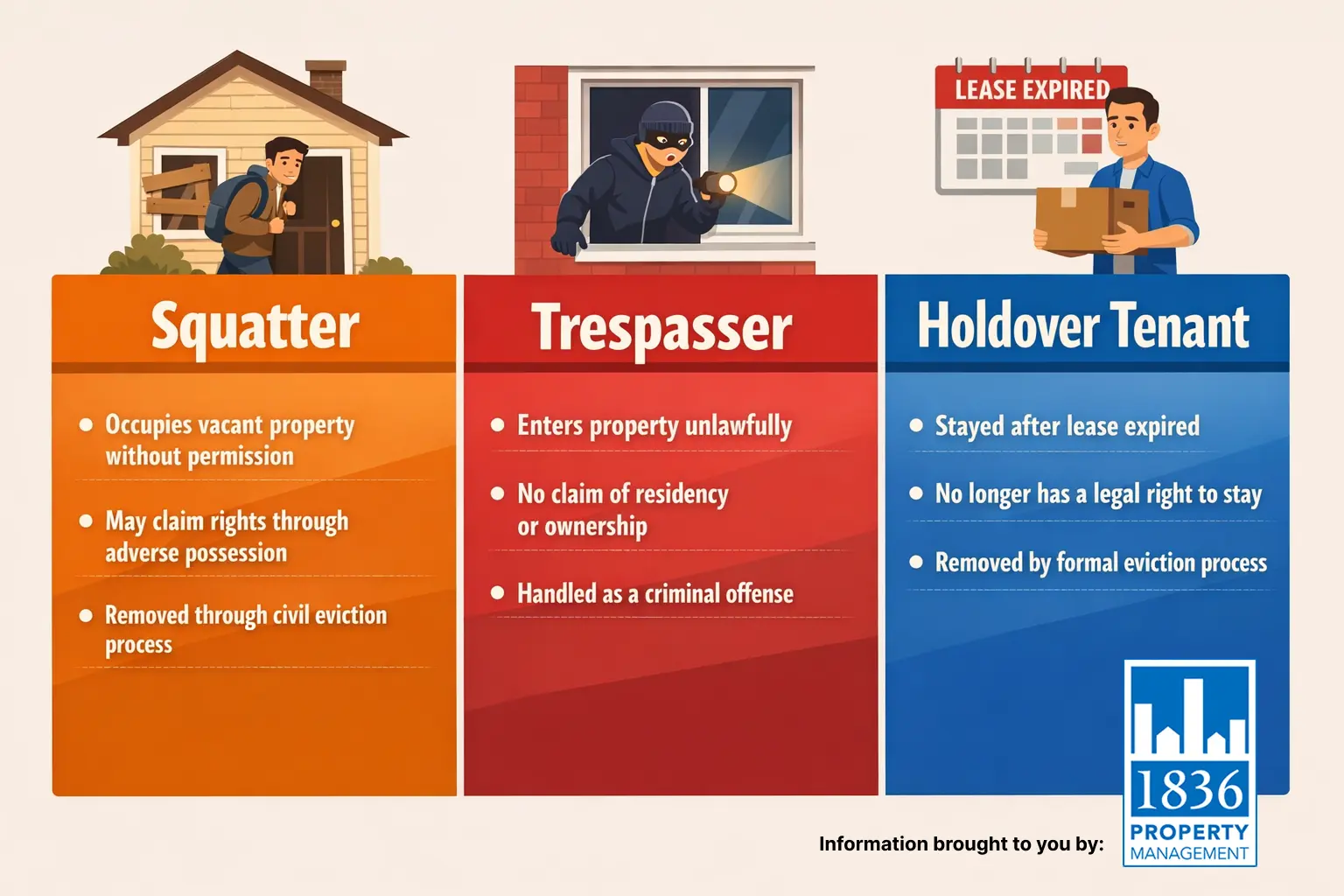
Quick Reference Comparison
| Legal Status | Initial Entry | Intent to Claim Ownership | Type of Offense | Removal Method |
|---|---|---|---|---|
| Squatter | Unlawful / No permission | Yes | Civil | Formal Eviction Process |
| Trespasser | Unlawful / No permission | No | Criminal | Police Intervention / Arrest |
| Holdover Tenant | Lawful / Had a lease | No | Civil | Standard Tenant Eviction |
The Doctrine of Adverse Possession in Texas
Hearing that a squatter may have “rights” can understandably feel alarming. However, in reality, those rights stem from an old legal doctrine called adverse possession, which originated in English common law and was originally designed to encourage land to be actively used rather than abandoned.
In Texas today, adverse possession still exists. Even so, it is far more limited than many people assume. Simply put, an unauthorized occupant does not gain ownership merely by moving in. Instead, state law requires strict, clearly defined conditions to be met continuously for a specific number of years.
Equally important, the burden of proof falls entirely on the person making the claim. As a result, Texas courts set a high bar, and property owner rights remain strongly protected under the law.
The 5 Strict Requirements for Adverse Possession
For someone to pursue an adverse possession claim in Texas, simply staying in a vacant home is not enough. Instead, state law requires that five separate legal elements be met at the same time. If even one element is missing, the claim fails.
With that in mind, here is how Texas courts generally evaluate adverse possession:
1. Actual possession
First, the occupant must physically use the property as an owner would. This typically means more than sleeping there. For example, it can include maintaining the home, making visible improvements, or otherwise exercising control over the space.
2. Open and notorious use
The occupancy cannot be hidden. The person’s presence must be obvious enough that a reasonable property owner or neighbor would notice someone is living there.
3. Exclusive possession
The individual must possess the property exclusively. In other words, they cannot share control with the legal owner, other unauthorized occupants, or a rotating group of residents.
4. Continuous possession
Furthermore, the property must be occupied without interruption for the full statutory period required under Texas law. Even short gaps in occupancy can reset the legal clock.
5. Hostile claim
Finally, in legal terms, “hostile” simply means the person is occupying the property without the owner’s permission. Therefore, if permission was ever granted, whether verbally or in writing, an adverse possession claim generally cannot succeed.
If someone was given permission to stay but remained after that permission expired, it is generally not considered hostile possession.
Instead, the person would typically be classified as a holdover occupant or tenant at sufferance, depending on the circumstances. Because the original entry was with permission, the “hostile” element required for adverse possession is missing, and the situation is usually handled through the standard eviction process rather than an adverse possession claim.
For Texas property owners, understanding these standards can be reassuring. Because the requirements are strict, courts expect clear proof that each element has been satisfied for the entire required timeframe. As a result, proactive oversight and professional property management can significantly reduce the risk of a claim gaining traction.
How Long Does It Take to Claim Squatters' Rights in Texas?
A common misconception is that someone can gain ownership of a property after only a few weeks or months. In reality, in Texas, adverse possession is governed by strict timelines outlined in the Texas Civil Practice and Remedies Code.
The 3 year statute
First, this is the shortest possible path, but it requires “color of title.” In other words, the occupant must hold a deed or title document that appears valid but is legally defective. If they occupy the property in good faith under that flawed document for three continuous years, they may attempt a claim.
The 5 year statute
Next, to qualify under this provision, the occupant must meet all of the following for five consecutive years:
- Use or cultivate the property
- Pay applicable property taxes
- Claim ownership under a registered deed, even if the deed is defective
Notably, all three elements must be satisfied at the same time.
The 10 year statute
By comparison, the ten year statute is often referred to as the default or “bare possession” rule. This applies when the occupant has no deed and has not paid property taxes. In that case, they must continuously use or cultivate the land for 10 uninterrupted years. Additionally, without a title document, the claim is generally limited to 160 acres unless the entire property is enclosed by a fence.
The 25 year statute
Finally, Texas law addresses situations where the true owner has a legal disability at the time the occupation begins, such as being under 18, of unsound mind, or serving in the military during wartime. Although certain deadlines may be paused, there is an absolute cap. After 25 uninterrupted years of qualifying possession, the original owner’s right to reclaim the property can be permanently barred.
Taken together, these timelines highlight an important point for Texas property owners: adverse possession requires long term, uninterrupted use under very specific conditions. Therefore, regular property inspections, tax monitoring, and professional management remain practical and effective ways to reduce risk and protect your investment.
How to Legally Evict a Squatter in Texas
If you discover someone living in your property without permission, it may be tempting to change the locks, shut off utilities, or remove their belongings. However, in Texas, these actions are considered “self help” evictions and are generally illegal. As a result, taking that approach can expose you to legal claims and significant financial liability.
Instead, property owners must follow the formal legal process. Depending on the specific facts, Texas law may allow for a streamlined removal process for certain unauthorized occupants. In other situations, the standard judicial eviction procedure applies. For example, when an occupant claims tenant status or the circumstances are disputed, the traditional court process, known as a Forcible Detainer action, is typically required.
Here is how that process generally works:
Step 1: Serve a Notice to Vacate
First, provide a written notice demanding that the occupant leave the property. In many cases, Texas law requires at least a three day notice, unless a written agreement states otherwise. Proper delivery is essential and may include personal delivery, mail, or approved posting methods.
Step 2: File a Forcible Detainer action
If the occupant does not leave by the stated deadline, you must then file an eviction case in the Justice of the Peace court located in the district or county where the property sits.
Step 3: Attend the court hearing
Next, you will appear before a judge and present documentation supporting your ownership and the occupant’s lack of legal right to remain. This typically includes your deed, proof of tax payments, the notice to vacate, and any relevant correspondence.
Step 4: Obtain a Writ of Possession
If the court rules in your favor, the occupant has a limited window to appeal. Once that period expires, the court may issue a Writ of Possession authorizing removal.
Step 5: Law enforcement executes the writ
Finally, the writ is delivered to the local constable or sheriff. The officer will post a final notice and, if necessary, supervise the physical removal of the occupant and their belongings.
Ultimately, for Texas property owners, following the correct legal steps is critical. By working with experienced property management and legal professionals, you can help ensure compliance, reduce delays, and protect your investment throughout the process.
2026 Legal Updates: Senate Bill 38 and Senate Bill 1333
For many years, Texas property owners raised concerns about how long the eviction process could take, particularly when unauthorized occupants were living in a home without paying rent. In response, state lawmakers enacted significant reforms that took effect in late 2025 and on January 1, 2026. As a result, the legal landscape for removing squatters and resolving possession disputes has shifted in meaningful ways.
Here is what Texas owners should understand about these updates.
Senate Bill 1333, expedited removal for true squatters
Effective in late 2025, SB 1333 created a more direct path for removing individuals who have no lease, no rental history, and no lawful claim to the property.
Direct involvement from law enforcement
In qualifying cases, owners may submit a sworn complaint to the local sheriff or constable. After verifying ownership and confirming that the occupant has no legal right to remain, law enforcement can serve notice and proceed with removal. Consequently, owners may avoid waiting for a traditional civil court timeline in clear cut situations.
Criminal penalties for fraudulent claims
In addition, the use of forged deeds, fake leases, or other fraudulent documents to justify occupancy can now carry criminal consequences. This change is intended to deter bad faith actors who previously relied on delay tactics.
Senate Bill 38, streamlined court process
Meanwhile, effective January 1, 2026, SB 38 revised the standard eviction framework in Justice of the Peace courts to reduce unnecessary delays.
Defined court timelines
Courts are now required to set eviction trials within a specified timeframe after filing, and constables must attempt service promptly. Therefore, cases are expected to move forward more efficiently.
Focus on possession
Justice courts are limited to determining the right to possession. As a result, unrelated counterclaims or unsupported title disputes cannot be used to stall the eviction decision.
Summary disposition in clear cases
When there are no genuine disputes of material fact and the occupant clearly lacks a legal right to remain, judges may issue rulings without a prolonged trial. This provision helps resolve straightforward cases more quickly.
Appeal safeguards
Finally, occupants who appeal an eviction decision may be required to pay rent into the court registry during the appeal. If payment is not made, the appeal can be dismissed, reducing incentive for delay.
Taken together, these legislative updates represent a meaningful shift for Texas investors and landlords. While due process protections remain in place, the revised framework provides stronger tools and clearer timelines for regaining possession. By staying informed and working with experienced property management professionals, owners can better manage risk and protect long term returns.
How to Protect Your Texas Property from Squatters
The most effective way to deal with squatters is prevention. After all, once someone occupies a property without permission, resolving the issue can require court filings, coordination with law enforcement, and valuable time. Therefore, for owners of vacant homes, properties between tenants, or active renovation projects, proactive oversight is essential.
With that in mind, here are practical steps Texas property owners can take to reduce risk:
Schedule regular inspections
First, avoid letting the property appear neglected. Homes that look abandoned are more likely to attract unauthorized occupants. Routine visits to collect mail, maintain landscaping, and check the exterior signal that the property is actively managed.
Reinforce entry points
In addition, upgrade standard locks with quality deadbolts, secure all windows, and ensure garages and gates are properly locked. Strong physical barriers remain one of the simplest and most effective safeguards.
Use visible security measures
Furthermore, motion lighting, security cameras, and monitored alarm systems can discourage unauthorized entry. Smart systems that send real time alerts directly to your phone add another layer of oversight.
Manage utilities appropriately
If a property will be vacant for an extended period, coordinating utility shutoffs can make the home less attractive to potential occupants. However, utilities should only be turned off when the property is legally vacant.
Post clear signage
Clearly visible “No Trespassing” signs help establish boundaries and can support law enforcement action if someone unlawfully enters the property.
Work with a professional property management team
Ultimately, a qualified tenant is the strongest protection against unauthorized occupancy. Professional management includes marketing, thorough tenant screening, routine inspections, maintenance coordination, and prompt handling of legal notices. At 1836 Property Management, our local expertise and hands on oversight help Texas property owners keep homes occupied, protected, and performing as intended.
In the end, preventive planning is often far less costly than resolving a dispute after it begins. By maintaining consistent monitoring and implementing the right safeguards, owners can significantly reduce exposure and protect long term value.
Frequently Asked Questions (FAQs)
Can police remove a squatter in Texas?
Yes, in certain situations. Under Senate Bill 1333, owners may file a sworn complaint with the local sheriff or constable if the occupant has no lease, no rental history, and no legal claim to the property. Once ownership is verified, law enforcement may remove a true squatter without a full civil trial. If the person claims tenant rights, the case may still go through the eviction process.
Do squatters have to pay property taxes?
Only under certain adverse possession statutes. The five year rule requires payment of property taxes and a registered deed. The more common ten year rule does not require tax payments, but it does require continuous, exclusive possession for a full decade.
Can I shut off utilities to force someone out?
No. Turning off water, electricity, or other utilities after someone has moved in is generally considered an illegal self help eviction. Owners must follow the formal legal process.
How long does it take to remove a squatter in Texas?
Timelines vary. With the 2026 legal updates, qualifying cases may move faster, especially under the expedited removal process. Traditional eviction cases are now subject to stricter court deadlines, but the exact timeframe depends on the facts and court scheduling.
Does a squatter automatically gain rights after a certain number of days?
No. There is no short term rule that grants ownership after a few days or weeks. Adverse possession in Texas requires meeting strict legal elements continuously for years.
What is the fastest way to protect my property?
Prevention is key. Regular inspections, strong physical security, visible monitoring systems, and placing qualified tenants quickly are the most effective ways to reduce risk. Professional property management can help owners stay compliant and proactive.